
This post may contain affiliate links. Read my disclosure policy.
I present my most magnificent roast turkey yet! Perfect for Thanksgiving, Christmas, or any holiday feast, with crispy golden skin, juicy breast meat, and perfectly cooked thighs. No brining or complicated techniques required! Just a simple, foolproof, reliable method so you can focus on all those delicious holiday sides!
I Finally Perfected My Thanksgiving Roast Turkey!
This garlic and herb butter roast turkey is the Thanksgiving centerpiece you've been looking for. Every year the turkey takes up the most room in my fridge, and for years it took up the most room in my head too! I tested this recipe more times than I can count and fine-tuned every little detail until it was just right. And now, in all humility, I present the most magnificent roast turkey of all time! It's a Thanksgiving classic, but it works just as well for Christmas or any big holiday meal.
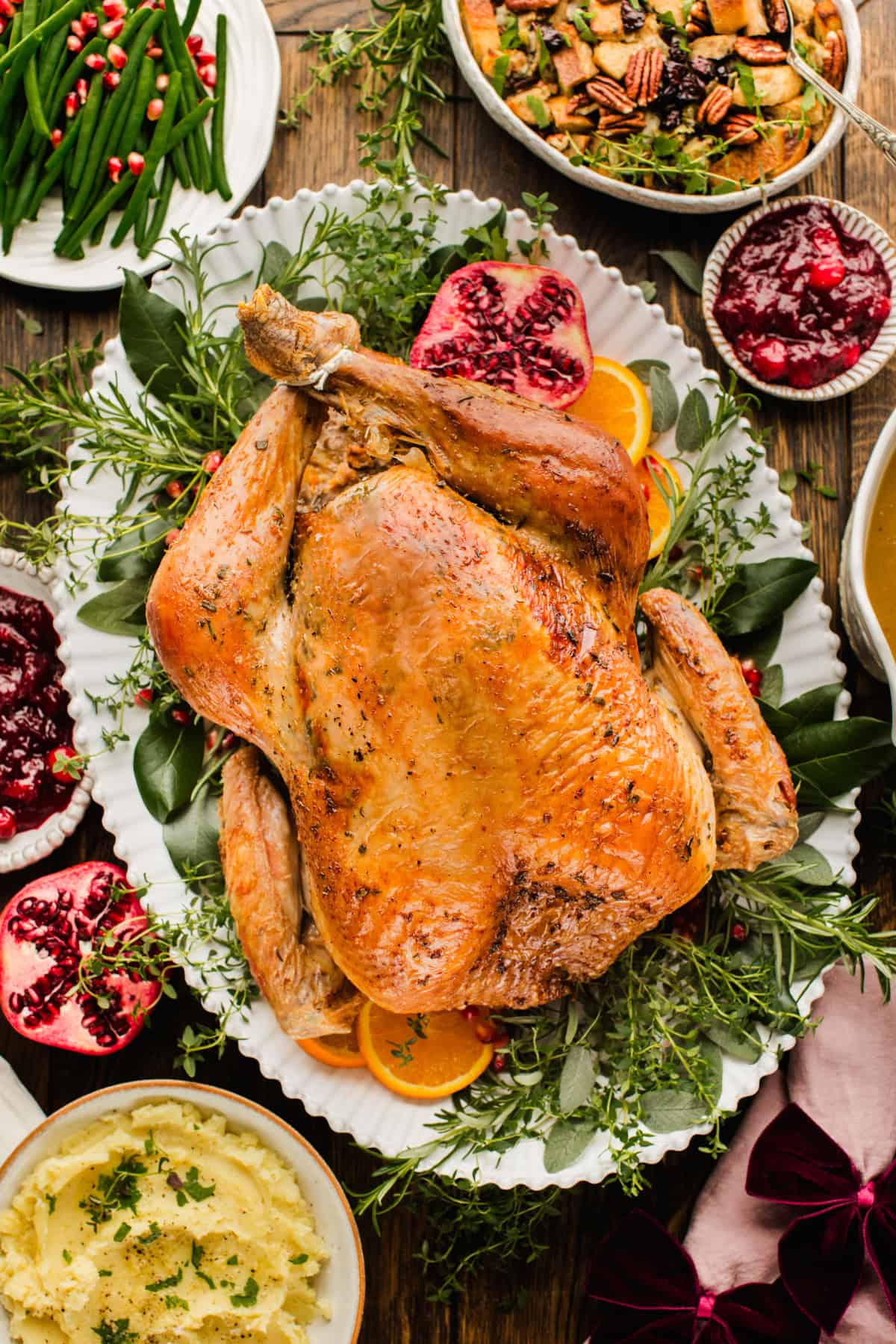
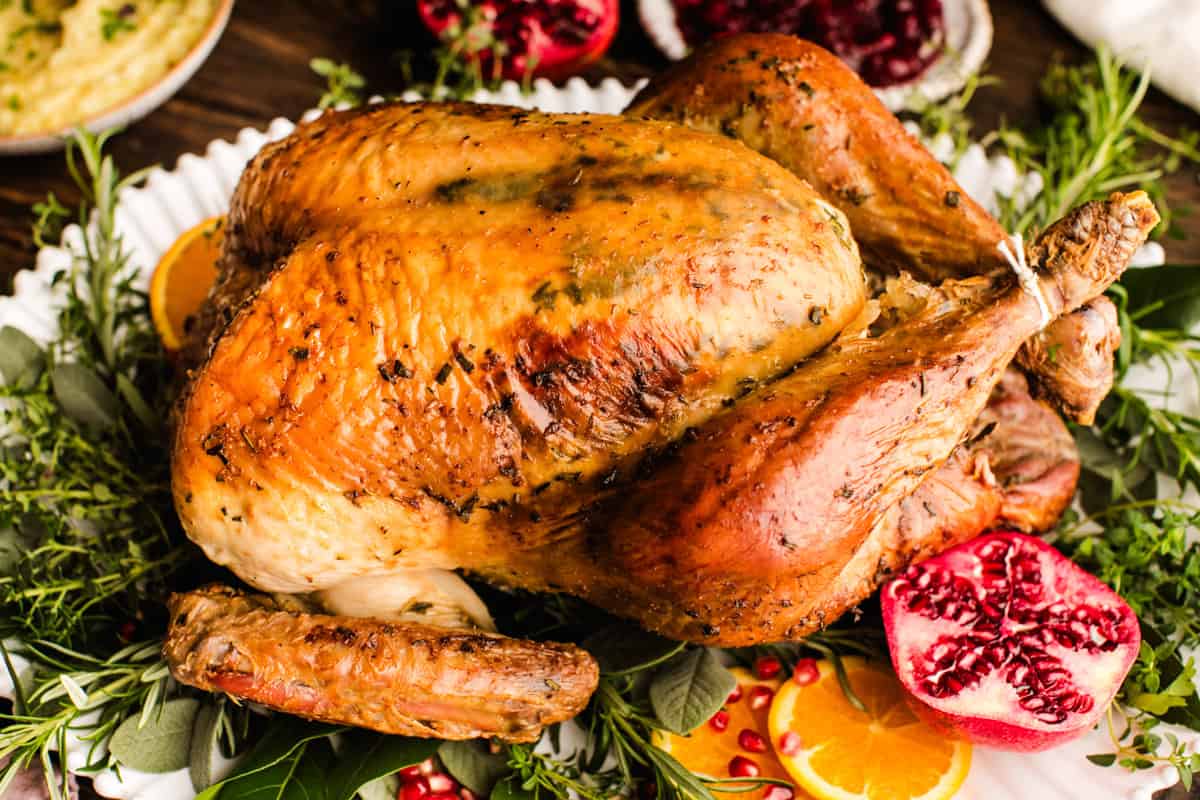
The goal is always the same: crisp, golden skin, juicy breast meat, and fully cooked thighs. This recipe gets you there with simple ingredients and a reliable method. You don't need a brining bucket or special equipment, just a roasting pan, some kitchen twine, and a good thermometer.
With the turkey taken care of, you can put your energy into the fun stuff: the sides! I have plenty of unique ones, like my sweet potato casserole with brown butter pecan streusel, super popular roasted Brussels sprouts with bacon and pecans, stunning butternut squash pasta salad with Brussels sprouts, and sausage stuffed butternut squash with cranberries. For even more ideas, browse my roundup of 60 Thanksgiving side dishes. Add a big boat of gravy, and get ready for a table full of happy guests.
Below, I'll show you exactly how I cook the most perfect turkey, from loosening the skin to carving the bird. You'll find every detail in the recipe card.
Here's Why You'll Love It:
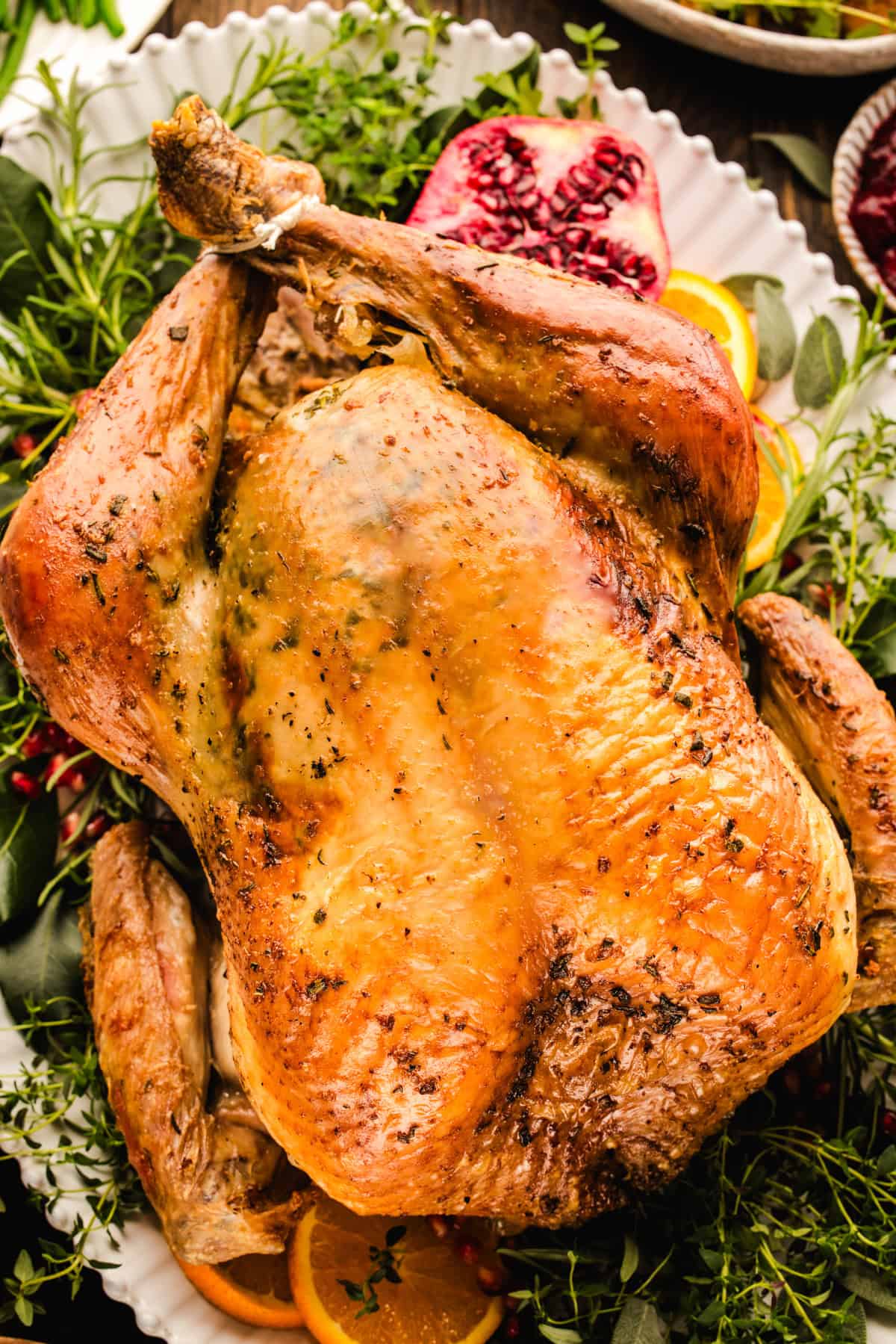
- Herb butter goes in two places. I spread a third of the garlic herb butter right on the breast meat. The breast is the part that dries out first, so this keeps it moist and seasoned from the inside. The rest of the herb butter coats the outside, so the skin browns evenly and turns crispy.
- A hot start and a gentle finish. I roast the turkey at 425°F (220°C) for 20 minutes to give the skin a head start on browning. Then I drop the oven to 300°F (150°C), which gives the thighs time to cook through before the breast dries out.
- The vegetables do double duty. Onions, carrots, and celery sit under the rack and flavor the pan drippings. Those drippings are the base for a rich homemade turkey gravy.
- A thermometer takes out the guesswork. Every oven and every turkey is different, so I go by temperature, not time. Once the breasts and thighs reach 165°F (74°C), dinner is ready.
- Read on for helpful tips to ensure 100% turkey success or skip directly to the recipe card at the bottom.
Ingredients You Need
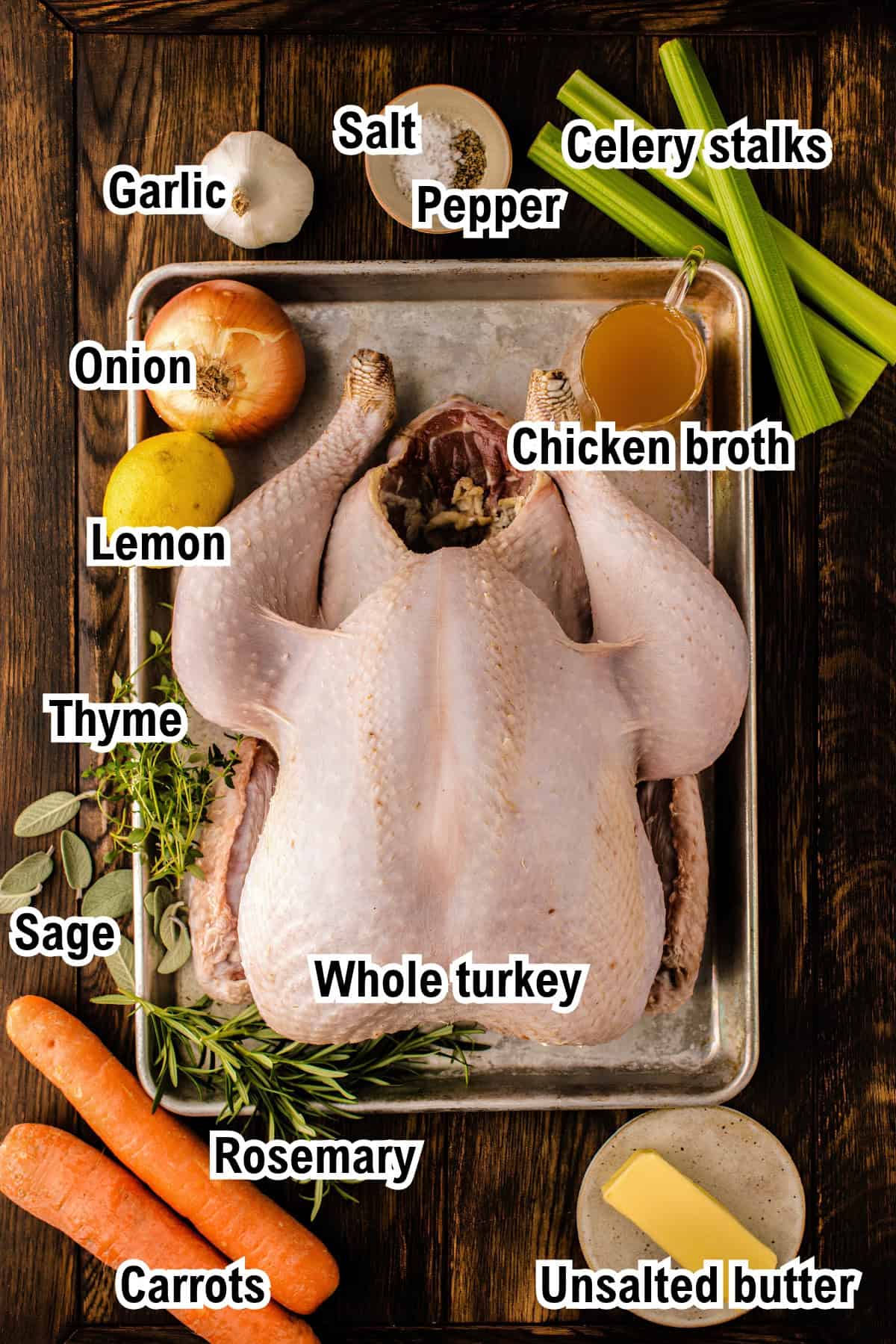
- Whole turkey: I used a 14 to 15 pound turkey, which serves 12 to 14 people. If yours is frozen, thaw it in the refrigerator. Plan on about 24 hours for every 4 to 5 pounds.
- Unsalted butter: I soften a full cup so it mixes easily and spreads under the skin without tearing it. Unsalted butter lets you control the salt.
- Fresh herbs: I chop sage, rosemary, and thyme for the butter and save whole sprigs for the cavity. These are the classic Thanksgiving herbs. Fresh herbs make a big difference here, so I don't recommend swapping in dried.
- Garlic and lemon: Minced garlic and lemon zest go in the butter. A whole halved garlic bulb and a quartered lemon go inside the turkey for gentle flavor.
- Onion, carrots, and celery: I scatter these under the rack. They lift the turkey, flavor the drippings, and give you a head start on gravy.
- Broth: I pour in 1½ cups of low-sodium chicken or turkey broth. Low-sodium keeps the drippings from getting too salty.
Choosing the Right Turkey
- Pick a 14-15 pound turkey. This recipe is designed for a whole turkey of about 14-15 pounds (6.3-6.8 kg).
- Using a bigger or smaller bird? Adjust the roasting time. The internal temperature is much more reliable than the cooking time when deciding if the turkey is done.
- Check the label for salt. If your turkey is labeled self-basting, enhanced, or pre-brined, check the packaging before you add the full amount of salt. These turkeys may already contain added salt.
- Self-basting, kosher, or pre-brined turkeys: These are already salted. If you use one, cut the kosher salt in the herb butter down to ½ teaspoon or leave it out completely.
- Fresh or frozen: Both work well. Fresh turkeys are ready to go, but order ahead because they sell out close to the holiday. Frozen turkeys are easy to find and often cheaper.
- A frozen turkey must be completely thawed before roasting. The safest way is to thaw it in the refrigerator, allowing about 24 hours for every 4-5 pounds (1.8-2.3 kg). A 15-pound turkey needs 3 to 4 full days, so plan ahead. Thaw it breast-side up, in its wrapper on a rimmed tray. Keep it cold. Keep the turkey in the refrigerator while it thaws, and never leave it on the kitchen counter to defrost.
- Heritage or organic birds: These are often leaner and can cook faster. Start checking the temperature early.
- Skip the bread stuffing inside the bird: Stuffing in the cavity slows down cooking and has to reach a safe temperature too. I bake my traditional stuffing in a separate dish and fill the turkey with just onion, lemon, garlic, and fresh herbs.
Prepping the Turkey
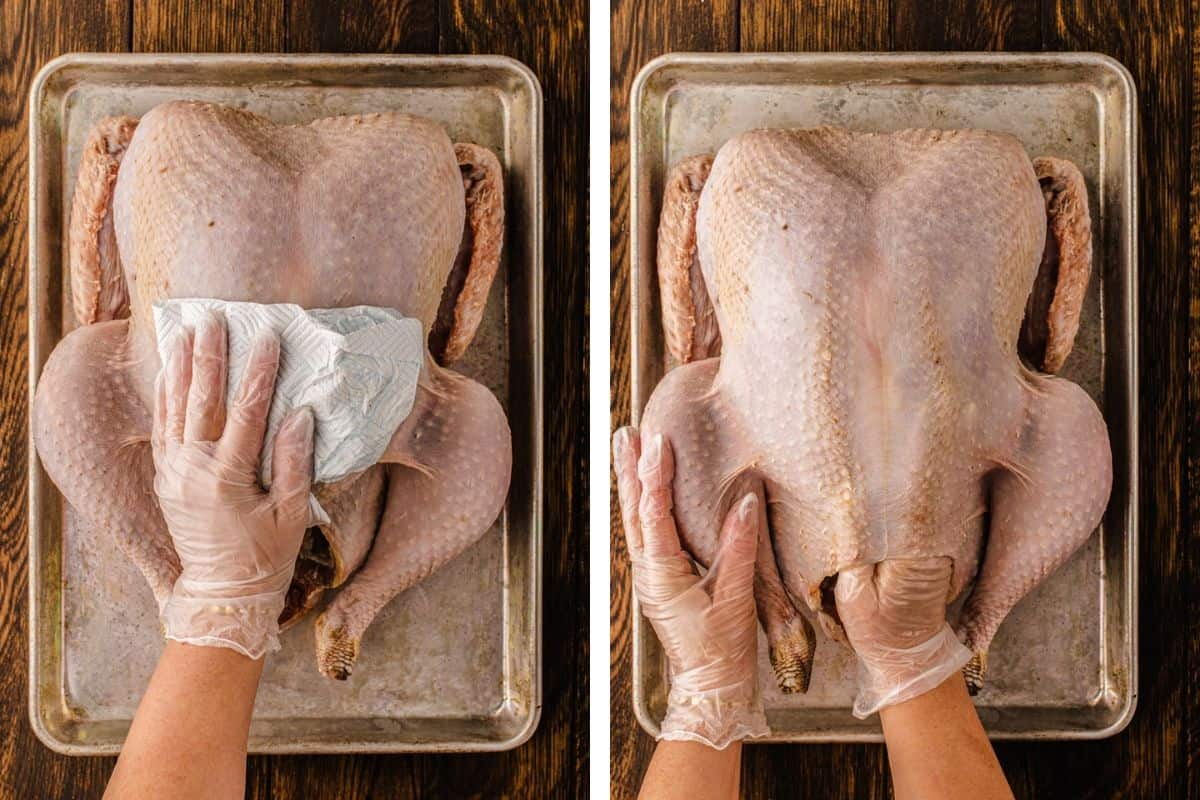
- Pat it very dry: Moisture on the skin keeps the butter from sticking and makes even browning harder. Use plenty of paper towels and get into the folds around the wings and legs.
- Use softened butter, not melted: Softened butter holds the herbs and garlic in place and spreads easily under the skin. Butter that's too firm can tear the skin, and melted butter just runs off.
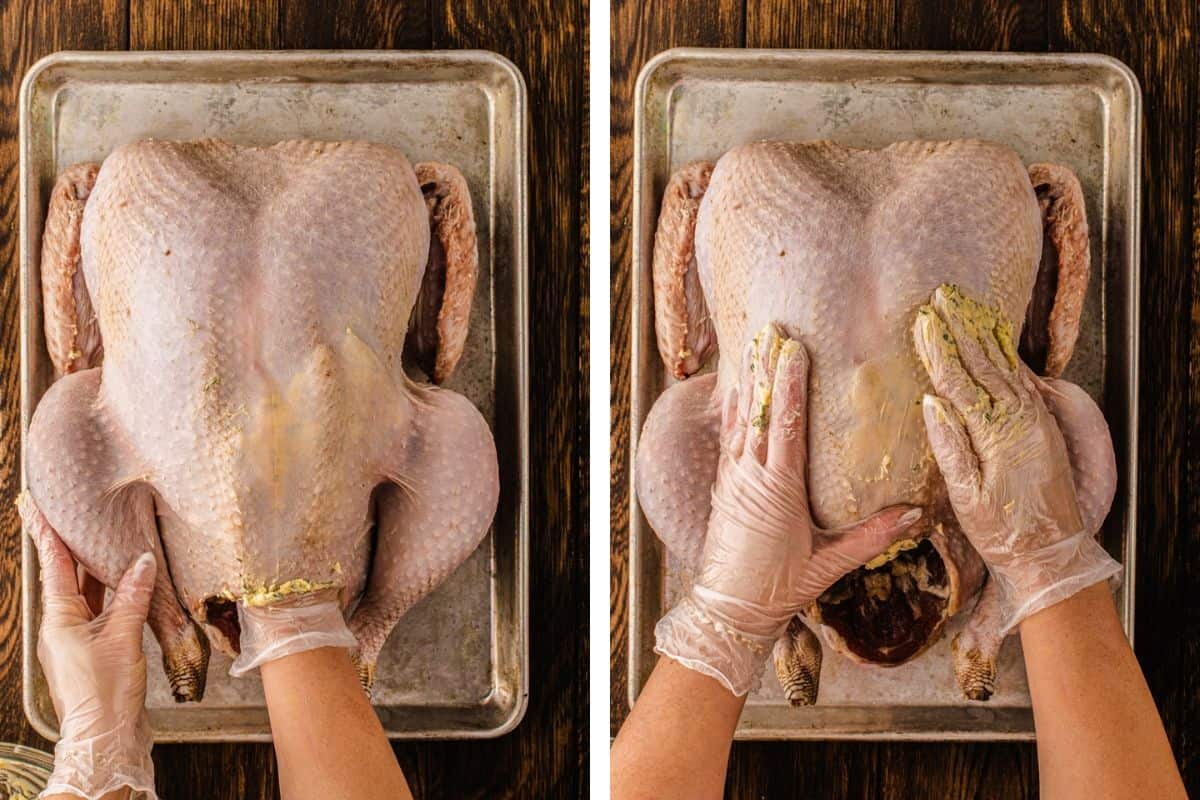
- Get the butter under the skin: Gently loosen the skin from the breast meat without pulling too hard, so it doesn't tear. Spread the herb butter underneath, then lightly massage the skin to distribute it.
- Don't overfill the cavity: The onion, lemon, garlic and herbs are there for flavor, not as stuffing. Place them loosely so heat can circulate. I recommend baking bread stuffing separately in a casserole dish.
Roasting Tips
- Use a roasting rack: The rack lifts the turkey above the vegetables and liquid, so hot air circulates evenly and the underside doesn't sit in the juices. If your pan has room, add the giblets and neck with the vegetables for extra-flavorful gravy.
- Start hot, then lower the heat: Starting at a higher temperature gets the skin browning. Lowering the heat for the rest of the roast cooks the turkey gently. If you keep the oven high the whole time, the skin can get too dark before the center is cooked.
- Treat roasting times as estimates: An unstuffed 14-15 pound turkey takes about 3-4 hours (mine took 2 hours and 55 minutes), but your oven and turkey can change that a lot. Start checking the temperature early. Ovens, bird shape and starting temperature all vary, so start checking early.
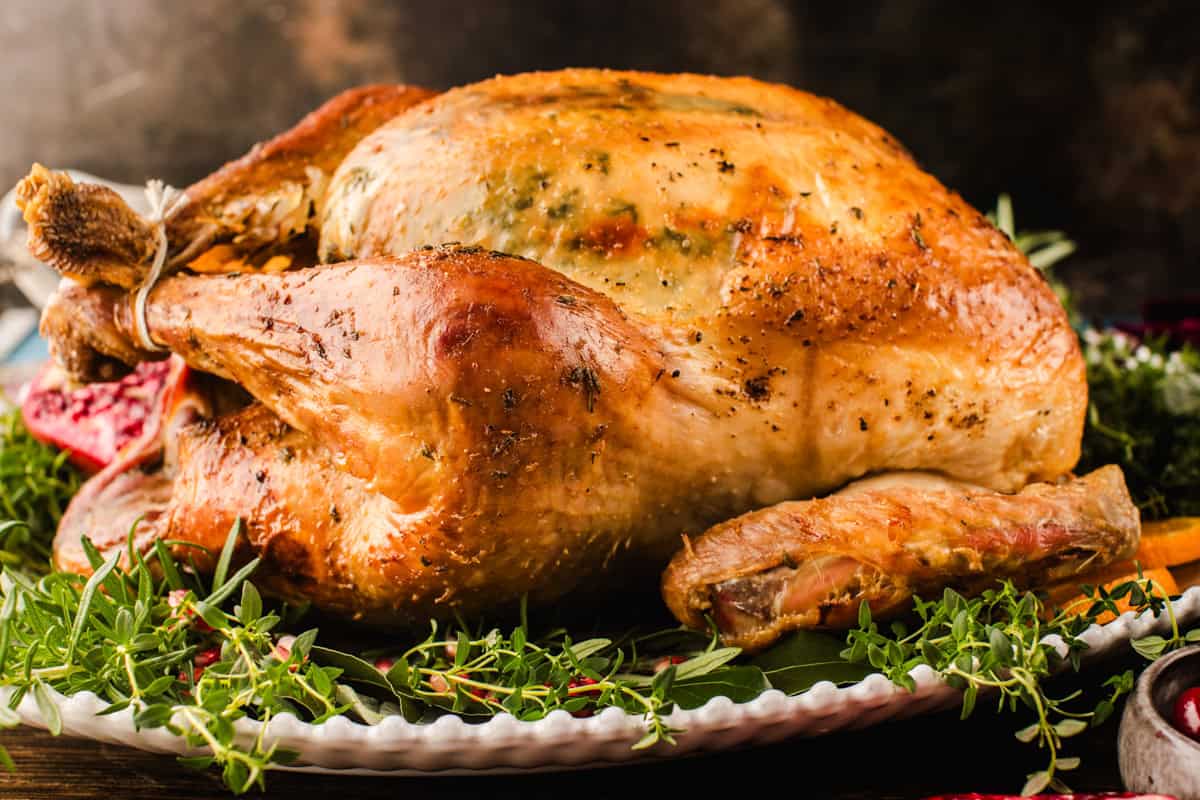
- Prevent the skin from burning and tent with foil once it's golden: The garlic and herbs in the butter can darken quickly. Once the skin is golden, tent the breast loosely with foil, keeping it slightly raised so it doesn't stick to the skin.
- Need more color at the end? If the turkey is almost done but still pale, remove the foil and let it brown briefly while you watch the temperature. Don't leave it in longer just for color, because the breast meat can dry out. Golden is better than very dark.
Checking for Doneness
- Use a leave-in probe thermometer: Insert it into the thickest part of the breast, with the tip in the meat and not touching bone. Readings near the surface, the bone or the cavity won't be accurate.
- Double-check with an instant-read thermometer: Temperatures can vary noticeably even within the breast. Check the thickest part of both breasts and both thighs instead of relying on one reading.
- Cook it all the way to 165°F (74°C). Some recipes pull the turkey early and let it finish while resting, but I don't trust that since it's not predictable. For this recipe, take the turkey out only when the breasts and thighs have all reached at least 165°F (74°C).
Resting, Drippings, and Carving
- Rest for 30-45 minutes. This keeps the juices in the meat. Cover it loosely with foil, since wrapping it tightly traps steam and softens the skin.
- Rest it in the pan or on a rimmed board: Don't move it straight onto a decorative platter. The hot juices will run across the platter and wilt the garnishes.
- Save the pan drippings for gravy: The vegetables, broth, butter and turkey juices make very flavorful drippings. Strain them through a fine-mesh sieve and skim off as much fat as you can. Use them for gravy, topping up with low-sodium chicken or turkey stock if needed.
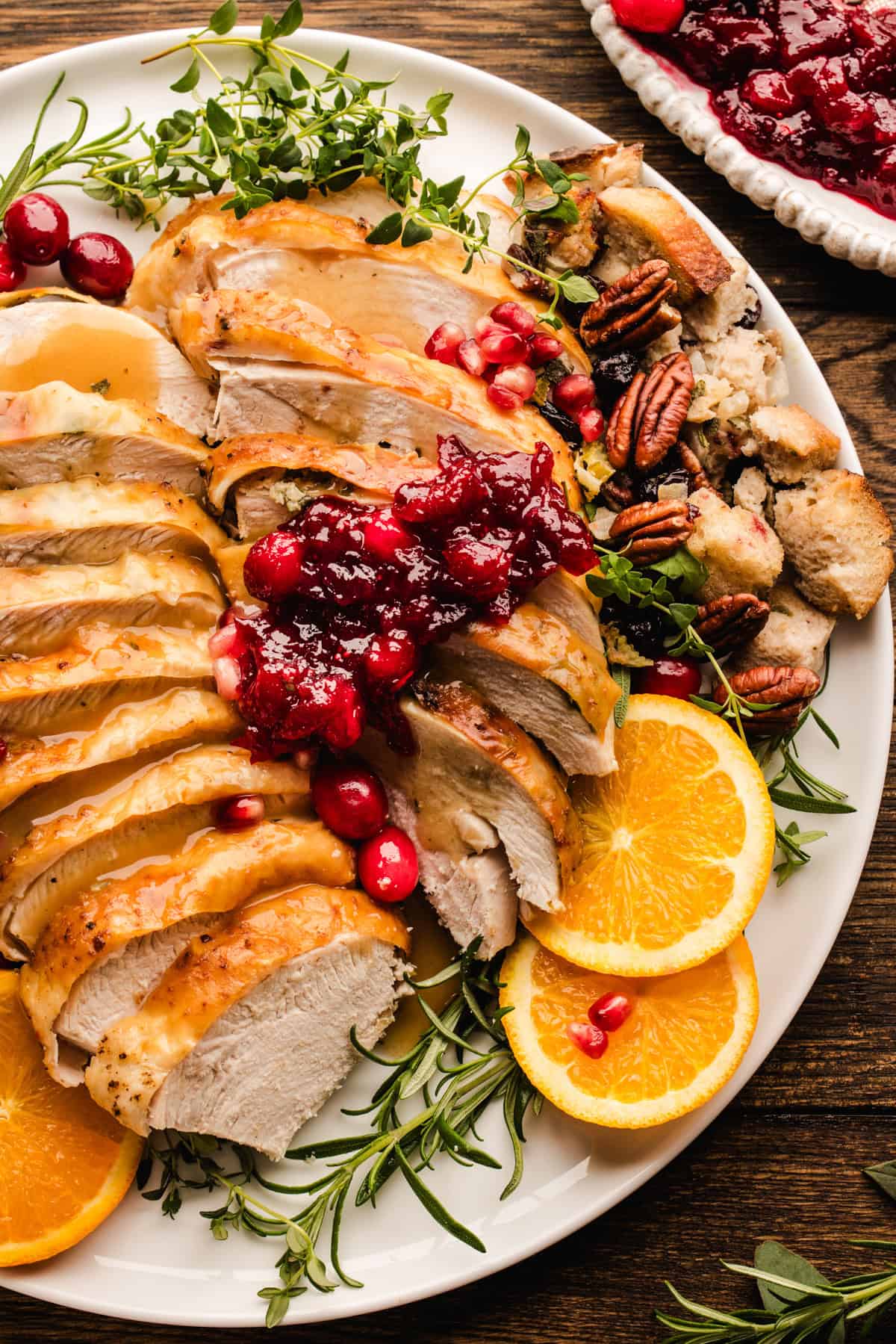
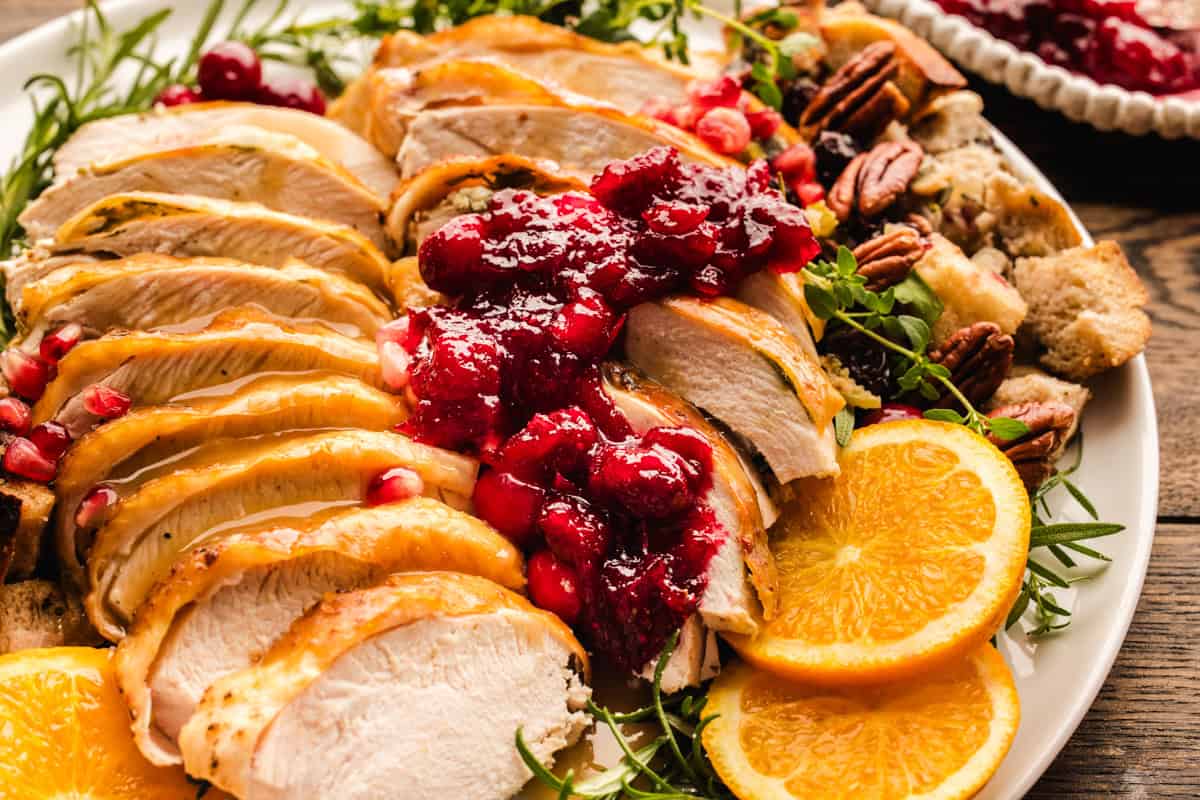
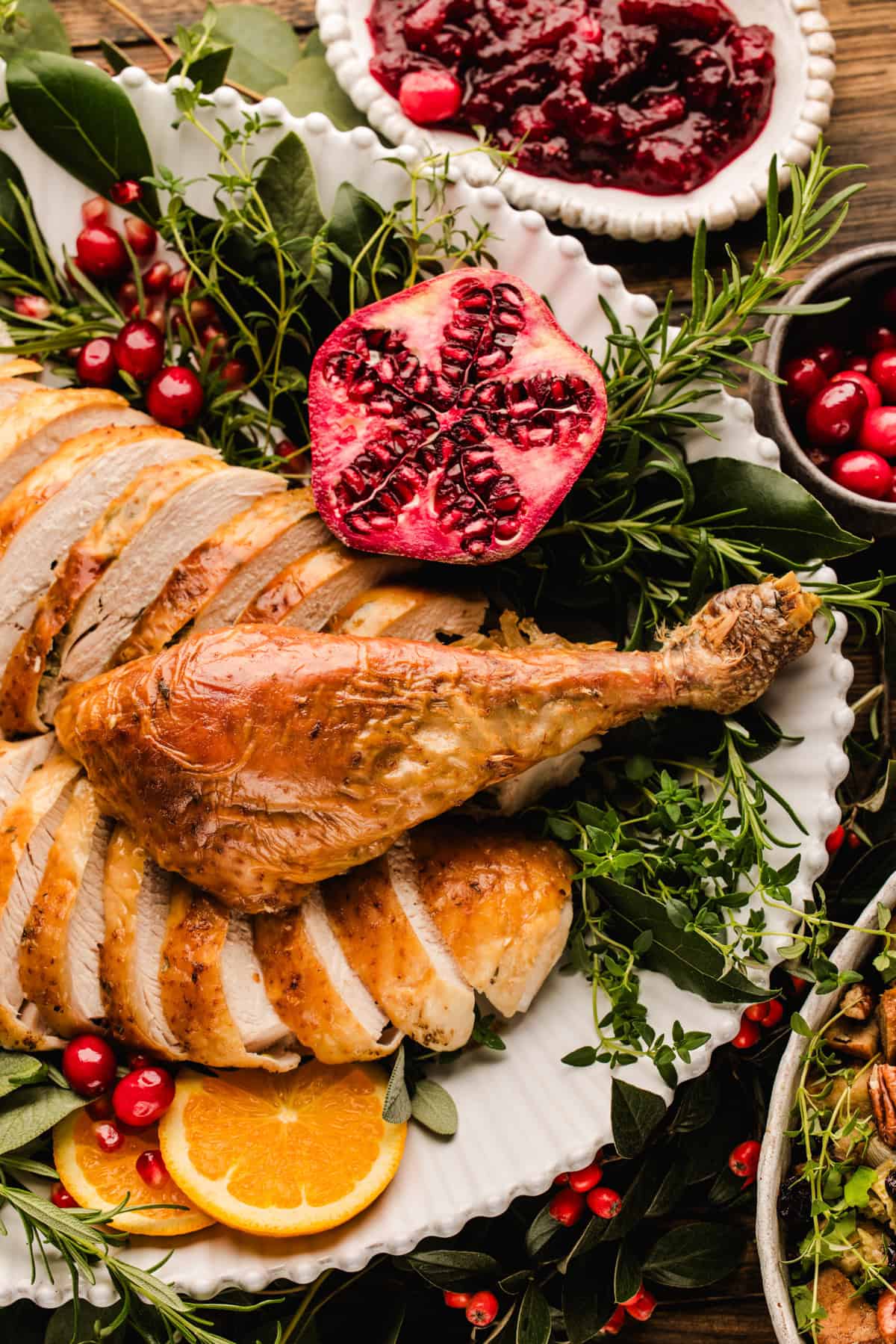
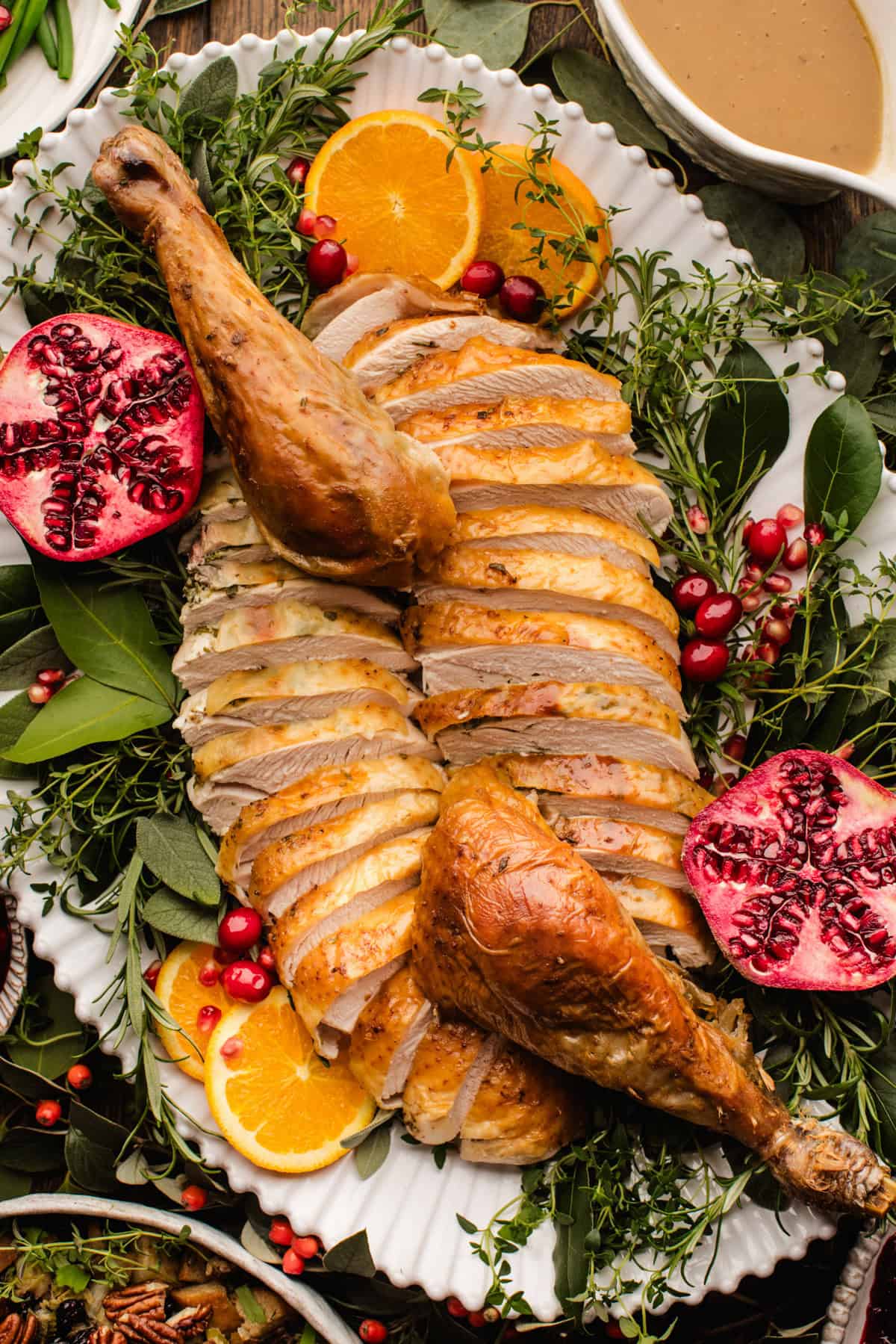
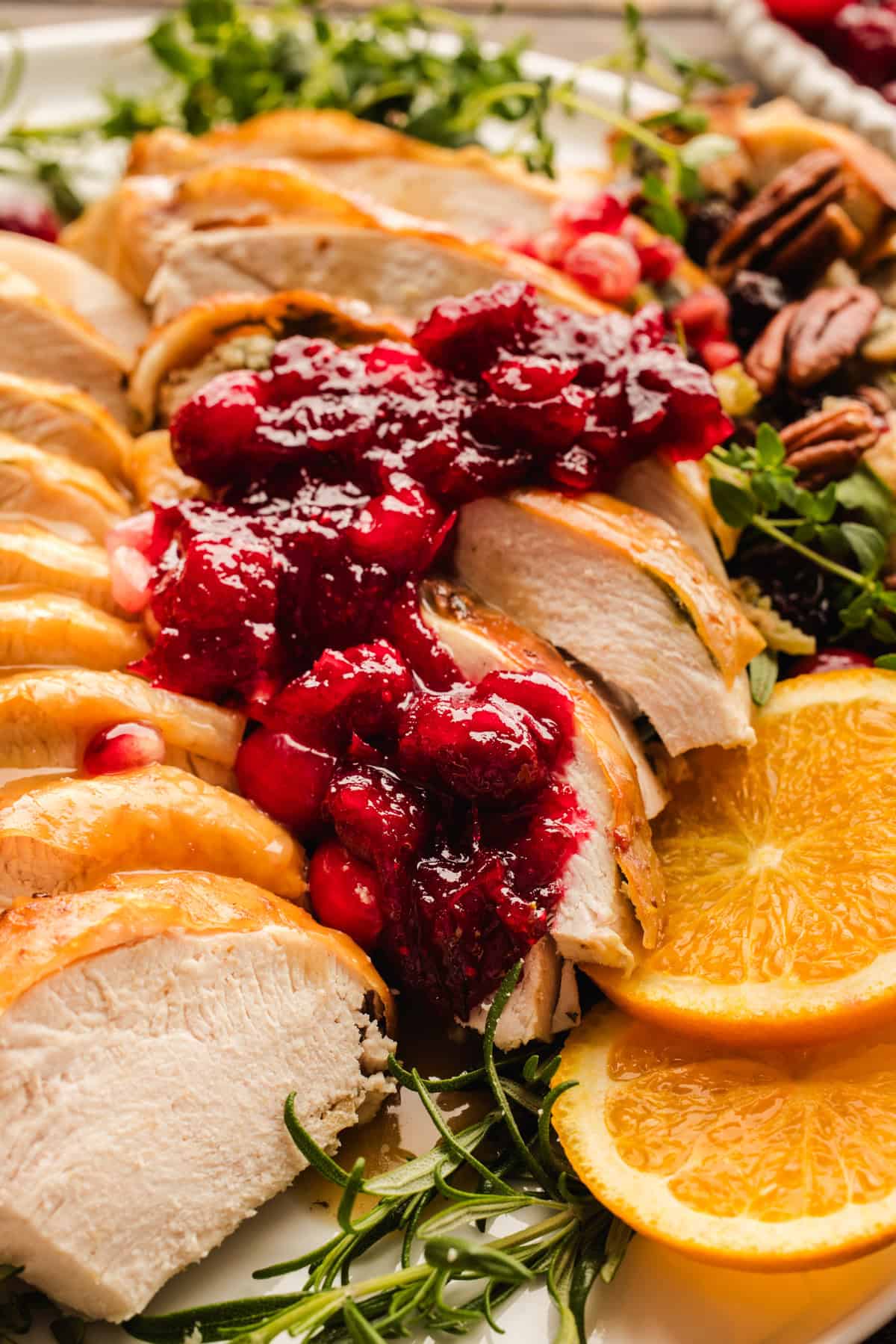
- Carving the breasts: Remove the twine. Take off the legs at the joints and separate the drumsticks and thighs. Find the breastbone and wishbone, cut down either side, and slide the knife tip along the bone. Then make a sideways cut at the base of each breast and pull it away in one piece. Slice crosswise on a cutting board, skin-side up, so the golden skin stays attached.
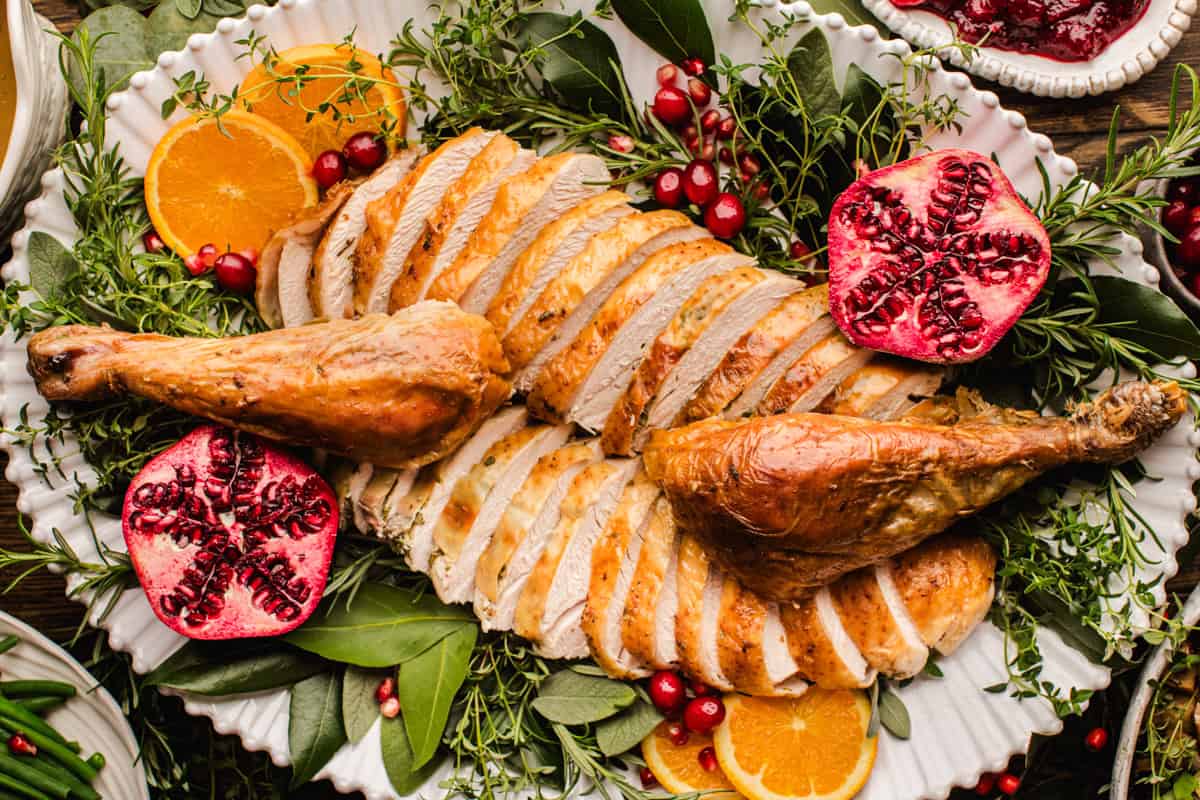
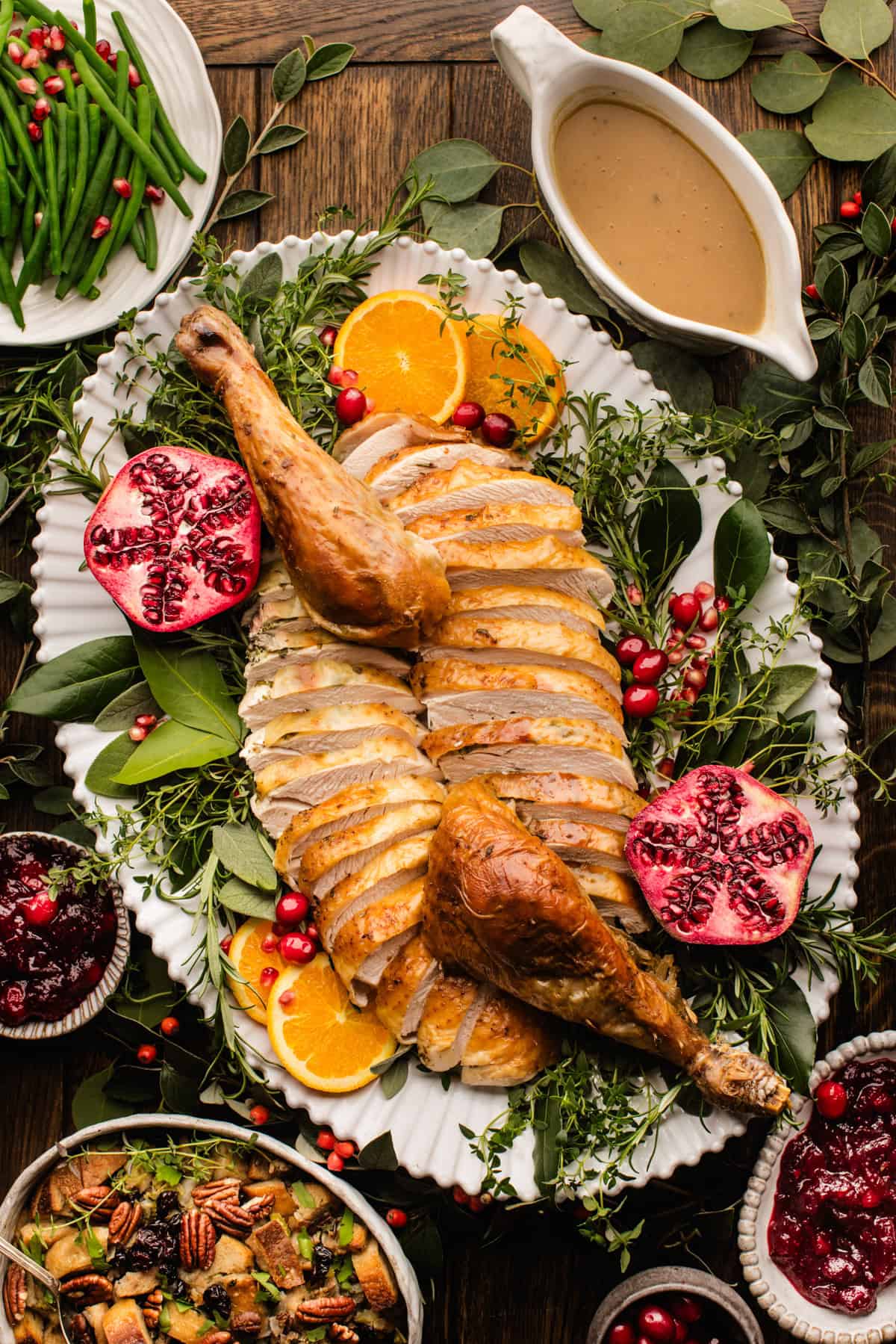
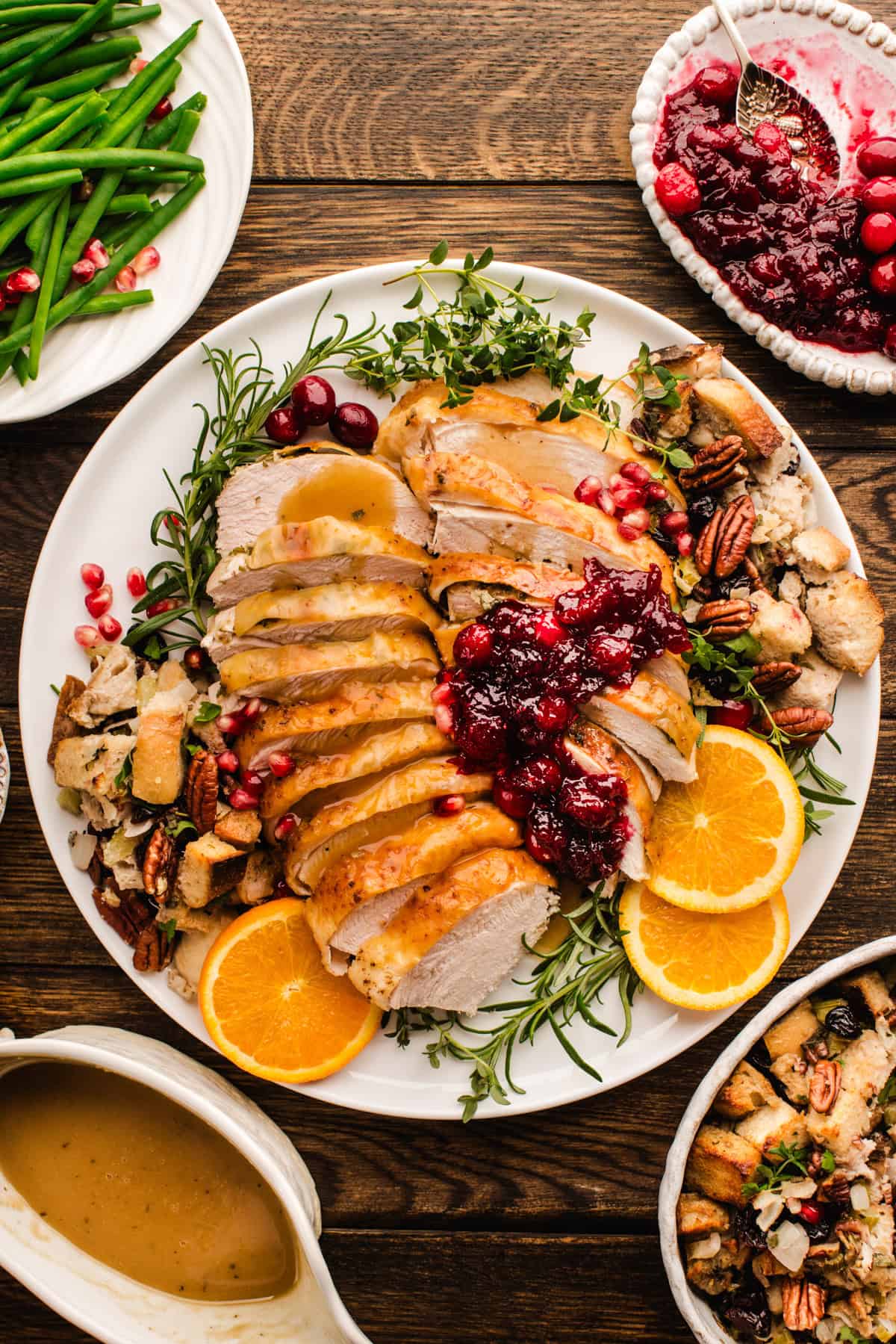
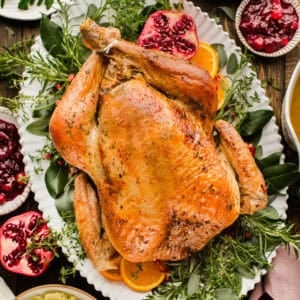
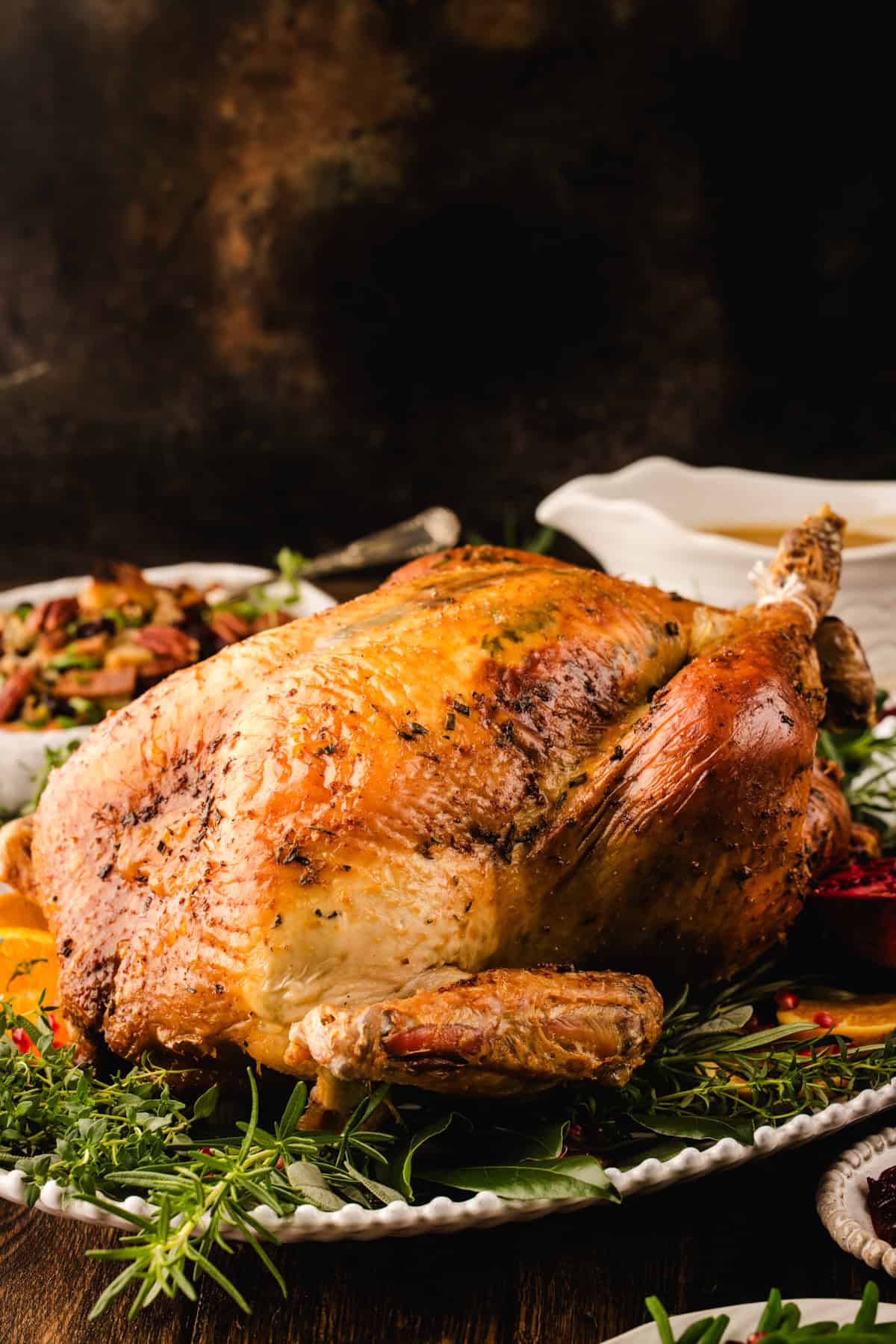
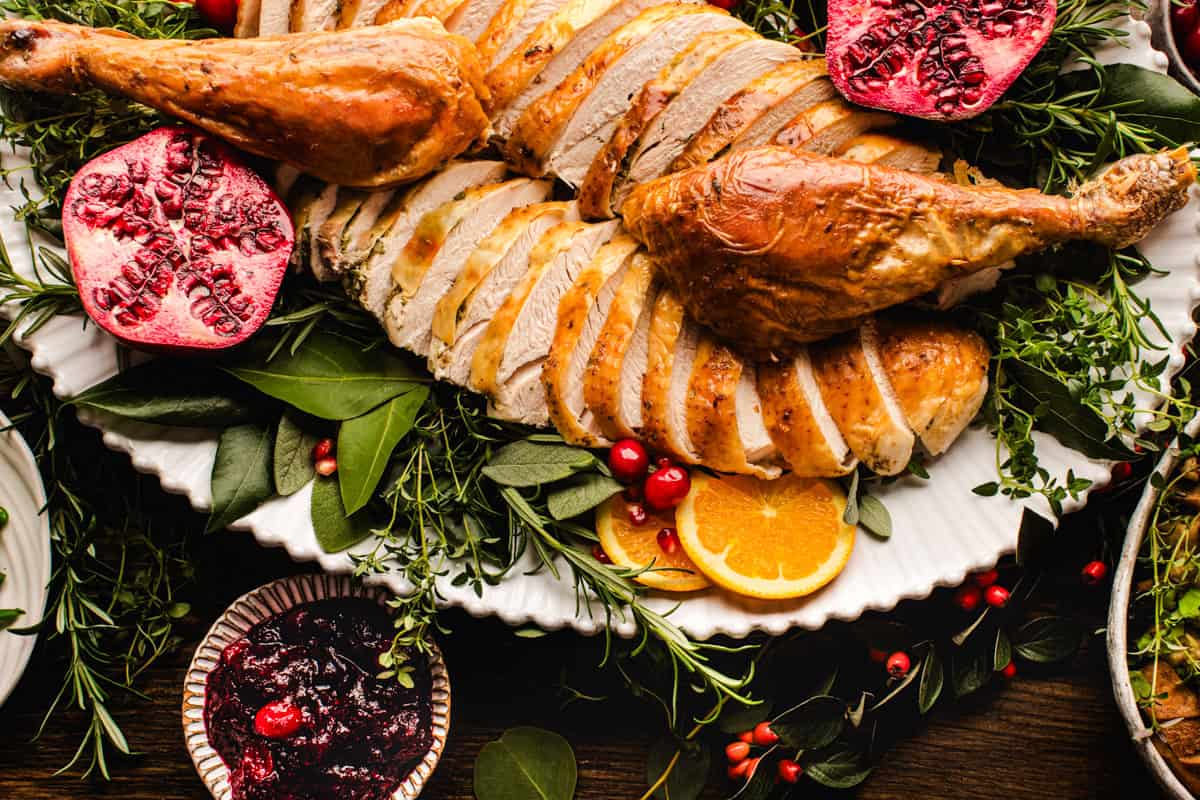
- Serving: Arrange the turkey on a large platter with fresh sage, rosemary, thyme, orange slices and pomegranate. Use only clean, food-safe greenery, and keep any decorative foliage that isn't meant to be eaten under the platter and away from the meat.
Roast Turkey with Herb Butter
Ingredients
For the Turkey and Herb Butter
- 15 pounds turkey 1 whole turkey (14-15 pounds), completely thawed if frozen, giblets and neck removed
- 1 cup unsalted butter softened
- 6 cloves garlic minced
- 2 tablespoons fresh sage finely chopped
- 1 tablespoon fresh rosemary finely chopped
- 1 tablespoon fresh thyme leaves
- 2 teaspoons kosher salt plus more as needed
- 1 teaspoon black pepper freshly ground
- 1 zest of lemon
For the Turkey Cavity
- 1 large onion quartered
- 1 large lemon quartered
- 1 whole garlic bulb halved crosswise
- 4 fresh rosemary sprigs
- 6 fresh thyme sprigs
- 6 fresh sage leaves (4-6 leaves)
For the Roasting Pan
- 2 large onions quartered
- 2 medium carrots roughly chopped
- 2 stalks celery roughly chopped
- 1½ cups chicken broth low-sodium, or turkey broth
Instructions
- Prep the turkey: Remove the turkey from the refrigerator approximately 30-60 minutes before roasting. Make sure it is completely thawed, then remove the neck and giblets from the cavities. Pat the turkey thoroughly dry with paper towels, including underneath the wings and around the legs. Do not rinse the turkey.
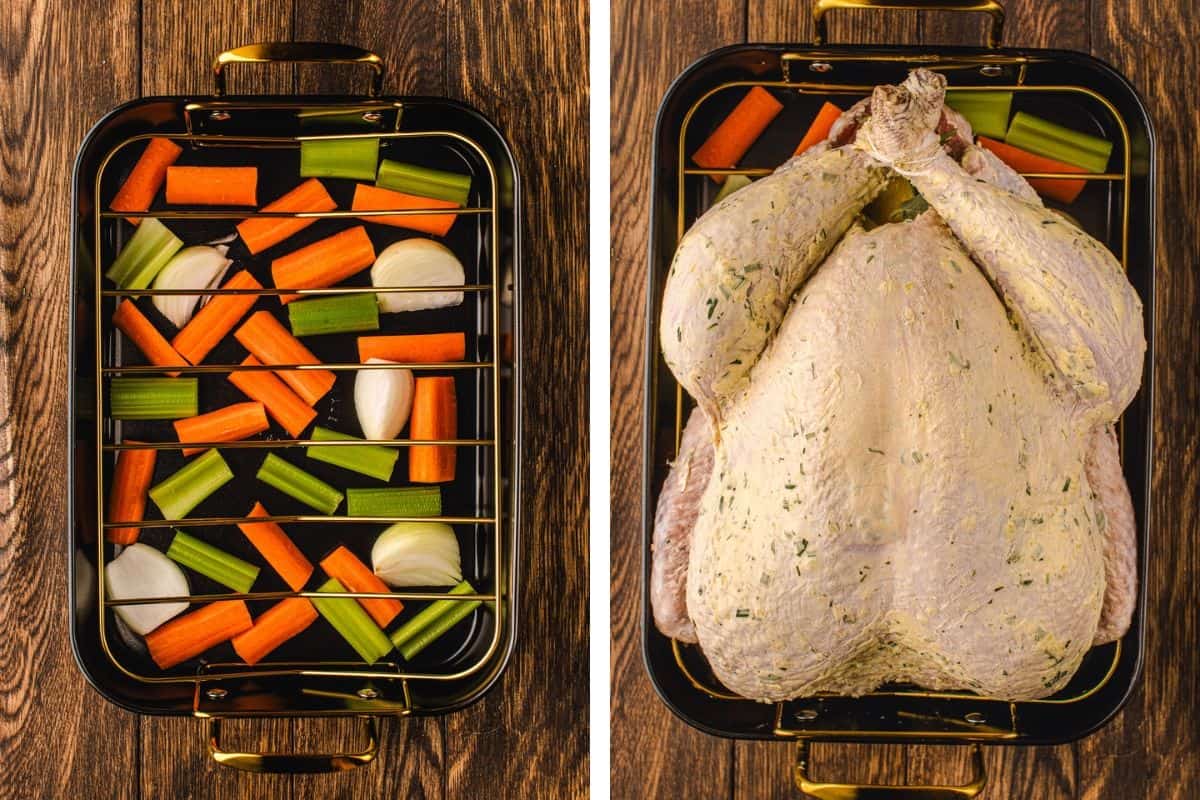
- Scatter the quartered onions, chopped carrots, and celery across the bottom of a large roasting pan. If you're using a rack, position it inside the pan now so you can make sure your vegetables fit underneath it.
- Preheat the oven to 425°F (220°C). Position the oven rack in the lower-middle section so there is plenty of room above the turkey.
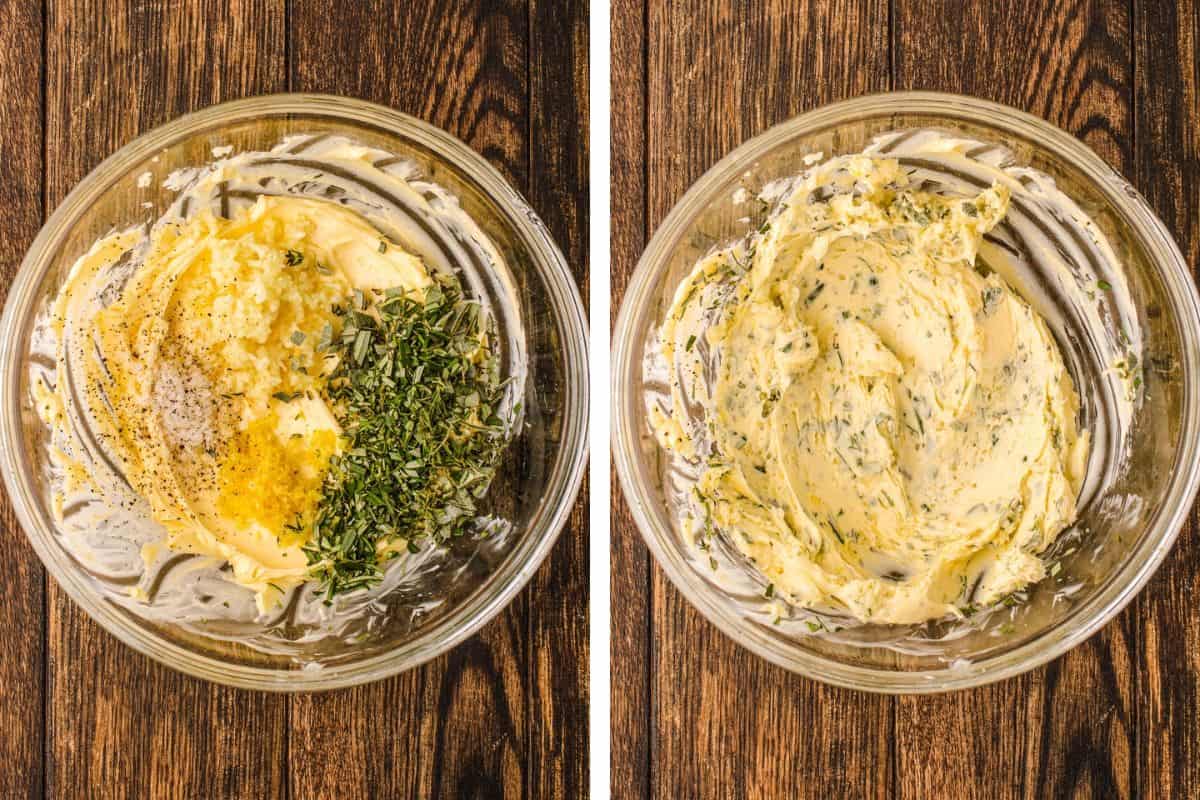
- Make the herb butter: In a medium bowl, combine the softened butter, minced garlic, chopped sage, rosemary, thyme, kosher salt, black pepper, and lemon zest. Mix until all the ingredients are evenly incorporated.
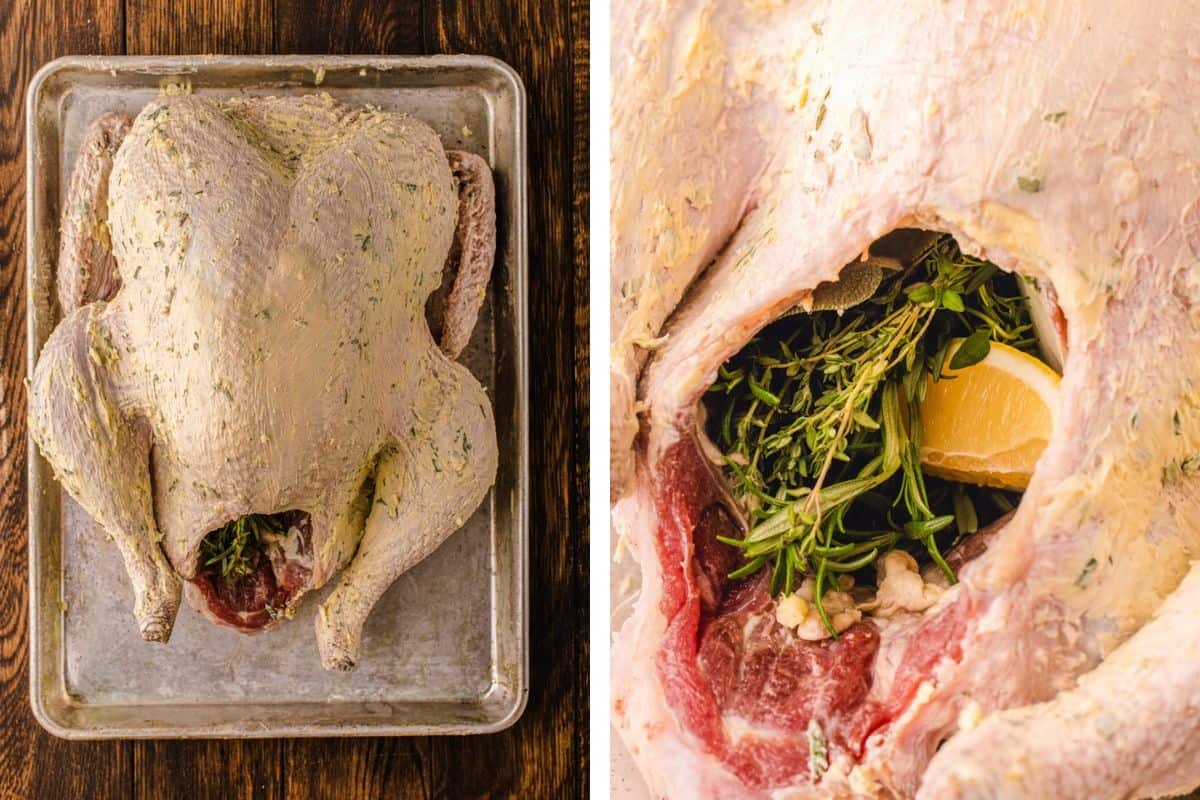
- Carefully loosen the skin covering the turkey breasts by gently sliding your fingers between the skin and the meat. Start at the neck end and work slowly toward the lower part of the breasts, taking care not to tear the skin.
- Spread approximately one-third of the herb butter underneath the loosened skin, distributing it evenly over both breasts. Gently massage the outside of the skin to help spread the butter into an even layer.
- Rub the remaining herb butter over the outside of the turkey, paying particular attention to the legs, thighs, and wings.
- Fill and truss: Place the quartered onion, lemon, halved garlic bulb, rosemary sprigs, thyme sprigs, and sage leaves loosely inside the turkey cavity. Do not pack the ingredients tightly, as air needs to circulate through the cavity while the turkey cooks.
- Tuck the wing tips underneath the turkey to prevent them from burning. Tie the legs loosely together with kitchen twine. If necessary, secure any loose skin around the cavity opening with oven-safe poultry pins.
- Place the prepared turkey on the rack in your pan, breast-side up. Pour in the chicken or turkey broth. The turkey should sit above the liquid rather than directly in it.
- If you have one, insert an oven-safe meat thermometer probe into the thickest part of one breast, avoiding the bone and the cavity. Position the tip near the center of the meat. Make sure the probe cable is routed out of your oven according to the manufacturer's instructions.
- Roast: Place the turkey in the preheated oven and roast uncovered for approximately 20 minutes. This initial period at a higher temperature helps the skin begin to brown.
- Reduce the oven temperature to 300°F (150°C). Continue roasting until the turkey is cooked through. Allow approximately 3-4 hours total for a 14-15 pound turkey, but begin checking the temperature well before the estimated finishing time.
- If using an oven-safe meat probe, you can usually set a target temperature and an alarm will sound when you reach temperature.
- Keep an eye on the skin as the turkey roasts. Once it has developed a deep golden color, loosely tent the breast with aluminum foil to prevent it from becoming too dark. Leave enough space between the foil and the skin to avoid disturbing the butter coating.
- Monitor the internal temperature throughout cooking. As the breast approaches 165°F (74°C), check several other areas using an instant-read thermometer, particularly the thickest part of the opposite breast and the innermost part of each thigh. Avoid touching bone when taking readings. All areas should reach at least 165°F (74°C).
- If the skin needs a little additional browning toward the end of cooking, remove the foil for the final few minutes. Watch closely to prevent the skin from burning.
- Rest: Remove the turkey from the oven once it has reached a safe internal temperature. Transfer it to a large carving board or leave it on the roasting rack above the pan to rest. Loosely cover with aluminum foil and allow to rest for 30-45 minutes before carving.
- Carve and serve: Remove the kitchen twine, poultry pins, and cavity aromatics. Carefully carve the turkey, beginning with the legs and thighs, followed by the breasts and wings. Slice the breast meat against the grain into even pieces.
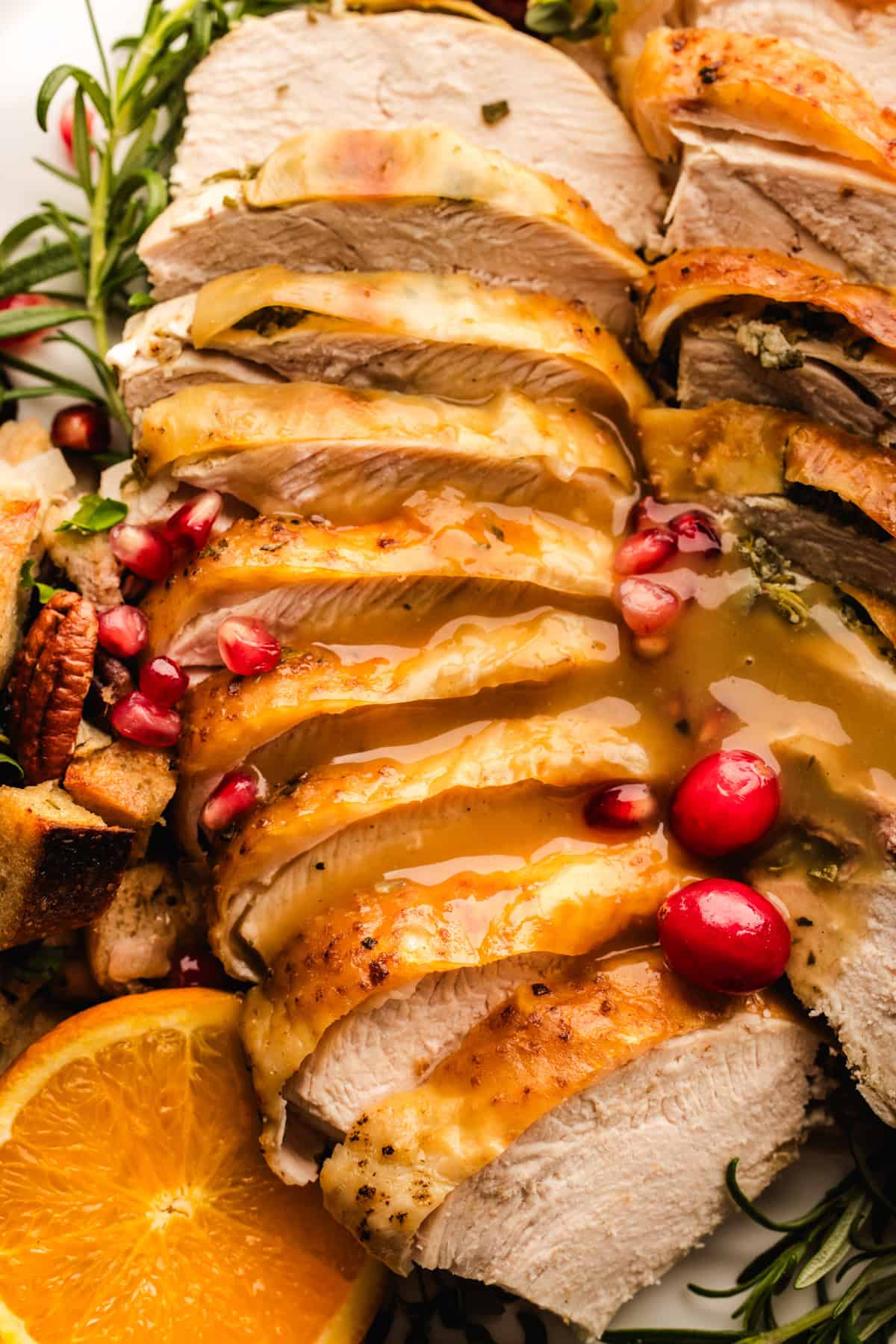
- Arrange the carved turkey on a large serving platter. Garnish with fresh rosemary, sage, thyme, orange slices, and pomegranate or any other colorful herbs and fruits you have on hand. Serve with turkey gravy and your favorite Thanksgiving sides.
Notes
- How do I thaw a frozen turkey? Thaw it in the refrigerator, breast-side up, in its wrapping on a tray. Allow about 24 hours for every 4-5 pounds, so plan on 3-4 days for a 14-15 pound turkey.
- Why not rinse the turkey? Rinsing spreads bacteria around your sink and counters. Patting the turkey dry is safer, and dry skin browns and crisps much better.
- Dry skin means crispy skin: Pat the turkey dry everywhere, even under the wings. Never rinse raw turkey, since it splashes bacteria around your sink.
- Is the turkey done at 165°F (74°C)? Yes. Check the thickest part of both breasts and the innermost part of each thigh. Every spot should read at least 165°F (74°C). Dark meat is even more tender at 170-175°F (77-79°C).
- Use a thermometer: Cooking times are a guide only. The turkey is done when both breasts and the innermost part of each thigh read at least 165°F (74°C).
- Keep the pan moist: If the broth evaporates before the turkey is done, add another ½ to 1 cup so the drippings don't scorch.
- Use the drippings for gravy: Strain the pan juices and vegetables through a fine-mesh sieve and skim off the fat. Use the juices to make your turkey gravy.
- Don't skip the rest: Resting lets the juices settle back into the meat. Carve too early and the juices end up on the cutting board.
- Special Tools: Large Roasting Pan with Rack | Oven-Safe Meat Probe or Instant-Read Thermometer | Kitchen Twine | Oven-Safe Poultry Pins | Aluminum Foil | Large Carving Board
Storage and Reheating
- Refrigerator: Refrigerate leftovers within 2 hours in airtight containers for up to 3 to 4 days. Take the meat off the bone first, and add a little broth or cooking juices to keep it moist.
- Freezer: Freeze sliced or shredded turkey in smaller portions in airtight containers or freezer bags for up to 3 months, pressing out as much air as you can. Thaw overnight in the refrigerator.
- Reheating: Put the slices in a baking dish with a splash of broth. Cover tightly with foil and warm at 300°F (150°C) until they reach 165°F (74°C). For single portions, microwave loosely covered in short bursts. Avoid reheating the same turkey more than once.
Make-Ahead Tips
- Herb butter: Make it up to 3 days ahead and keep it in an airtight container in the refrigerator. Let it soften before spreading.
- Vegetables: Chop the onion, carrots and celery the day before and refrigerate them.
- Roast on serving day: For the best flavor and texture, roast the turkey the day you plan to serve it.
Nutrition
Nutrition Disclaimer:
The nutritional information on this website is only an estimate and is provided for convenience and as a courtesy only. The accuracy of the nutritional information for any recipe on this site is not guaranteed. It should not be used as a substitute for a professional nutritionist's advice.
How to Make Thanksgiving Roast Turkey (Step-by-Step Photos)
Here's a quick overview. Full instructions, times, and temperatures are in the recipe card above.
- Prep the turkey and pan. Take the turkey out of the fridge 30 to 60 minutes before roasting. Remove the neck and giblets, then pat it very dry. Scatter the onions, carrots, and celery in the roasting pan and set the rack on top.
- Mix the herb butter. Stir the softened butter with garlic, sage, rosemary, thyme, salt, pepper, and lemon zest. Soft butter matters here. Cold butter tears the skin, and melted butter just slides off.
- Butter under the skin. Slide your fingers between the skin and the breast meat, starting at the neck end. Spread about one-third of the butter underneath, then press on the outside of the skin to smooth it out. Rub the rest of the butter all over the outside.
- Fill the cavity and tie. Add the onion, lemon, garlic, and herb sprigs loosely. Tuck the wing tips under and tie the legs together with twine.
- Add the broth. Set the turkey breast-side up on the rack and pour the broth into the pan. The broth keeps the drippings from burning and gives you a flavorful base for gravy.
- Roast hot, then low. Roast at 425°F (220°C) for 20 minutes, then lower the oven to 300°F (150°C). Tent the breast with foil once the skin turns deep golden.
- Check the temperature in several spots. The thickest part of both breasts and the innermost part of each thigh should all read at least 165°F (74°C). Keep the thermometer away from the bone for an accurate reading.
- Rest, carve, and garnish. Let the turkey rest under loose foil for 30 to 45 minutes. Carve the legs and thighs first, then slice the breast against the grain. Pile it onto a platter with fresh herbs, orange slices, and pomegranate.
- Got leftovers? Swap shredded turkey for the chicken in my puff pastry chicken pot pie or white chicken chili. It's a cozy way to enjoy the rest of the bird.
FAQs
- How long does it take to cook a 15-pound turkey? With this method (20 minutes at 425°F/220°C, then 300°F/150°C), a 14 to 15 pound unstuffed turkey takes about 3 to 4 hours. Ovens vary, so I start checking the temperature around the 2½ hour mark. The turkey is done when the breasts and thighs read at least 165°F (74°C).
- Can I stuff the turkey? I don't. A stuffed turkey takes longer to cook, and the stuffing itself has to reach 165°F (74°C), which often means overcooked breast meat. I fill the cavity with just onion, lemon, garlic, and fresh herbs and bake my stuffing in a separate dish, where it gets crispy on top.
- What temperature should turkey be when it's done? The thickest part of the breast and the innermost part of each thigh should all reach 165°F (74°C). Avoid touching bone when you take a reading, since bone gives a false high number.
- Do I really need to rest the turkey? Yes! Resting for 30 to 45 minutes lets the juices settle back into the meat, so they end up on your plate instead of the cutting board. The turkey stays hot under the foil, and it gives you time to make gravy from the drippings and warm up a batch of garlic butter dinner rolls.
- Can I dry brine the turkey? Yes! If you have time, rub the turkey with kosher salt and refrigerate it uncovered for 1 to 2 days. Pat it dry and skip the salt in the herb butter.
More Thanksgiving Recipes
- Cheesy Sweet Potato Gratin with Toasted Pecans
- Hasselback Butternut Squash with Candied Pecans
- Mashed Potatoes with Roasted Garlic
- Easy Scalloped Potatoes
- Brussels Sprouts with Bacon, Pecans, and Cranberries
- Green Beans with Pine Nuts
- Apple Stuffed Acorn Squash
- Holiday Salad
- Classic Pecan Pie
- Apple Pumpkin Bundt Cake
- 50+ Thanksgiving Recipes for the Complete Holiday Menu
Submit your question or provide a review of the recipe + star rating RIGHT HERE.