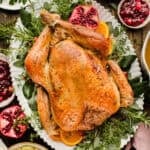
Roast Turkey with Herb Butter
Thanksgiving dinner deserves a turkey that steals the show, and this Garlic Herb Butter Whole Roasted Turkey makes a magnificent holiday centerpiece! No brining or complicated techniques required! Just a simple, no-fuss method so you can focus on all those delicious holiday sides!
Servings 14
Calories 687kcal
Ingredients
For the Turkey and Herb Butter
- 15 pounds turkey 1 whole turkey (14-15 pounds), completely thawed if frozen, giblets and neck removed
- 1 cup unsalted butter softened
- 6 cloves garlic minced
- 2 tablespoons fresh sage finely chopped
- 1 tablespoon fresh rosemary finely chopped
- 1 tablespoon fresh thyme leaves
- 2 teaspoons kosher salt plus more as needed
- 1 teaspoon black pepper freshly ground
- 1 zest of lemon
For the Turkey Cavity
- 1 large onion quartered
- 1 large lemon quartered
- 1 whole garlic bulb halved crosswise
- 4 fresh rosemary sprigs
- 6 fresh thyme sprigs
- 6 fresh sage leaves (4-6 leaves)
For the Roasting Pan
- 2 large onions quartered
- 2 medium carrots roughly chopped
- 2 stalks celery roughly chopped
- 1½ cups chicken broth low-sodium, or turkey broth
Instructions
- Prep the turkey: Remove the turkey from the refrigerator approximately 30-60 minutes before roasting. Make sure it is completely thawed, then remove the neck and giblets from the cavities. Pat the turkey thoroughly dry with paper towels, including underneath the wings and around the legs. Do not rinse the turkey.
- Scatter the quartered onions, chopped carrots, and celery across the bottom of a large roasting pan. If you're using a rack, position it inside the pan now so you can make sure your vegetables fit underneath it.
- Preheat the oven to 425°F (220°C). Position the oven rack in the lower-middle section so there is plenty of room above the turkey.
- Make the herb butter: In a medium bowl, combine the softened butter, minced garlic, chopped sage, rosemary, thyme, kosher salt, black pepper, and lemon zest. Mix until all the ingredients are evenly incorporated.
- Carefully loosen the skin covering the turkey breasts by gently sliding your fingers between the skin and the meat. Start at the neck end and work slowly toward the lower part of the breasts, taking care not to tear the skin.
- Spread approximately one-third of the herb butter underneath the loosened skin, distributing it evenly over both breasts. Gently massage the outside of the skin to help spread the butter into an even layer.
- Rub the remaining herb butter over the outside of the turkey, paying particular attention to the legs, thighs, and wings.
- Fill and truss: Place the quartered onion, lemon, halved garlic bulb, rosemary sprigs, thyme sprigs, and sage leaves loosely inside the turkey cavity. Do not pack the ingredients tightly, as air needs to circulate through the cavity while the turkey cooks.
- Tuck the wing tips underneath the turkey to prevent them from burning. Tie the legs loosely together with kitchen twine. If necessary, secure any loose skin around the cavity opening with oven-safe poultry pins.
- Place the prepared turkey on the rack in your pan, breast-side up. Pour in the chicken or turkey broth. The turkey should sit above the liquid rather than directly in it.
- If you have one, insert an oven-safe meat thermometer probe into the thickest part of one breast, avoiding the bone and the cavity. Position the tip near the center of the meat. Make sure the probe cable is routed out of your oven according to the manufacturer's instructions.
- Roast: Place the turkey in the preheated oven and roast uncovered for approximately 20 minutes. This initial period at a higher temperature helps the skin begin to brown.
- Reduce the oven temperature to 300°F (150°C). Continue roasting until the turkey is cooked through. Allow approximately 3-4 hours total for a 14-15 pound turkey, but begin checking the temperature well before the estimated finishing time.
- If using an oven-safe meat probe, you can usually set a target temperature and an alarm will sound when you reach temperature.
- Keep an eye on the skin as the turkey roasts. Once it has developed a deep golden color, loosely tent the breast with aluminum foil to prevent it from becoming too dark. Leave enough space between the foil and the skin to avoid disturbing the butter coating.
- Monitor the internal temperature throughout cooking. As the breast approaches 165°F (74°C), check several other areas using an instant-read thermometer, particularly the thickest part of the opposite breast and the innermost part of each thigh. Avoid touching bone when taking readings. All areas should reach at least 165°F (74°C).
- If the skin needs a little additional browning toward the end of cooking, remove the foil for the final few minutes. Watch closely to prevent the skin from burning.
- Rest: Remove the turkey from the oven once it has reached a safe internal temperature. Transfer it to a large carving board or leave it on the roasting rack above the pan to rest. Loosely cover with aluminum foil and allow to rest for 30-45 minutes before carving.
- Carve and serve: Remove the kitchen twine, poultry pins, and cavity aromatics. Carefully carve the turkey, beginning with the legs and thighs, followed by the breasts and wings. Slice the breast meat against the grain into even pieces.
- Arrange the carved turkey on a large serving platter. Garnish with fresh rosemary, sage, thyme, orange slices, and pomegranate or any other colorful herbs and fruits you have on hand. Serve with turkey gravy and your favorite Thanksgiving sides.
Notes
- How do I thaw a frozen turkey? Thaw it in the refrigerator, breast-side up, in its wrapping on a tray. Allow about 24 hours for every 4-5 pounds, so plan on 3-4 days for a 14-15 pound turkey.
- Why not rinse the turkey? Rinsing spreads bacteria around your sink and counters. Patting the turkey dry is safer, and dry skin browns and crisps much better.
- Dry skin means crispy skin: Pat the turkey dry everywhere, even under the wings. Never rinse raw turkey, since it splashes bacteria around your sink.
- Is the turkey done at 165°F (74°C)? Yes. Check the thickest part of both breasts and the innermost part of each thigh. Every spot should read at least 165°F (74°C). Dark meat is even more tender at 170-175°F (77-79°C).
- Use a thermometer: Cooking times are a guide only. The turkey is done when both breasts and the innermost part of each thigh read at least 165°F (74°C).
- Keep the pan moist: If the broth evaporates before the turkey is done, add another ½ to 1 cup so the drippings don't scorch.
- Use the drippings for gravy: Strain the pan juices and vegetables through a fine-mesh sieve and skim off the fat. Use the juices to make your turkey gravy.
- Don't skip the rest: Resting lets the juices settle back into the meat. Carve too early and the juices end up on the cutting board.
- Special Tools: Large Roasting Pan with Rack | Oven-Safe Meat Probe or Instant-Read Thermometer | Kitchen Twine | Oven-Safe Poultry Pins | Aluminum Foil | Large Carving Board
Storage and Reheating
- Refrigerator: Refrigerate leftovers within 2 hours in airtight containers for up to 3 to 4 days. Take the meat off the bone first, and add a little broth or cooking juices to keep it moist.
- Freezer: Freeze sliced or shredded turkey in smaller portions in airtight containers or freezer bags for up to 3 months, pressing out as much air as you can. Thaw overnight in the refrigerator.
- Reheating: Put the slices in a baking dish with a splash of broth. Cover tightly with foil and warm at 300°F (150°C) until they reach 165°F (74°C). For single portions, microwave loosely covered in short bursts. Avoid reheating the same turkey more than once.
Make-Ahead Tips
- Herb butter: Make it up to 3 days ahead and keep it in an airtight container in the refrigerator. Let it soften before spreading.
- Vegetables: Chop the onion, carrots and celery the day before and refrigerate them.
- Roast on serving day: For the best flavor and texture, roast the turkey the day you plan to serve it.
Nutrition
Calories: 687kcal | Carbohydrates: 6g | Protein: 111g | Fat: 23g | Saturated Fat: 11g | Polyunsaturated Fat: 3g | Monounsaturated Fat: 6g | Trans Fat: 1g | Cholesterol: 361mg | Sodium: 1013mg | Potassium: 1270mg | Fiber: 1g | Sugar: 3g | Vitamin A: 2086IU | Vitamin C: 10mg | Calcium: 87mg | Iron: 5mg