
This post may contain affiliate links. Read my disclosure policy.
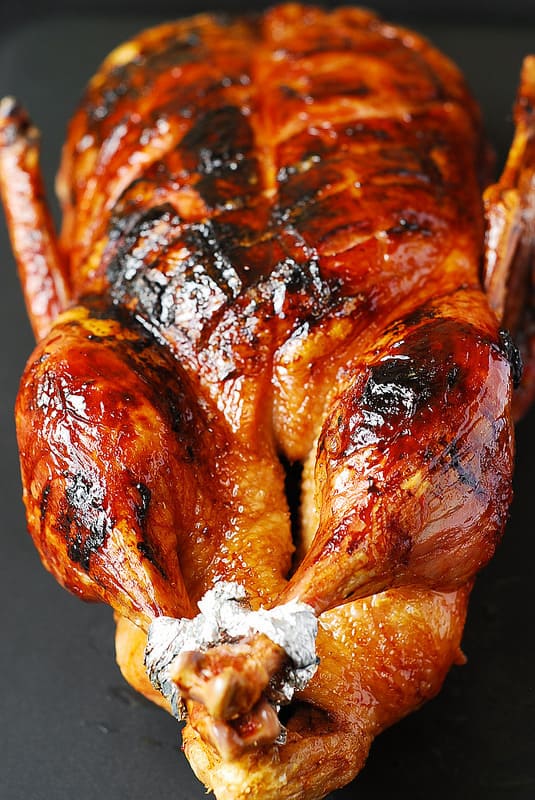
Ever wondered how to cook duck? It's much simpler than most people think. This Roast Duck has tender and juicy meat, crispy skin, and it's glazed with the honey-balsamic glaze to give the duck a beautiful roasted look. Perfect holiday main dish recipe or something you can make any time for a special occasion.
Why This Roast Duck Is Perfect for the Holidays
It's a great-looking dish - perfect for any special occasion, and with the holidays coming up, this roast duck will look great on any Thanksgiving menu (my 50 best Thanksgiving recipes), or as a Christmas and New Year's Eve dinner idea. By the way, the honey-balsamic glaze in this recipe DOES NOT MAKE THE DUCK SWEET - I did not want a sweet duck. It only gives a nice crispiness and beautiful look to the duck skin. Your duck will have a very savory and juicy flavor from the garlic and lemon that you'll stuff inside the duck cavity. SO GOOD! Cooking this duck does take some time and effort, which makes it a perfect holiday main dish or a special occasion dinner. If you love duck, you've got to try these recipes next: Thai duck curry and festive duck breast with cranberry sauce. My other popular "big" holiday main courses are braised short ribs with polenta, rich Beef Bourguignon (French Red-Wine Beef Stew), and apple cider braised pork shoulder.
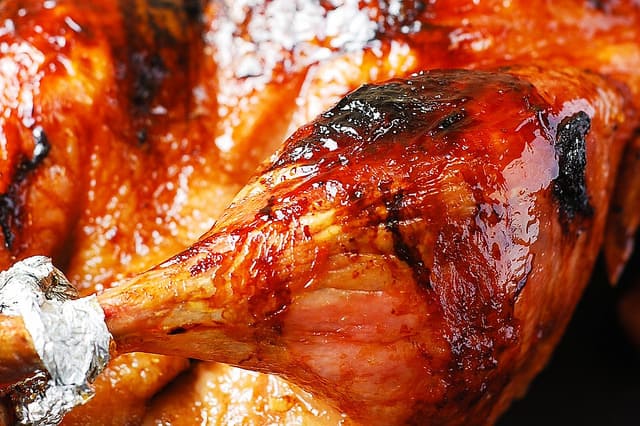
This recipe has very detailed instructions (with step-by-step photos) on how to prepare and cook the duck - which could be very helpful if you've never cooked the duck before. The duck will be roasted in the oven at 350 F for about 3 hours, and in addition to the beautiful duck, you'll end up with a lot of duck fat which I highly recommend you save and use for roasting vegetables, potatoes, and even cooking your breakfast eggs with it!
The Best Festive Sides to Dress Up Your Roast Duck
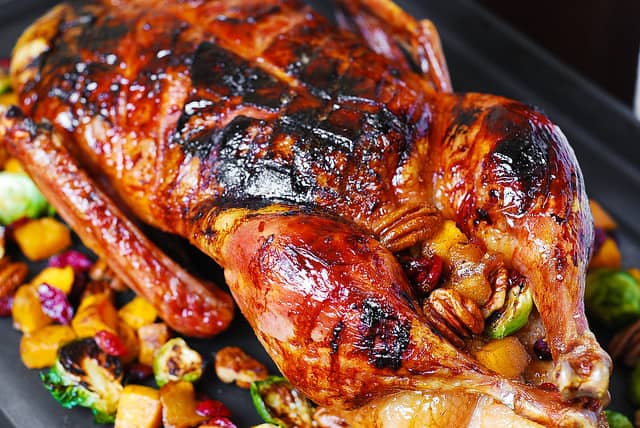
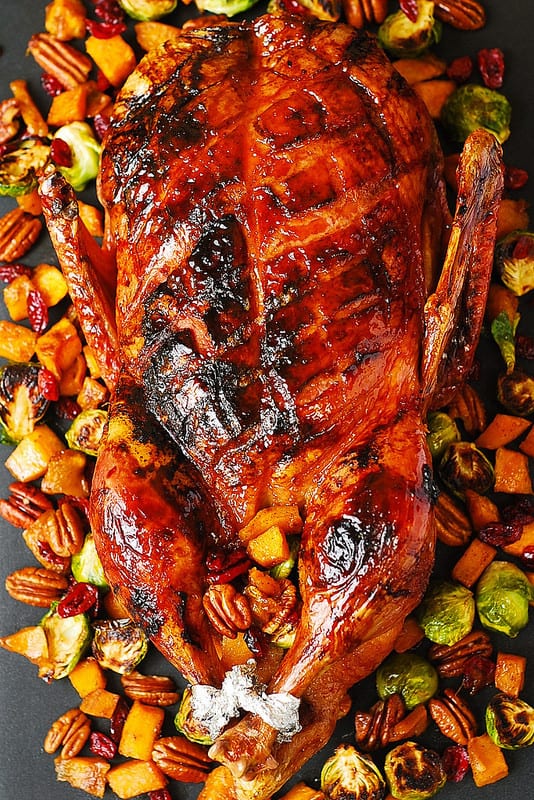
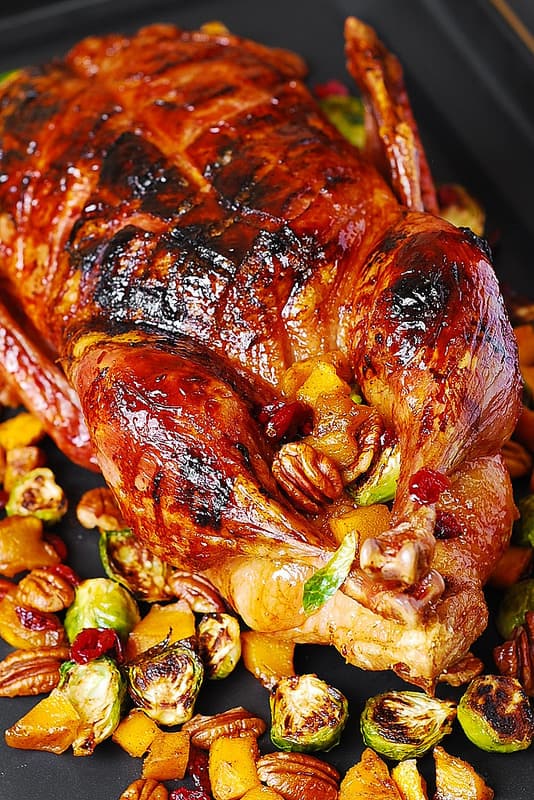
If you want a really beautiful and festive presentation for your holiday duck, use my recipe for Roasted Brussels Sprouts, Butternut Squash glazed with Cinnamon & Maple Syrup, with Pecans & Cranberries as garnish for the duck (this is what you see on the photo below). You can garnish the duck and decorate the serving platter with these colorful veggies - they will have all the holiday colors and flavors and will look very pretty with duck. You can also make these side dishes:
- Roasted Garlic Mashed Potatoes
- Green Beans with Pine Nuts
- Roasted Brussels Sprouts with Bacon
- Sausage Stuffed Butternut Squash
- Butternut Squash Pasta Salad with Pecans and Cranberries
- Roasted Asparagus with Bacon, Garlic, and Cheese
How to Prepare a Whole Duck for Roasting
Step-by-step photos and instructions start here (the complete recipe without photos is at the bottom of this post). I recommend that you read and look through these photos and then scroll down to the recipe box itself for more condensed version of the recipe (without photos).
- If using frozen duck, make sure it's completely defrosted (defrosted in the refrigerator for a couple of days).
- Remove the giblets from inside the duck. Rinse the duck, inside and outside, with cold water. Pat dry with paper towels:
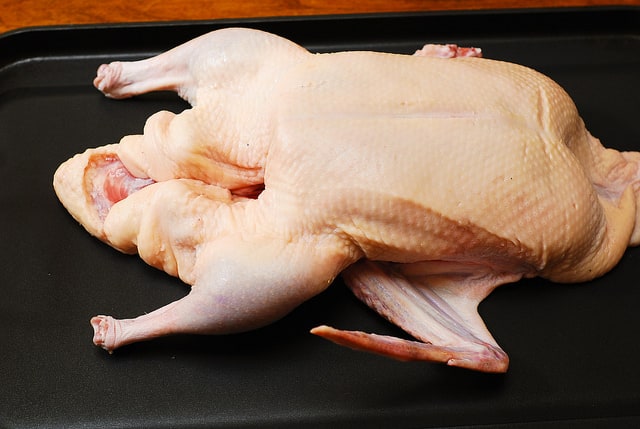
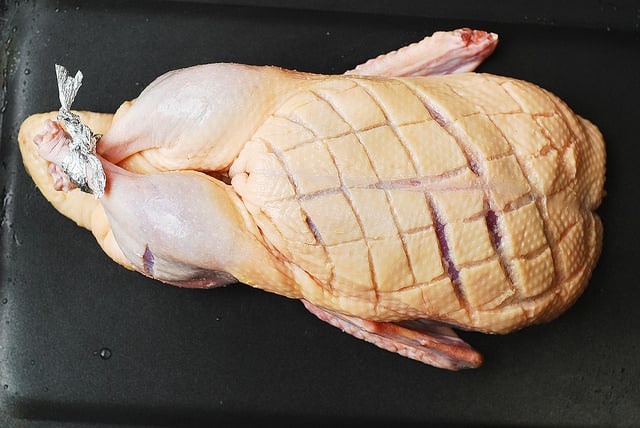
- Set the duck on the working surface. Score the duck's skin on the breast side in a diamond pattern, making sure you only cut the skin, without reaching the meat.
- The 2 deep cuts to the right of the photos is the example of how NOT TO SCORE, but it's still OK, as I did not cut through the meat but did reach the meat in those 2 cuts on the right:
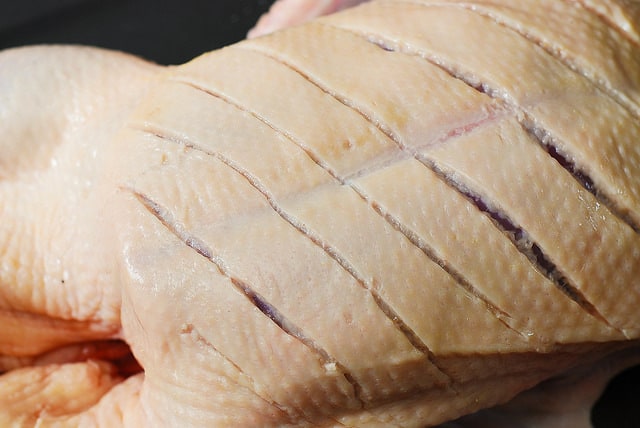
- The duck breast should be scored in a diamond pattern:
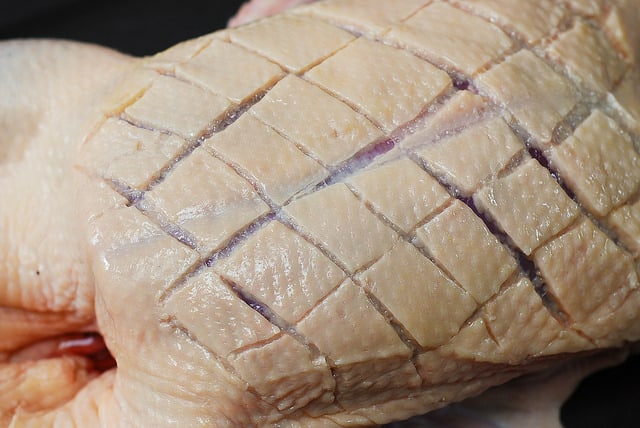
- This is what the duck should look like, breast side up, scored (see 2 deep scores on the right - try not to do that but it's OK as long as you don't cut into the meat itself):
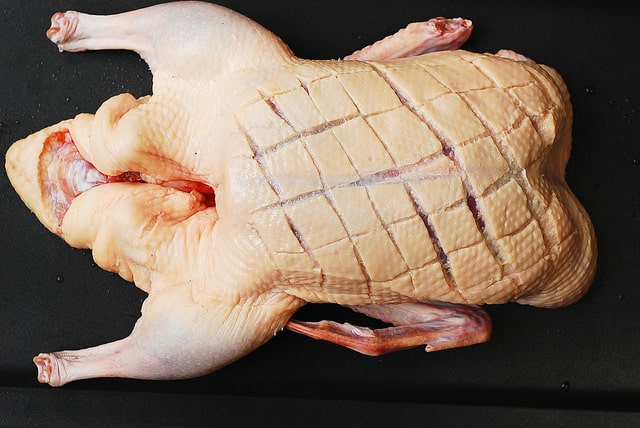
- Poke the other fatty parts of the duck with the tip of the knife all over, to ensure fat release, especially in very fatty parts. You don't need to poke the duck legs as the skin is pretty thin there (except for where the duck legs connect to the duck body).
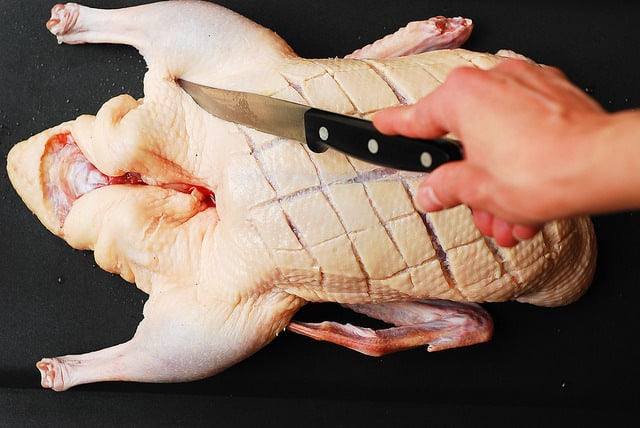
- Season the duck very generously with salt both inside the cavity of the duck and outside on the skin, legs, all over.
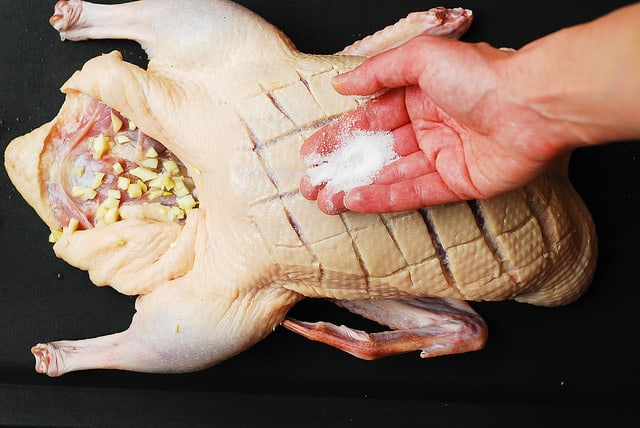
- Add 5 chopped garlic cloves and lemon slices inside the duck cavity (these are just for flavor, not for eating - you will discard them after cooking).
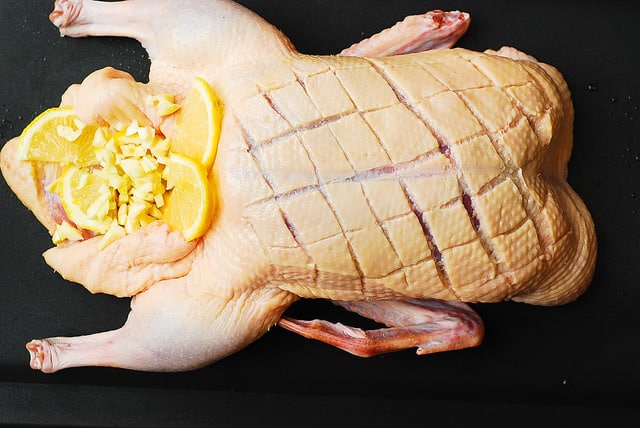
- The duck will have flapping skin on both ends - fold that skin inwards, to hold the garlic and lemon inside.
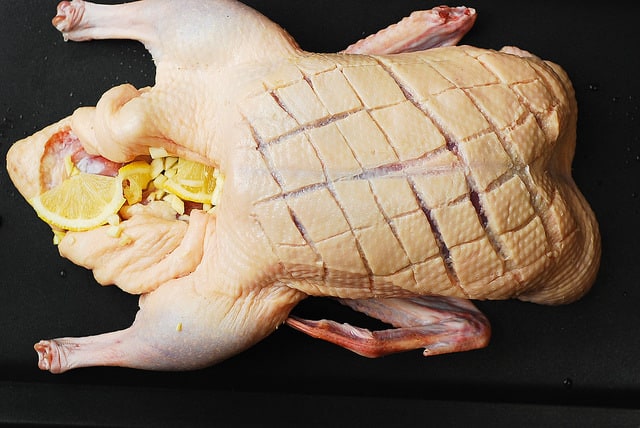
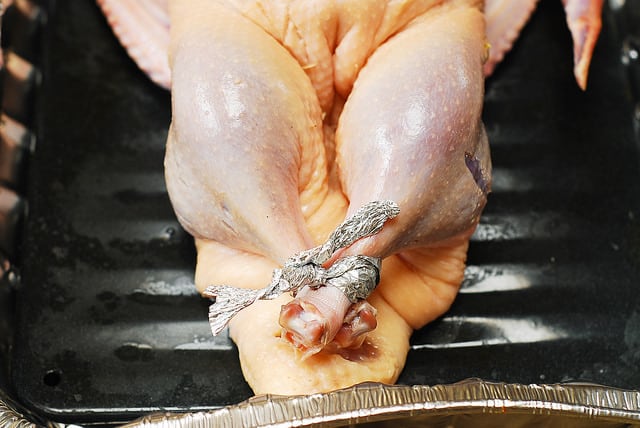
- Tie the duck legs with butcher's twine or butcher's string (or, in my case, I just used folded aluminum foil to tie up the duck legs, because I forgot to get butcher's twine):
- Place the bird breast side up on a large roasting pan with a rack (the roasting pan should have a roasting rack to lift the duck from the bottom of the pan and allow the fat to drip below the duck).
How to Roast Duck in the Oven
THIS IS A RECIPE OVERVIEW WITH STEP-BY-STEP PHOTOS. SCROLL DOWN TO THE RECIPE CARD TO SEE THE COMPLETE RECIPE.
Note: this is the recipe for a duck cooked to the final internal temperature of 165 F (well-done, not dry, not overcooked, just juicy and well-done). Use an internal meat thermometer at all times to guide you through the process. Adjust the cooking times proportionally if you prefer to cook your duck medium (140 F internal temperature) or medium-rare (130 F internal temperature).
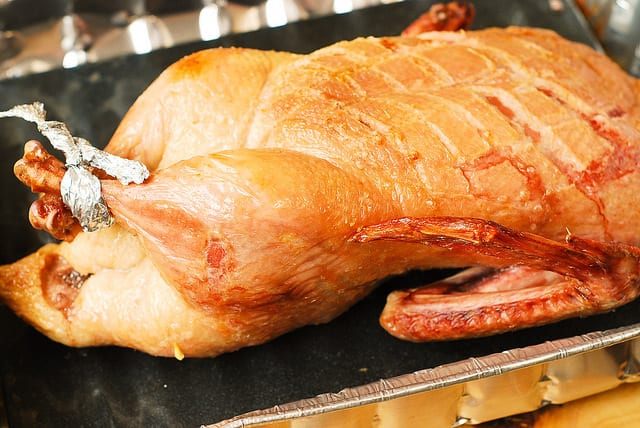
1) Roast the duck for about 40 minutes at 350 F, breast side up, then remove the duck from the oven, it should look like this after the first 40 minutes of roasting:
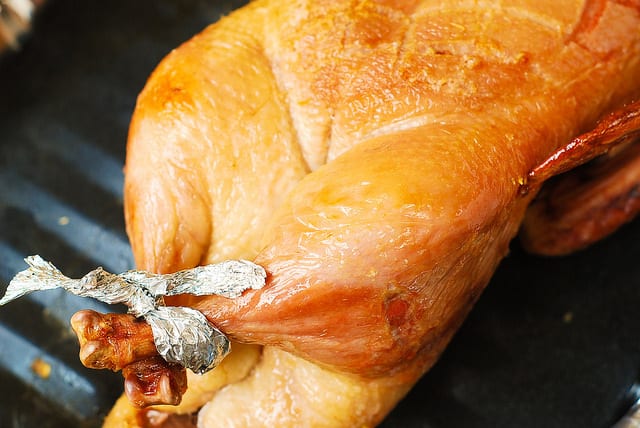
2) Then, flip the duck breast side down, and roast for 20 or 40 minutes at 350 F breast side down. After 20 minutes of roasting, check the duck's internal temperature with an instant meat thermometer. If the temperature reaches 140 F, proceed to the next step. If the meat temperature is below 140 F, roast the duck for 10 or 20 more minutes or until the temperature reaches 140 F. The duck should look like this - it's breast side down on this picture:
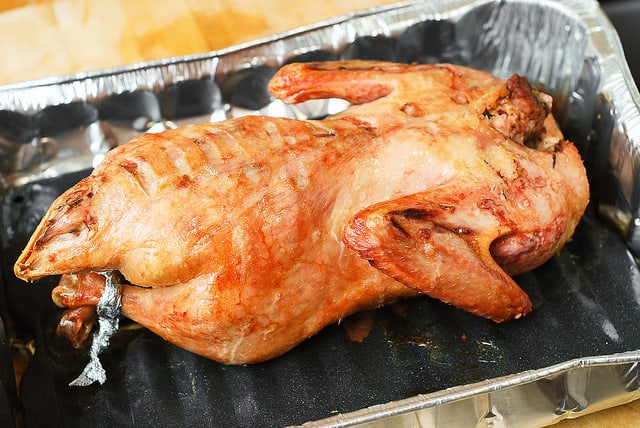
3) Remove the roasting pan with the duck from the oven, careful not to spill the juices (fat) in the roasting pan. Carefully remove the duck to a platter (making sure the lemons and garlic from the cavity do not fall out - keep the skin on both ends of the duck folded), and carefully pour off all the duck fat juices from the roasting pan into a large heat-proof bowl or container.
4) In a small bowl make balsamic glaze: combine ½ cup of balsamic vinegar with the freshly squeezed juice of 1 lemon and ¼ cup of honey. Set the duck breast side up again on the roasting rack in the roasting pan. Brush all of the duck with the balsamic mixture (especially the scored duck breast) and cook the duck breast side up for another 20 minutes at 350 F, brushing every 10 minutes with the mixture. Continue to measure the duck's internal temperature with the meat thermometer.
5) Add more honey to the mixture if it's too thin; it should be relatively thick. Roast the duck for another 20 minutes, brushing the duck breast side every 5 minutes with honey balsamic mixture.
6) Remove the duck from the oven once its internal temperature reaches 155 F (and after you've briefly broiled it if needed). Let it rest, uncovered, on the kitchen counter for about 15 minutes. During this time, the duck will continue cooking in residual heat until it reaches 165 F.
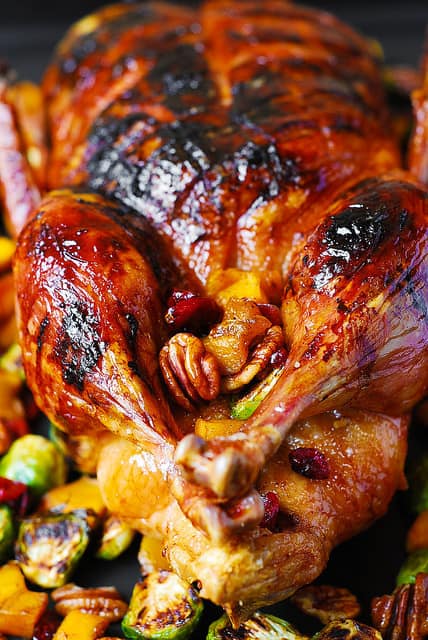
7) In the end, the duck should be nicely browned with crispy skin like this:

8) Untie the legs:

9) Serve: If you want a really beautiful and festive presentation for your holiday duck, use my recipe for Roasted Brussels Sprouts, Butternut Squash glazed with Cinnamon & Maple Syrup, with Pecans & Cranberries. or Hasselback Butternut Squash with Candied Pecans.
Serving Suggestions
You can garnish the duck and decorate the serving platter with colorful veggies - they will have all the holiday colors and flavors and will look very pretty with duck:
- Roasted Garlic Mashed Potatoes
- Green Beans with Pine Nuts
- Hasselback Squash with Candied Pecans
- Holiday Cheese Ball (with fresh herbs, pecans, pumpkin seeds, and cranberries)
- Apple Spinach Salad with Honey-Mustard Lemon Dressing
- Brussels Sprouts with Balsamic Glaze
- Stuffed Butternut Squash with Spinach, Bacon, and Cheese
- Apple Stuffed Acorn Squash
- Roasted Brussels Sprouts with Bacon
- Green Beans with Garlic, Lemon, and Parmesan
- Sausage Stuffed Butternut Squash
- Butternut Squash Pasta Salad with Pecans and Cranberries
- Roasted Asparagus with Bacon, Garlic, and Cheese

Roast Duck Recipe
Ingredients
Roast Duck
- 6 lb whole Pekin duck
- salt
- 5 garlic cloves chopped
- 1 lemon small or medium, chopped
Glaze
- ½ cup balsamic vinegar
- 1 lemon , freshly squeezed juice
- ¼ cup honey
Instructions
HOW TO THAW FROZEN DUCK
- If you purchased a frozen duck, make sure it's completely defrosted in the refrigerator for a couple of days. Then remove it from the refrigerator about 30 minutes before cooking to bring it closer to room temperature.
PREHEAT THE OVEN TO 350 °F (175 °C)
- Pre-heat the oven to 350 °F (175 °C). Prepare a large roasting pan with a rack so the duck is elevated and fat can drip beneath.
PREPARE THE DUCK
- Remove the giblets from the duck cavity (if present). Rinse the duck inside and out with cold water; pat thoroughly dry with paper towels.
- Set the duck on the working surface. Score the duck's skin on the breast in a diamond pattern, ensuring you only cut the skin, without reaching the meat. Poke the other fatty parts of the duck with the tip of the knife all over, to ensure fat release, especially in very fatty parts. You don't need to poke the duck legs as the skin is pretty thin there (except where the duck legs connect to the duck body). Season generously with salt inside the cavity and all over the skin, legs and exterior. Place the duck breast side up. (refer to step-by-step photos on scoring duck's skin above this recipe card - please scroll up).
- Place the chopped garlic cloves and lemon slices inside the duck cavity (these are just for flavor, not for eating - you will discard them after cooking). The duck will have flapping skin on both ends - fold that skin inwards, to hold the garlic and lemon inside. Tie up the duck legs with butcher's twine (or aluminum foil if twine is unavailable).(again, refer to the step-by-step photos above).
GENERAL GUIDELINES on roasting the whole duck safely in the oven
- Before you go ahead with the recipe, please review these general guidelines.
- According to USDA, to safely cook the duck in the oven at 350 Fahrenheit you have to cook it for 30 minutes per pound, which equals 3 hours for a 6-pound duck. Of course, one should use a meat thermometer and cook the duck to one's preference (medium-rear, for example), but at your own risk. 🙂 Here is the link for the USDA's safe cooking guidelines for whole ducks.
- The duck is considered safe to eat (according to USDA) when an internal temperature reaches 165 °F using a meat thermometer. That's when it's well done. If you take the duck out of the oven once the internal temperature is 155 F and let it sit for 10-15 minutes on the counter until it reaches 165 F - the duck will be well-done, delicious, and safe to eat. Check the internal temperature in the thigh's and wing's innermost part and the breast's thickest part.
- If you prefer to cook your duck rare or medium-rare, the internal temperature (as measured by a meat thermometer) at which you take it out of the oven is 130 Fahrenheit. For medium, take it out at 140 Fahrenheit. But it could be not safe to eat (according to USDA). Do so at your own risk. 🙂 The USDA recommends roasting the duck for 30 minutes per pound at 350 F to be safe.
RECIPE OVERVIEW
- With these considerations in mind, here is the recipe for a duck cooked to a final internal temperature of 165°F (well-done, juicy, and not overcooked). Always use an internal thermometer to guide the process. As a general rule, whole ducks roast at about 30 minutes per pound at 350°F (175°C), and you can adjust all cooking times proportionally if you prefer your duck medium (140°F) or medium-rare (130°F).
HOW TO ROAST THE DUCK IN THE OVEN
- Step 1. Roast for 40 minutes. Place the duck breast-side up on the prepared rack in the roasting pan. Roast uncovered at 350 °F (175 °C) for 40 minutes.
- Step 2. Roast for 20 minutes (or up to 40 minutes). Flip the duck so it's breast-side down, and continue roasting uncovered at 350 °F (175 °C) for 20 minutes. After 20 minutes of roasting, check the duck's internal temperature with an instant meat thermometer. If the temperature reaches 140 F, proceed to the next step. If the meat temperature is below 140 F, roast the duck for 10 or 20 more minutes or until the temperature reaches 140 F.
- Step 3. Remove duck fat. You now have roasted the duck for 1 hour (or 1 hour 20 minutes total). Remove the roasting pan with the duck from the oven, careful not to spill the juices (fat) in the roasting pan. Transfer the duck to a platter, and carefully pour off the rendered duck fat from the roasting pan into a heat-proof container (you can save this fat for roasting vegetables later). Make sure the lemons and garlic from the cavity do not fall out - keep the skin on both ends of the duck folded.
- Step 4. Make a honey-balsamic glaze and roast for 20 minutes, brushing the duck with the glaze. In a small bowl, combine ½ cup balsamic vinegar + the juice of 1 lemon + ¼ cup honey. Place the duck breast-side up again on the rack in the roasting pan. Brush all over the duck (especially the scored breast) with the balsamic mixture. Return it to the oven at 350 °F (175 °C) and roast for 20 minutes, brushing every 10 minutes with the glaze.
- Step 5. Roast for 20 minutes and continue brushing the duck with the glaze. If the glaze seems thin, add more honey (it should be relatively thick). Then roast the duck another 20 minutes at 350 °F (175 °C), brushing every 5 minutes with the honey-balsamic glaze.
- Step 6. Broil the duck (optional and if needed). You can carefully broil the duck for about 5 or 10 minutes (check it regularly to ensure it doesn't char too much). Broiling the duck is a great option if the skin is not crispy enough. It will speed up the caramelization of the skin if your duck is already cooked to a desired internal temperature (as measured by a meat thermometer).
- Step 7. Remove the duck from the oven. Remove the duck from the oven once the internal temperature reaches ~155 °F (68 °C) (for well-done finished to 165 °F). Let it rest, uncovered, on the kitchen counter for ~15 minutes - during this time the internal temperature will carry over to the final target of 165 °F.
- Step 8. Discard the lemon. Then, carefully remove and discard the lemon from the cavity (being careful not to get burned). Carve the duck and serve!
Notes
- This recipe is written for a 6-lb duck; if your duck is significantly smaller or larger, adjust the time proportionally. As a general rule, a whole duck needs about 30 minutes of roasting time per pound when cooked at 350°F (175°C).
- Using a meat thermometer is essential - times are estimates; internal temperature is your reliable guide.
- If you prefer medium rather than well-done, adjust the cooking times - but be aware the USDA considers 165 °F (74 °C) the safe minimum for poultry.
Why is the calorie amount in the Nutrition Section so huge?
The huge calories (about 3,000 calories per serving) you see on the nutrition label (the nutrition info on my site is approximate anyway!) include a large amount of duck fat rendered when you roast the duck. You will not eat this fat with the duck (it's rendered and then removed from the roasting pan). But you can save it and use some of it to roast the potatoes or eggs for the next several days.Duck's weight matters!
Ducks come in different sizes. The recipe, as written, is for a 6-pound duck. If your duck is half that size (3 pounds), adjust cooking times accordingly (in half). Use a meat thermometer as your guidance.Looking for Thanksgiving side dishes to serve with duck?
I have created a comprehensive recipe collection of 60 Thanksgiving side dishes conveniently categorized by ingredient: Green Beans, Butternut Squash, Sweet Potatoes, Brussels Sprouts, Potatoes, Acorn Squash, Spaghetti Squash, Asparagus, Broccoli, etc. It's a great resource to browse through for a last moment holiday inspiration! This side dishes will also work great for Christmas and New Year's Eve.Looking for a complete Thanksgiving menu?
Be sure to check out my 50 Best Thanksgiving Recipes (The Complete Holiday Menu) - it includes everything: Fall-inspired holiday appetizers, side dishes, salads, main courses, pasta recipes, desserts, and even breakfast. This holiday menu features proven, tried, and true Thanksgiving dishes that have been reader favorites for years (I've been publishing recipes since 2012).⬇️⬇️ My most popular Thanksgiving side dishes, salads, and desserts are below. They will pair beautifully with the roast duck. I highly recommend you check them out. ⬇️⬇️
Updated recipe
I originally posted this recipe on October 24, 2015. I updated this recipe on October 28, 2023, and again on November 16, 2025, to make it more complete and helpful. Let me know in the comments what you think of the updates - or if you miss the old version (which I can repost).Nutrition
Nutrition Disclaimer:
The nutritional information on this website is only an estimate and is provided for convenience and as a courtesy only. The accuracy of the nutritional information for any recipe on this site is not guaranteed. It should not be used as a substitute for a professional nutritionist's advice.
My Most Popular Thanksgiving Side Dishes
- Thanksgiving Side Dish with Roasted Brussels Sprouts, Cinnamon Butternut Squash, Pecans, and Cranberries
- Roasted Acorn Squash Stuffed with Apples
- Stuffed Butternut Squash with Spinach, Bacon, and Cheese
- Butternut Squash Pasta Salad with Brussels Sprouts, Pecans, and Cranberries
- Roasted Brussels Sprouts with Bacon and Balsamic Glaze
My Most Popular Thanksgiving Salads
- Fall Pasta Salad with Roasted Butternut Squash
- Apple Spinach Salad
- Winter Pear Salad
- Christmas Salad with Mandarin Oranges and Honey-Mustard Lime Dressing
I haven't previously had success doing a duck and flipping it over. This recipe worked terrifically for me. The balsamic lemon basting liquid turned the duck skin a beautiful amber color. Instead of using honey, I used fig jam and apricot jam (1 tablespoon of each) for just a hint of fruity sweetness. This is a great step-by-step recipe for a beautifully cooked and delicious duck.
Margaret, I am so happy you found this recipe helpful! I really appreciate it when people take the time to share their feedback on recipes - thank you for this! And, I love your changes - using fig jam and apricot jam - that sounds so good! 🙂
Great recipe!
I've roasted a turkey before, but this is my first time for duck.
I prefer the breast meat on the slightly pink side, so I roasted it a little over 2 hours instead of 3.
As an aside, are you sure that calorie count is for a single serving and not the entire duck? I know duck is a rich meat, but I don't think 6 ounces or so of even the richest foods can tally up a calorie count in excess of 2000 calories
Jack, thank you for such a thoughtful and detailed comment. Very helpful to me and other readers. The calorie count includes the duck fat which is, obviously, is VERY HIGH IN CALORIES. However, you don't use duck fat when you eat the duck. You should certainly use the duck fat to roast regular potatoes or sweet potatoes, though, or even eggs!
How long for a 4 pound duck?
If your duck is 4 lbs, I would suggest the following changes:
1)
In the recipe card under the Section where it says: Roast the duck for 3 hours I would follow steps 1 through Step 2 but reduce the total cooking time for these 2 steps from 1 hour and 40 minutes to only 1 hour. That means that in step 1 under the Section Roast the duck for 3 hours, you would roast the duck for 30 minutes, and then roast the duck for another 30 minutes in step 2. You will cook the duck for a total of 1 hour instead of 1 hour and 40 minutes during those first 2 steps. All of this is done in the preheated oven at 350 F.
2)
Then follow the rest of the steps.
You will continue to cook the duck for 40 minutes while brushing it with the balsamic vinegar lemon mixture (without honey) as described in step 4.
3)
Then, you will continue to cook the duck for 40 more minutes, while brushing it with the balsamic vinegar + lemon + honey mixture as described in step 5. At this point, make sure to check your duck for doneness every 10 minutes. It’s best to use a meat thermometer. The cooked duck should measure an internal temperature of 165 °F using a meat thermometer. If the duck is not cooked to your preference, continue cooking the duck and brushing it with the honey-balsamic mixture, checking it for doneness every 10 minutes.
4)
Your total cooking time will be about 1 hour + 40 minutes + 40 minutes = 2 hours and 20 minutes or less since during the last 40 minutes you will be checking the duck for doneness every 10 minutes so that it's cooked to your liking.
ENJOY!
Hi! I’m going to try this recipe but I have a 8lb Muscovey duck. Are there any alterations that need to be made to cooking time?
I would say proceed with the recipe as is (without any changes), and use a meat thermometer as your guidance.
After roasting the duck for 2 hours, make sure to check your duck for doneness every 10 minutes. It’s best to use a meat thermometer. The cooked duck should measure an internal temperature of 165 °F using a meat thermometer. If the duck is not cooked to your preference, continue cooking the duck and brushing it with the honey-balsamic mixture, checking it for doneness every 10 minutes.
Julie, I have a beautiful frozen big Muscovy duck. My daughter raised. I have never roasted a duck. I am going to try your recipe . It’s sounds delicious. My question can you suggest interesting way to use the leftovers?
Here is one recipe to use with leftover duck:
Duck with Cranberry Sauce
Made it for New Years dinner.
Tasty, like the instructions and the pictures step by step.
Thank you!
I am glad the recipe was a success! Thank you so much for taking the time to share your feedback! 🙂
Amazing!!! Really appreciate the clear instructions! Made it tonight as a special occasion dinner and it was fantastic!! Looking forward to trying more of your recipes! Thank you!
Bill, you are very welcome! Thank you for taking the time to share your feedback and being so positive - I appreciate it!
Thank you, Julia! I used this recipe last weekend and it was superb! I hadn't roasted a duck in over 30 years, and I much appreciated your in-depth instructions. I had to laugh about the pictures at different stages of roasting, it looked JUST like the pictures. Well done, and thank you!
I cant find a 6 lb, only 3lbs by me! How should I adjust the cooking time?
When you say roast the duck...is it in a covered roasting pan or is it in an open top? I've never cooked a duck until now so Ineed to know as I usually cover the turkey or roast with a lid to cook...thanks...kathy
Kathy, the duck is roasted uncovered at all times. Enjoy!
Can I make gravy with the drippings?
Yes, you can!
3 lb is a really small duck. I would reduce the cooking times in half.
And, use a meat thermometer for more precision. The cooked duck should measure an internal temperature of 165 °F using a meat thermometer. If the duck is not cooked to your preference, continue cooking the duck and brushing it with the honey-balsamic mixture, checking it for doneness every 10 minutes.
Carol, thank you so much for such a kind and uplifting comment! It made my day and made me smile at the same time. I appreciate that you took the time to share your thoughtful and kind feedback. 🙂
This is the first time that I have ever cooked a roast duck. I am so proud of myself. I followed the step the step-by-step instructions and my roasted duck is absolutely beautiful! Thank you for the recipe and the easy-to-follow instructions. I took pictures of
the finished roasted duck so that I could show my friends and family how beautiful it was'
This is the first time that I have cooked a roast duck. I am so proud of myself. I followed the step-by-step instructions, and the roasted duck is absolutely beautiful! Thank you for the recipe and the easy-to-follow instructions. I took a picture of the finished roasted duck so that I could show my friends and family how beautiful it was,
Sandra, I am so happy that you loved this recipe! Thank you for taking the time to share your positive feedback and kind words. I appreciate it!!
I made this recipe last year and it was absolutely delicious! I loved the easy to follow directions. I will be making this for New Year's Day this year. Thank you for this wonderful recipe!
Kathy, you are very welcome! I am so happy you've made this recipe more than once. I know a lot of people might like the recipe but don't have the time to comment, which is why I especially appreciate the glowing reviews like yours - they really make my day!
So glad this recipe was a success! Thank you for the comment! 🙂
I’m looking forward to making this in New Years however one of my guests is sensitive to honey. Is there another ingredient I could swap this for such as maple syrup?
Yes, maple syrup can be used!
Excellent recipe for New Years Eve lunch. This will be how I make roast duck from now on. I love roast duck but have rarely made it because the results weren't good due to flabby skin. This time skin was actually crisp. I didn't have balsamic vinegar, so I substituted Chinese black vinegar with a pinch of sugar, which worked great and I'll make it the same way next time.
Wow, Neil, I just love your comment! Glad the recipe was a success and that the skin was crispy! Thank you for sharing about your substitutions and for taking the time to share such a positive comment. 🙂
Dear Julia, thank you SO much for this wonderful, clear, delicious roast duck recipe. Best I have ever followed. Used it for two large ducks, side by side in a big roasting dish. Perfect!! Served it with a Brussels bubble and squeak, red cabbage, roasted butternut squash, quince jelly plus duck giblet gravy.
Angelina, thank you so much for such a kind, heart-warming, and uplifting comment. I so appreciate it! 🙂 I am glad this recipe was a success! 🙂
I used rice syrup and squeezed juice from 2 oranges… amazing!
That's a great option, too!
This is the best duck I have ever had. I made it for my family tonight and everyone was absolutely amazed how good it was. So juicy and tender and crunchy! As a side dish I roasted quinces which complimented this roasted duck really well. And I sprinkled the quinces with the balsamic and honey.
Thank you so much for the recipe and for such detailed description.
Marina, it makes me so happy to read comments like yours. I am very glad the recipe was enjoyed by your family. Thank you for the wonderful feedback! 🙂
I have never been a fan of duck for dinner but with my husband and I being alone this year due to Covid "hibernation" I decided to try this recipe. OMG this changed my opinion of duck. Kind of sweet, savory and sour all in one. THANK YOU. Merry Christmas.
Mary, I am so glad this recipe was enjoyed! 🙂 Glad you've chosen to roast the duck this Christmas - great choice! Happy Holidays to you and your family!
Soooo amazing! Thanks for this recipe. Looks just like yours. Wish I could post my pick. Happy New Year!
Joan, I am so pleased to read your feedback! 🙂 So glad the duck turned out well. I don't use Instagram much (I should!), but if you like, you can share your photo under my Facebook post here: https://www.facebook.com/photo/?fbid=442565757221508&set=a.280091133468972
Made this roasted duck for Christmas dinner. This was my first time preparing a whole bird and god, it was just perfect! Thanks for this great recipe and clear step-by-step instructions!
Francis, thank you so much for taking the time to share your feedback! Glad the recipe was a success! 🙂
I am making this tonight. I have dry brined the duck and I want to do it on high heat for the first 20 minutes. How should I adjust the time ? My duck is 6.6 pounds
If you want to roast the duck on high heat for the first 20 minutes, I would say follow the directions I posted below for 4.5 lbs duck which reduces total cooking time to 2 hours and 20 minutes. See my response to the recent comment below.
This turned out excellently for Christmas dinner, but only because I reduced the cooking time. Duck only needs 12-15 minutes per pound unstuffed. For the 7 pound duck I had, that would amount to half the cooking time described in this recipe. I understand the longer time is to allow the fat to render and the skin to crisp, so I split the difference. So, 40 minutes first stage, 30 minutes second stage, 30 minutes third stage, then 5-10 minutes under broiler. Duck was 160 degrees, just a tiny bit pink, very juicy with just a little bit of fatty skin. Skin was not crispy but still tasted great. NOTE: you won’t use all the marinade so cut back on measurements, especially if you’re using your expensive balsamic vinegar! Also, cover the tips of the wings with foil until the last stage. Follow the directions on the stuffing. That will seem like a lot of garlic and lemon but it works.
Beth, thank you so much for such detailed and helpful feedback. It would be so useful for other readers - thank you for taking the time to share it.