
This post may contain affiliate links. Read my disclosure policy.
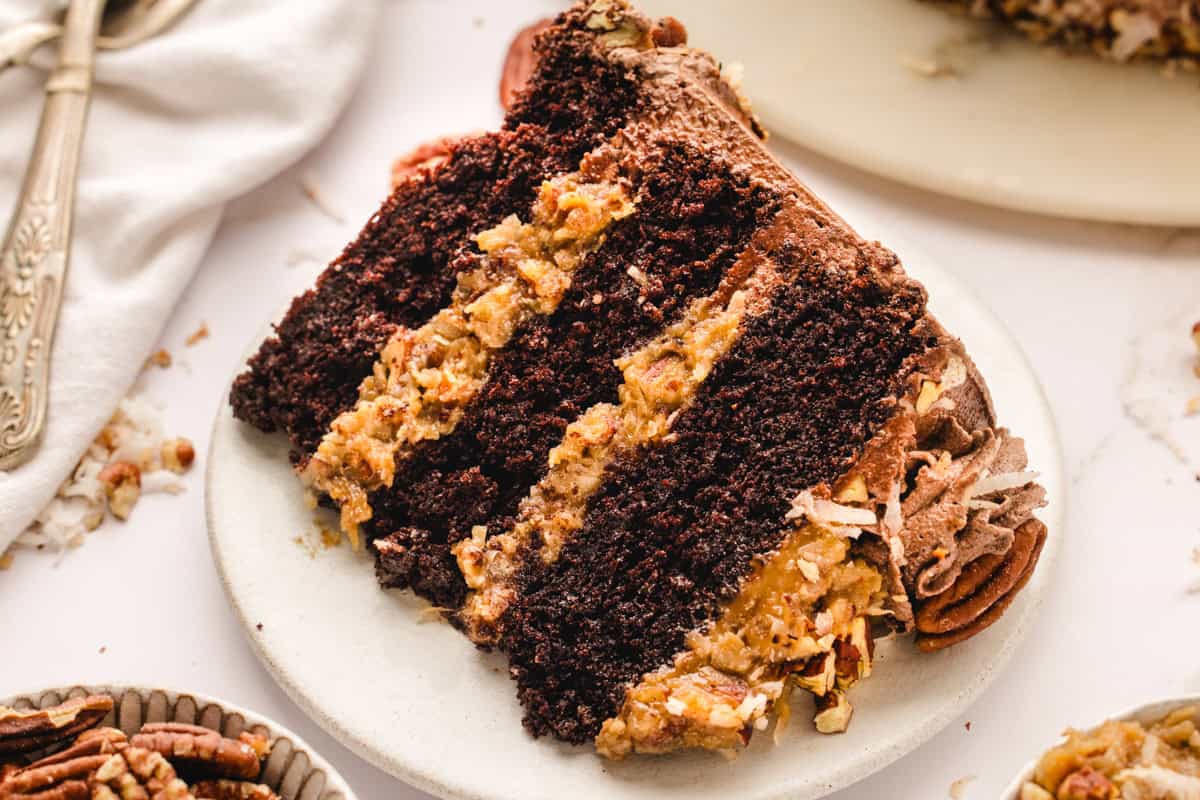
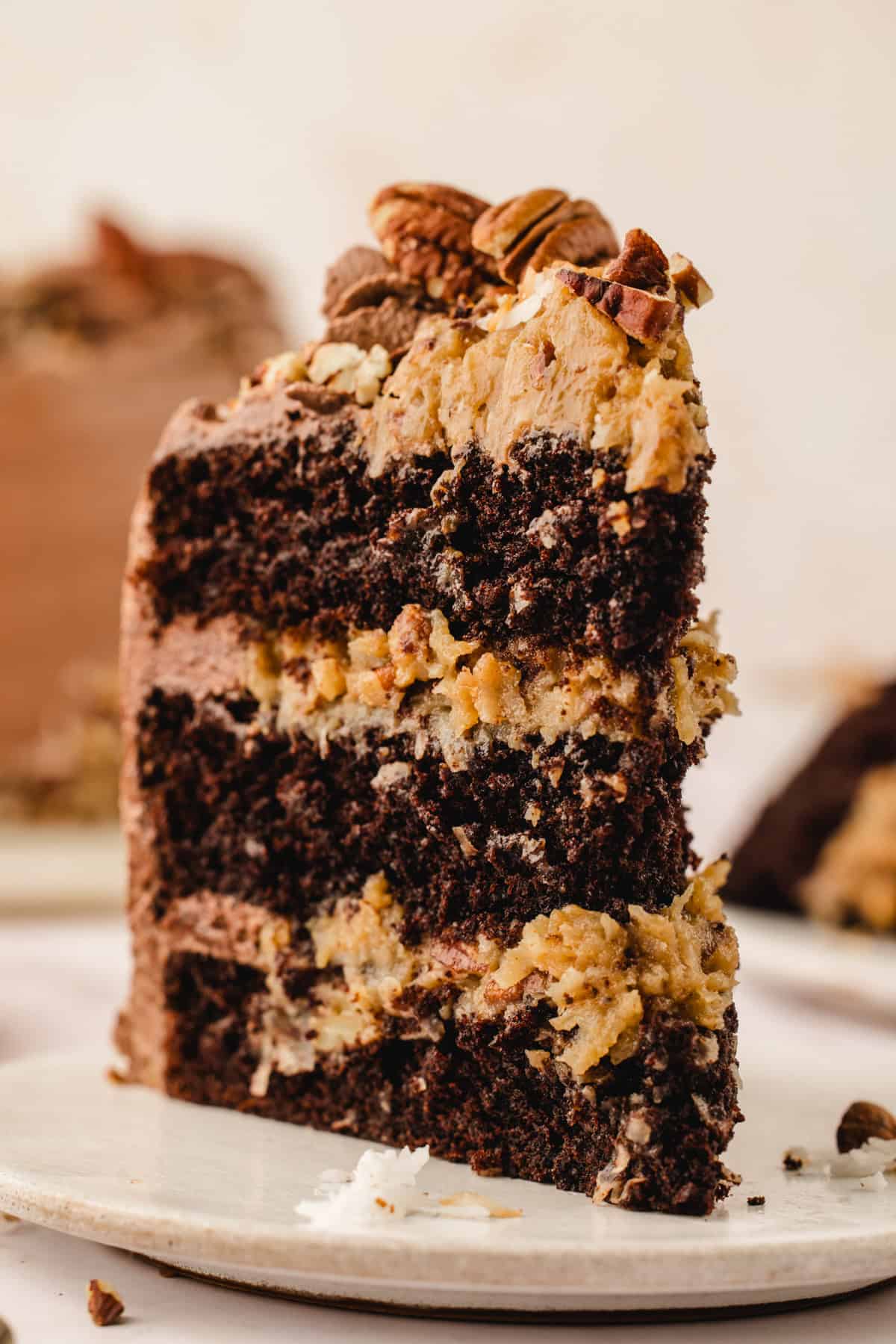
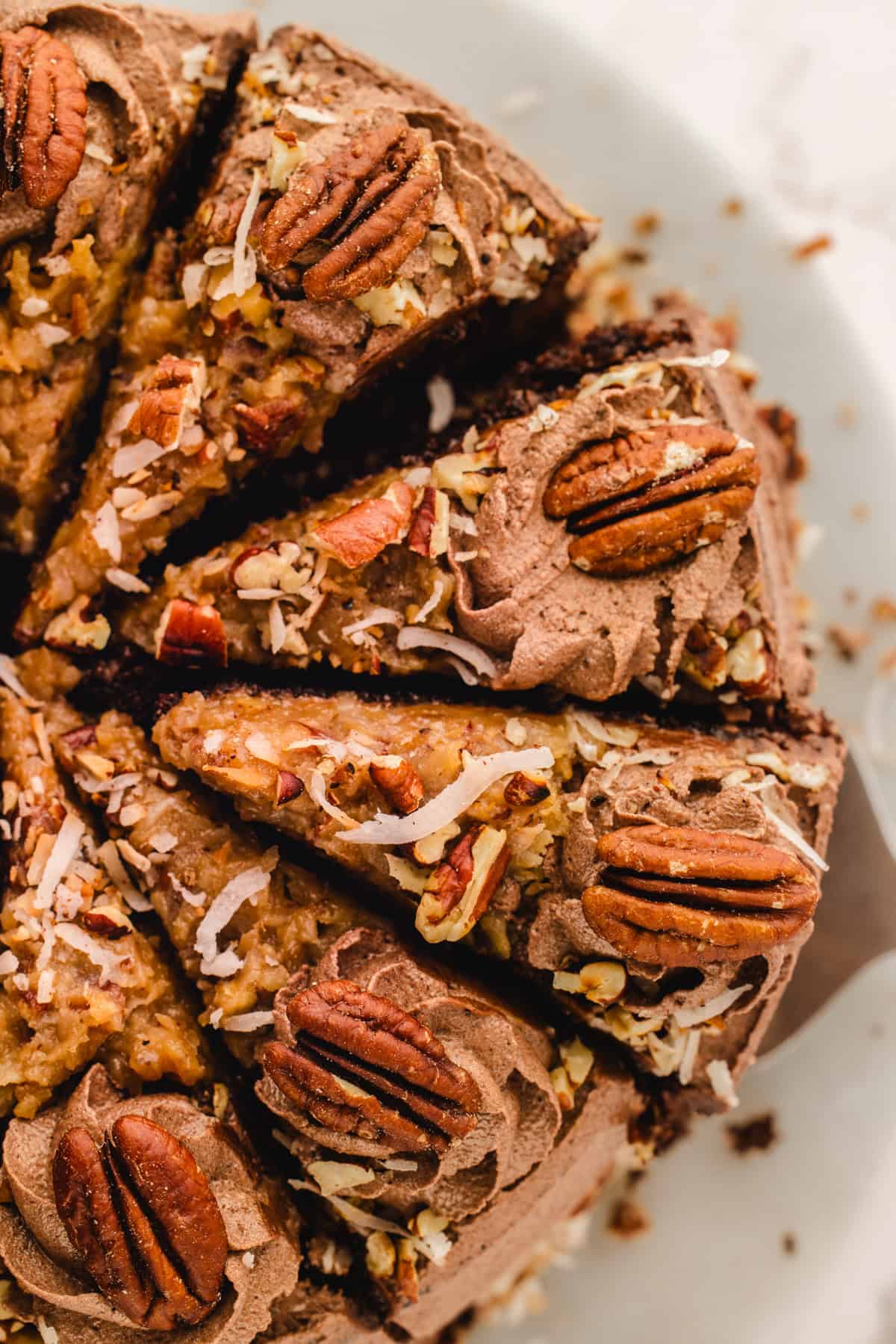
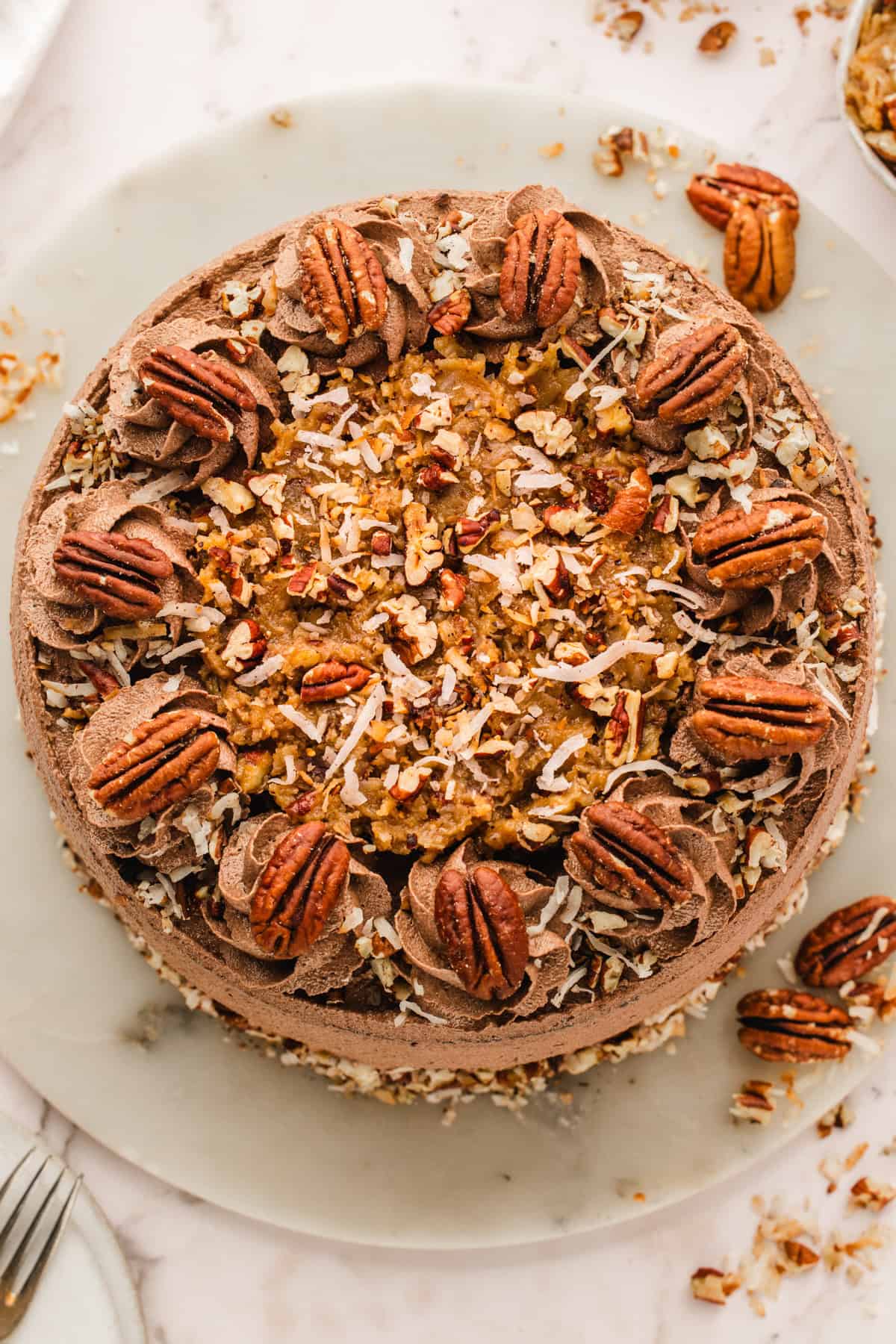
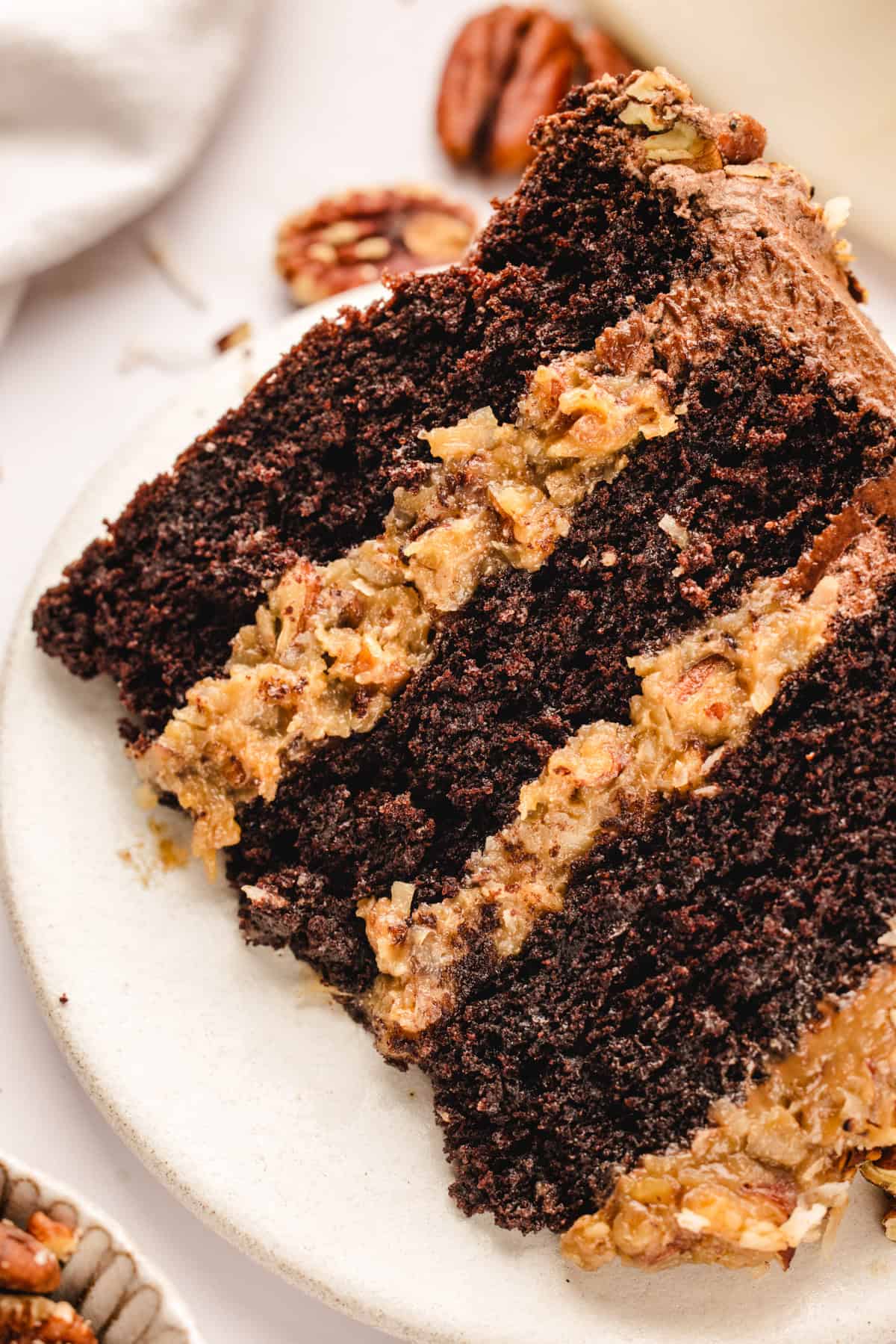
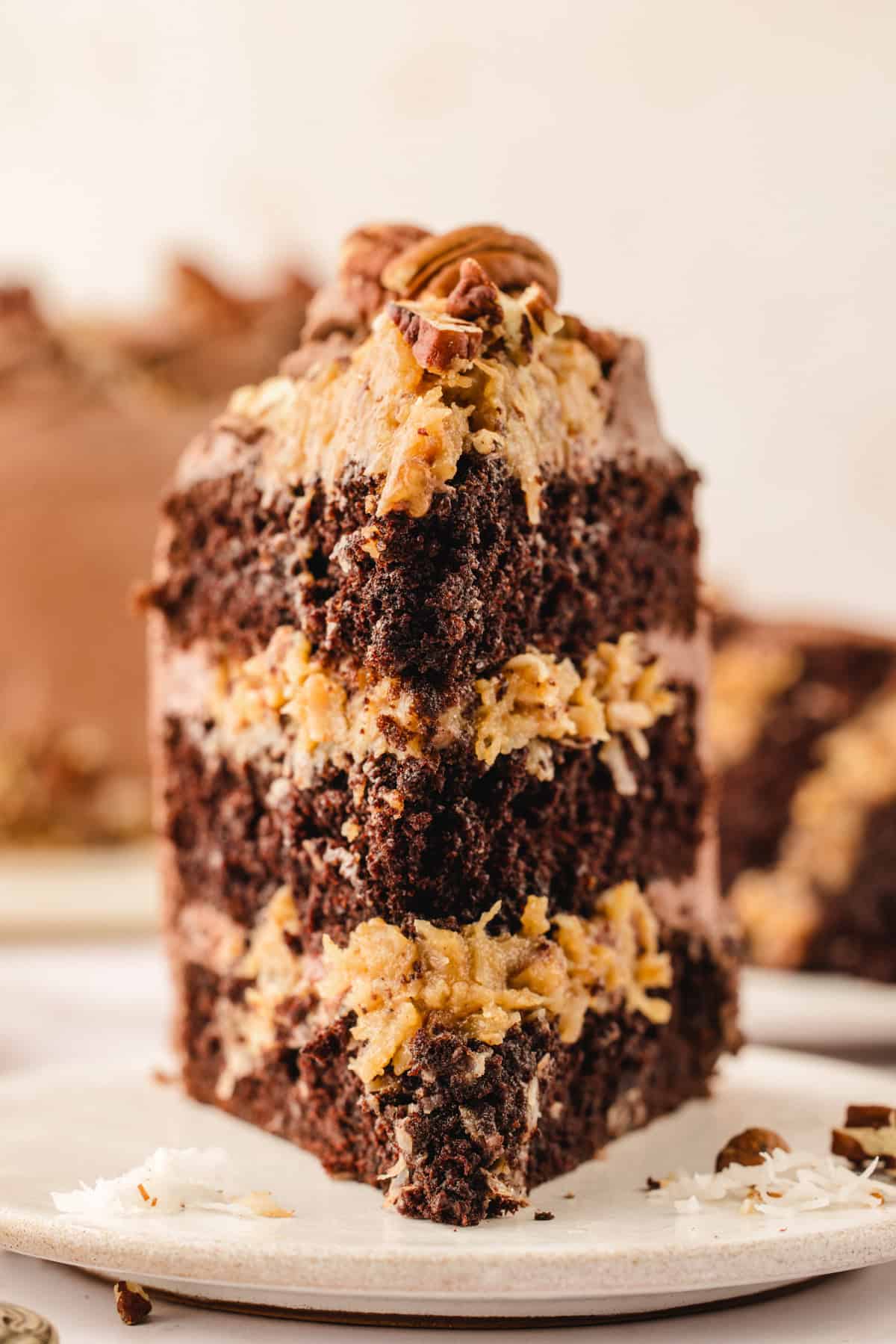
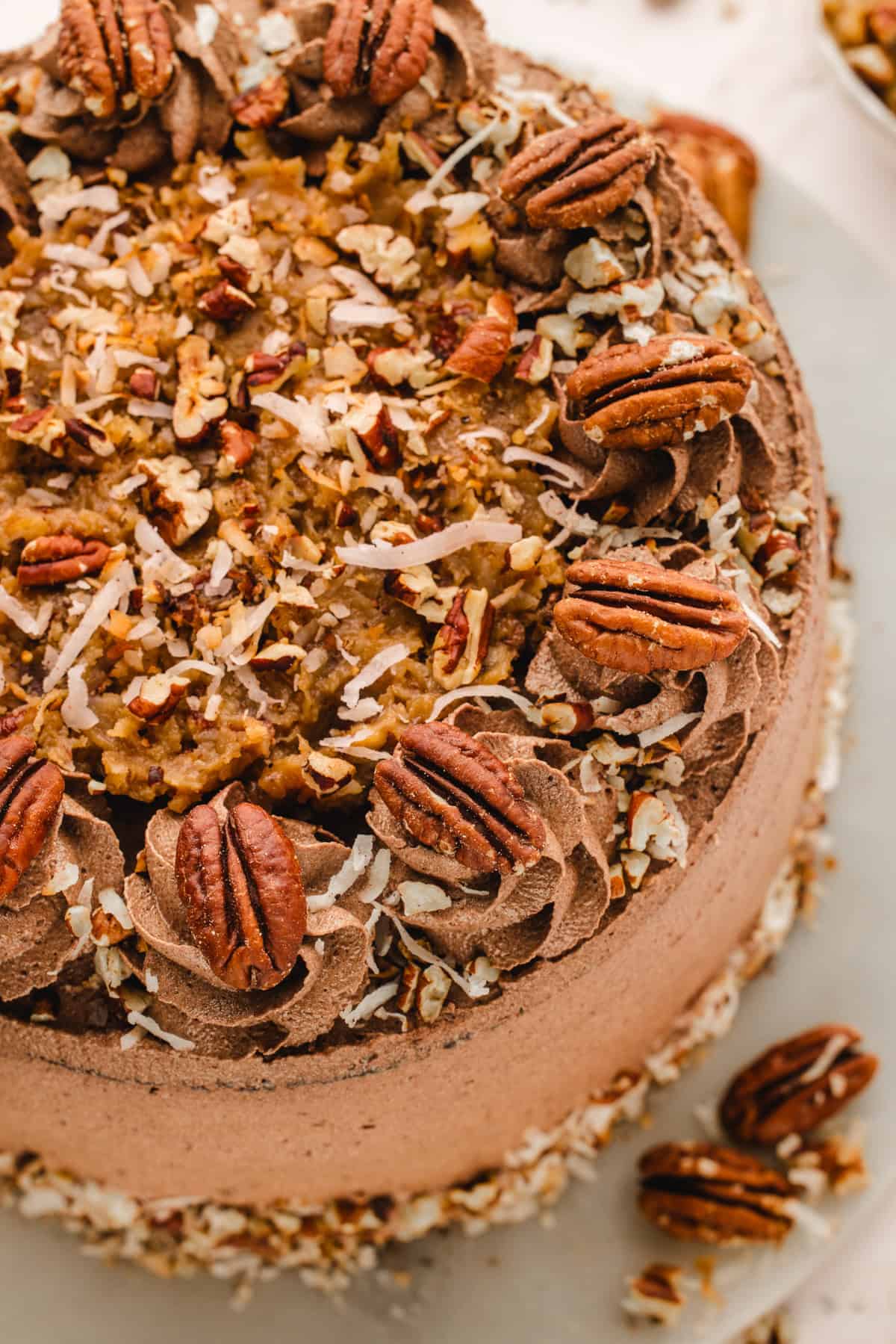
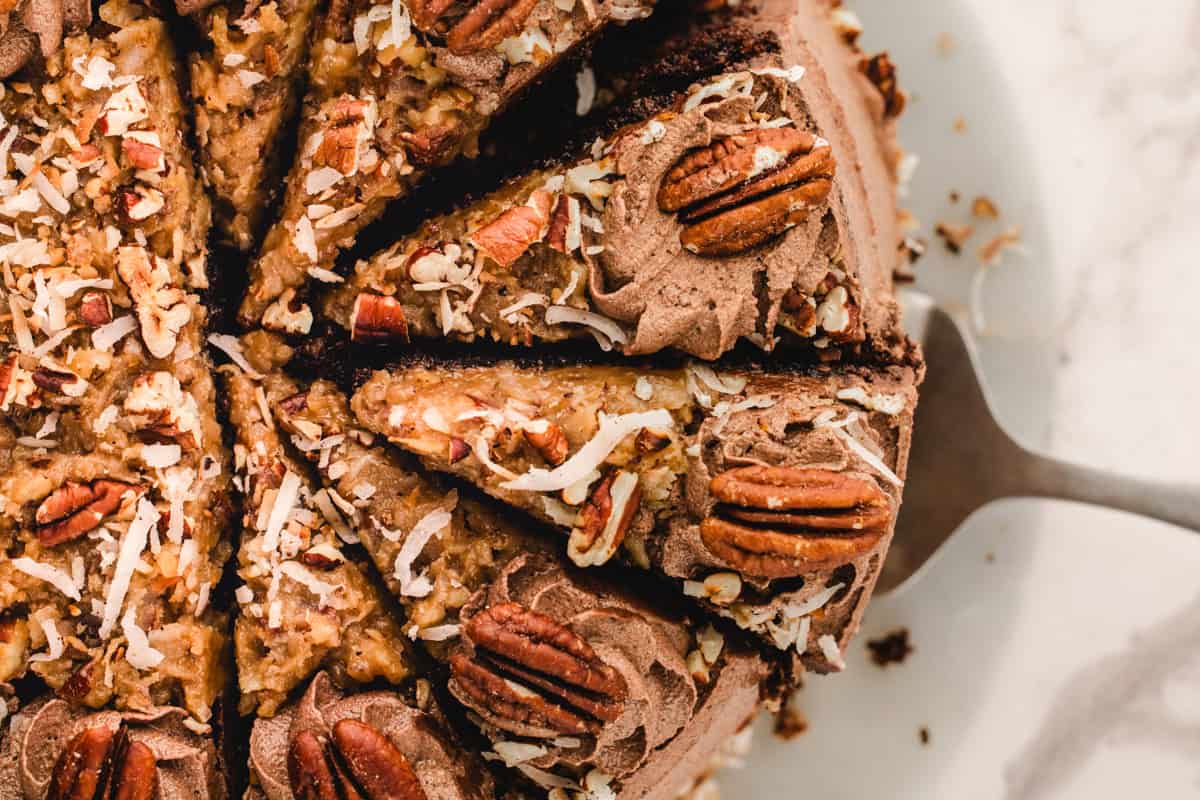
This homemade German chocolate cake recipe has three moist chocolate cake layers, a gooey coconut pecan filling made from scratch, and a silky chocolate buttercream that frosts the whole cake. It's rich, nutty, and caramel-sweet, and it slices into tall, gorgeous wedges for birthdays and holidays.
What Makes This German Chocolate Cake Different
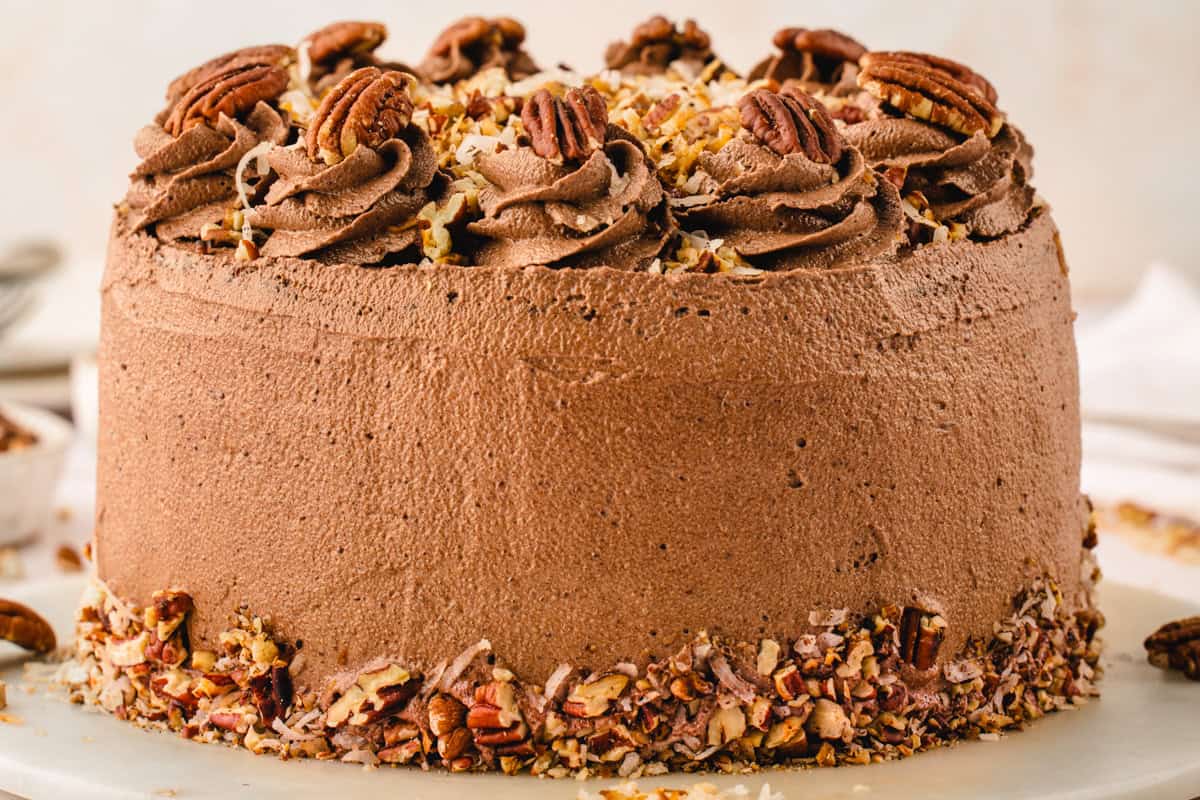
I love making tall, beautiful layer cakes for birthday celebrations, from my cherry layer cake with cherry buttercream to a light and gorgeous lemon raspberry cake. But this German chocolate cake takes the top spot for a birthday cake: three moist chocolate cake layers, a thick coconut-pecan filling, and silky chocolate buttercream. I use natural unsweetened cocoa powder in the batter, plus hot coffee, which deepens the chocolate flavor rather than giving the cake an obvious coffee taste (it doesn't taste like coffee, I promise).
I toast the pecans before adding them to the filling because toasting brings out their buttery flavor and makes a noticeable difference against the sweet coconut.
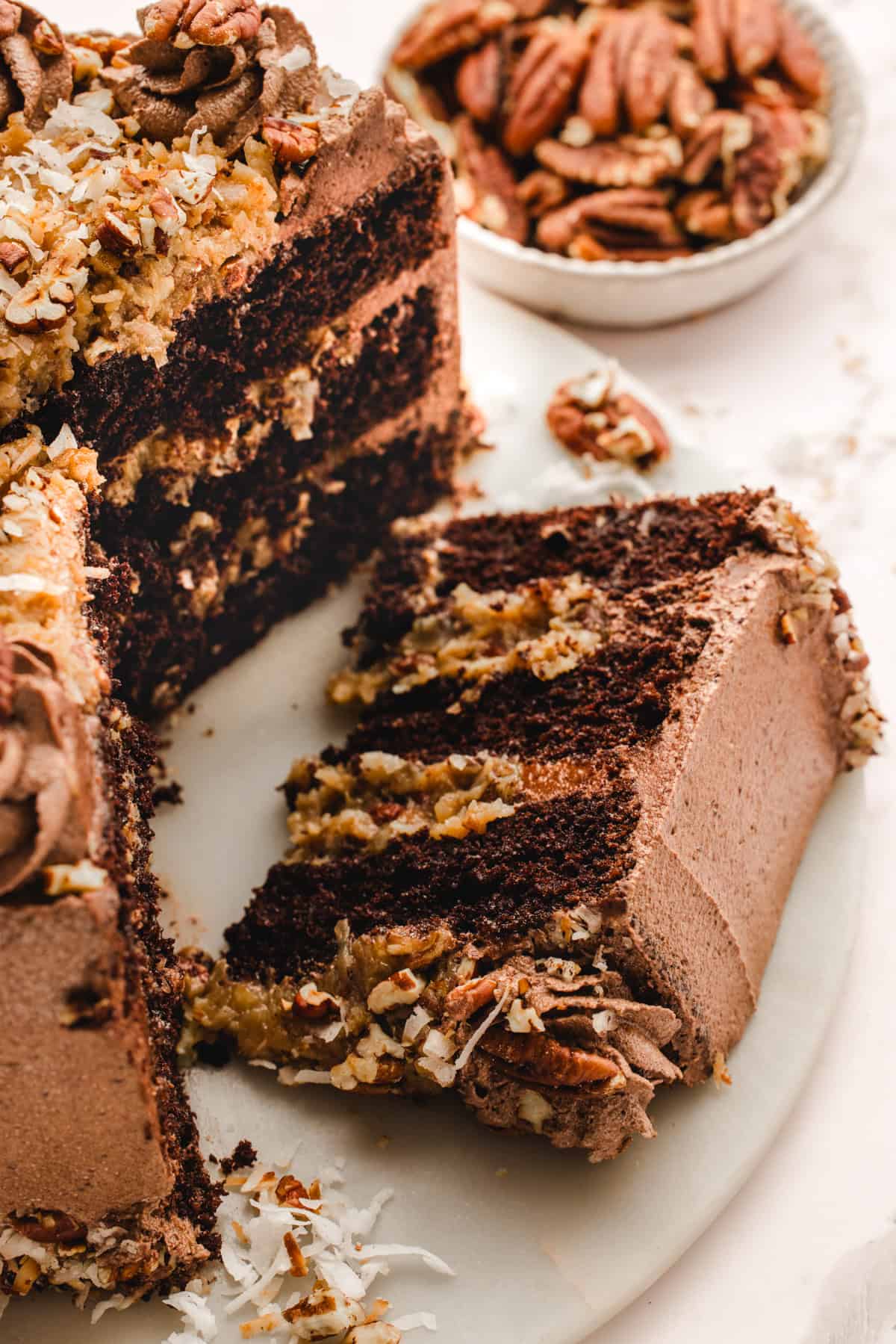
And to keep all of that soft filling in place, I pipe a thick buttercream dam around each layer. It helps support the cake and prevents the soft coconut pecan filling from squeezing out of the sides when you stack the cake.
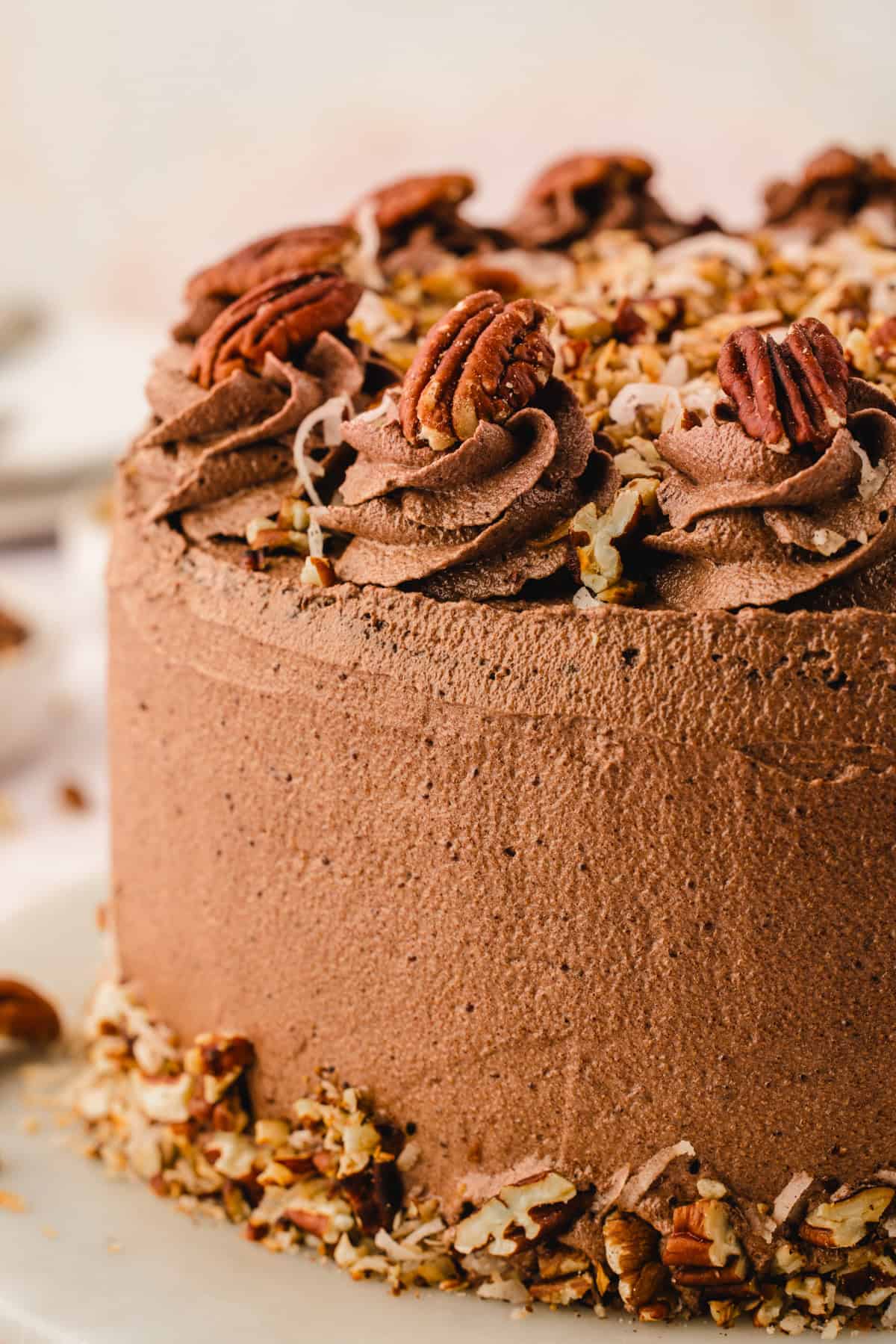
I've also always wanted a little more chocolate on the outside, so my version wraps everything in a rich chocolate buttercream. A traditional German chocolate cake leaves the sides bare (the so-called "naked" cake). I like to frost mine with chocolate buttercream. It holds the layers together, makes slicing cleaner, and adds even more chocolate. If you love a chocolate and cream combo, try my Black Forest cheesecake next. (It's always a hit!)
Note: I've included plenty of helpful tips below, before the recipe card , to help you make this cake successfully, and I encourage you to read them. But if you'd rather get straight to baking, feel free to jump to the fully printable recipe card and come back to the tips later!
Is German Chocolate Cake Actually German?
Nope! For years I assumed German chocolate cake came from Germany. It doesn't! It's as American as it gets, and it's named after a man called Sam German. Here's a little trip down history lane for you:
In 1852, an American baker named Samuel German created a sweet baking chocolate for the Baker's Chocolate Company. It was sold as "German's Sweet Chocolate." About a hundred years later, in 1957, a Dallas newspaper printed a reader's recipe for "German's Chocolate Cake" using that chocolate. It spread across the country fast. Over time, the apostrophe and the "s" disappeared, and "German chocolate cake" stuck. So the name comes from a person, not a country. Did you know that? I thought that was such a fun fact!
Today, the one thing every German chocolate cake shares is that coconut-pecan filling. The cake underneath varies a lot. Mine uses natural cocoa powder and coffee for a deeper chocolate layer than the original mild sweet-chocolate cake.
Key Ingredients
I encourage you to read this section for lots of helpful info, but feel free to jump to the fully printable recipe card instead.
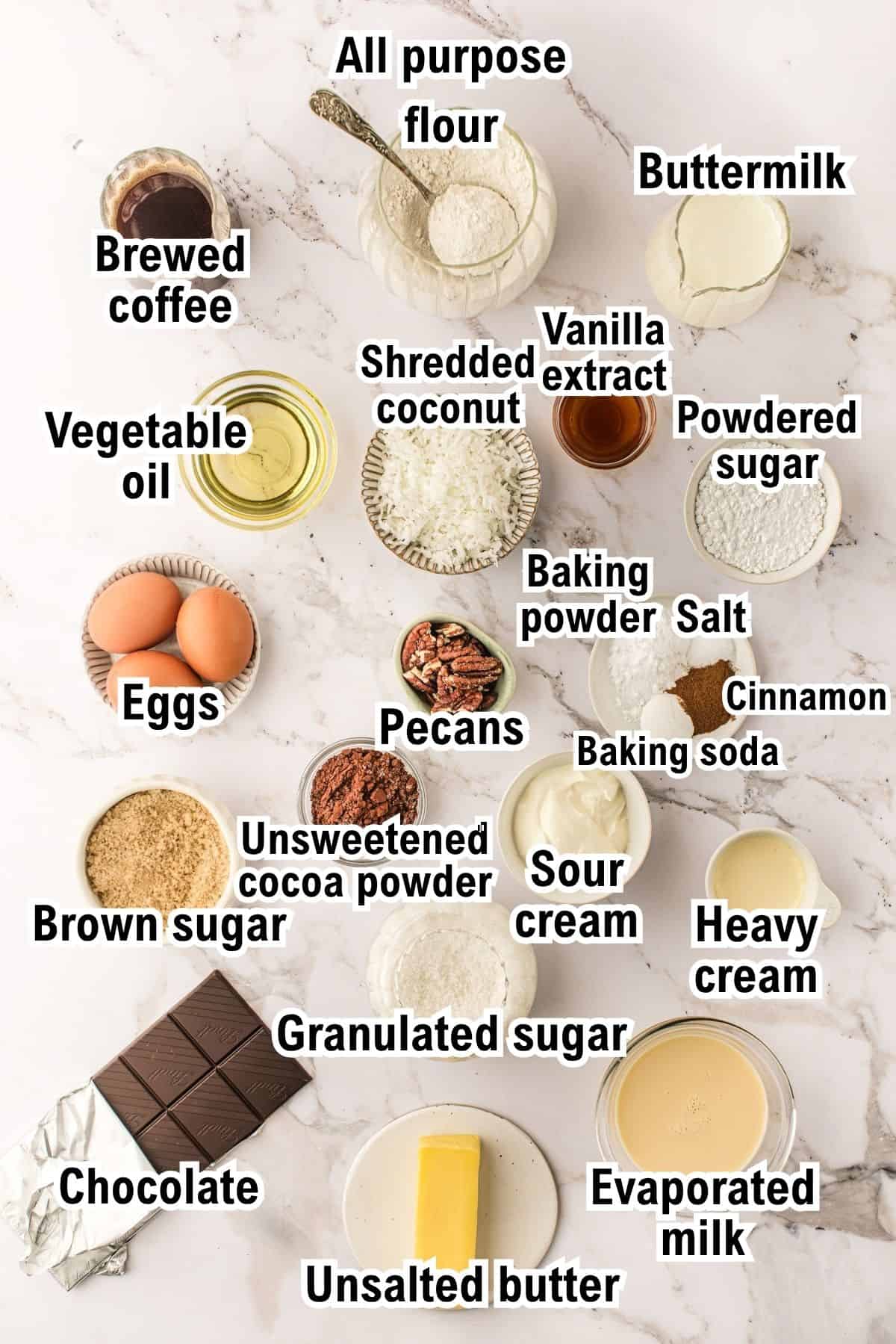
- Best cocoa for German chocolate cake: For the cake layers, I use natural unsweetened cocoa powder (like Hershey's or Ghirardelli natural). The baking soda needs the natural acidity in the cocoa to help the layers rise, so I don't recommend swapping in Dutch-process cocoa for the cake. For the buttercream, either natural or Dutch-process works fine.
- Room-temperature eggs, sour cream, and buttermilk: Room-temperature ingredients are important here, particularly because the cake contains melted butter. If the eggs, sour cream, or buttermilk are refrigerator-cold, they can cause the butter to firm up as soon as everything is combined.
- Hot coffee: The coffee is there to deepen the chocolate flavor rather than give the cake an obvious coffee taste. You can use hot water instead if you prefer.
- Evaporated milk and egg yolks: I cook these with butter and brown sugar to make the classic filling. The yolks thicken it gently, so keep the heat at medium. Don't use sweetened condensed milk here; it's much sweeter and won't thicken the same way.
- Pecans: I always toast the pecans before making the filling. Toasting brings out their buttery flavor and makes a noticeable difference against the sweet coconut pecan filling.
- Sweetened shredded coconut: I fold in 2 full cups for a filling that's chewy and loaded with coconut. Unsweetened shredded coconut works if you prefer a less sweet cake, but the filling will be a little drier.
- Dark or semisweet chocolate: I melt 4 ounces into the buttercream for a silkier, richer frosting. Use a good bar, not chocolate chips, since chips contain stabilizers that keep them from melting smoothly.
Tips for the Moist Chocolate Cake Layers
- Don't overmix: Once the flour goes into the batter, mix only until the ingredients come together.
- Expect a thin batter: The hot coffee is added at the end and will loosen the batter considerably. A thin batter is expected, so don't be tempted to add more flour.
- Weigh the batter: For even layers, I recommend weighing the finished batter and dividing it equally among the three pans.
- Check early: Start checking the cakes at the lower end of the baking time. A chocolate cake that is slightly underbaked rather than overbaked will stay much more moist.
Tips for the Coconut Pecan Filling
- Stir constantly: The coconut pecan filling needs constant stirring while it cooks.
- Keep the heat at medium: Don't turn up the heat to make the process faster. The yolks need time to thicken the mixture gently without scrambling.
- Don't judge it while hot: The filling thickens considerably as it cools. It should be completely cool before it goes anywhere near the cake.
- Save some for the top: Reserve the coconut pecan filling for the top before you begin filling the cake. This guarantees you have enough left to recreate the characteristic German chocolate topping.
Tips for the Chocolate Buttercream (Without Lumps)
- Match the temperatures: The melted chocolate needs to be cool enough that it won't melt the butter, but still fluid enough that it won't set into tiny pieces when it hits the buttercream. Aim for the melted chocolate and softened butter to be at roughly the same temperature.
- Don't cool the chocolate in the refrigerator: This can cause the chocolate around the edges of the bowl to begin setting before the center has cooled. Simply leave it at room temperature and stir it occasionally.
- Re-warm if it starts to set: If the melted chocolate has thickened noticeably or is beginning to set before you add it, warm it very briefly until fluid again, then allow it to return to room temperature. Never pour hot chocolate into the buttercream.
- Tiny chocolate flecks? If you notice a few tiny hard chocolate flecks right after adding the melted chocolate, stop before trying to warm the entire bowl. The flecks mean some of the chocolate has set on contact with the cooler butter. Keep making the buttercream first, because very small flecks may become virtually unnoticeable once the cocoa and powdered sugar are mixed in.
- Too soft or greasy? If the finished buttercream is too soft or looks slightly greasy, the butter has probably become too warm. Refrigerate the bowl for 10 to 15 minutes, then beat briefly on medium speed. Repeat the short chill if needed rather than using direct heat.
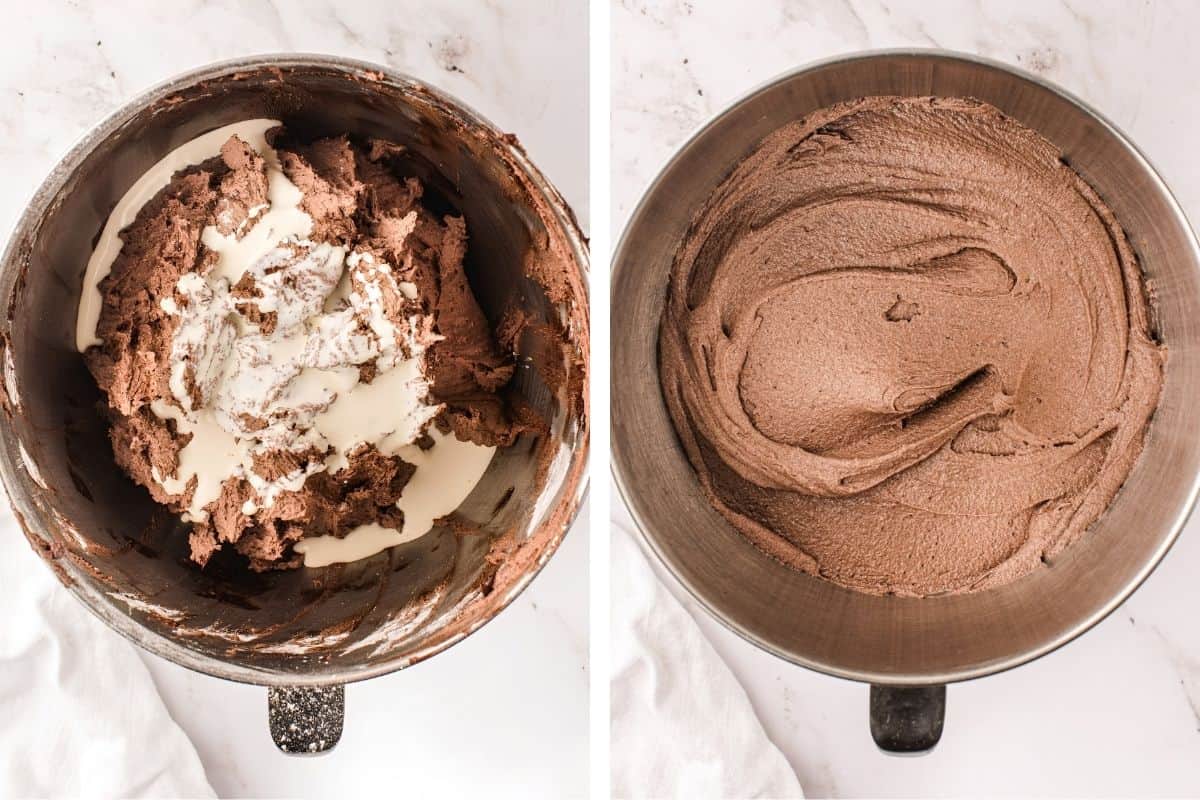
- Add the heavy cream slowly: You may not need the full amount, especially on a warm day. The finished buttercream should spread easily but still hold the ridges from a star piping tip.
Please note: There is a slight risk that adding melted chocolate to buttercream can cause the chocolate to seize. Getting it right comes down to technique and experience. I'm confident that if you follow the instructions exactly as written on the recipe card and review the step-by-step photos below the recipe card, you won't have any issues. However, if this is a cake for a very special occasion, you may prefer to play it safe and leave the melted chocolate out of the buttercream.
Assembling the Cake
- Cool everything completely: Make sure both the cakes and the coconut filling are completely cool before assembling.
- Pipe a buttercream dam: A thick buttercream dam around each filling layer helps support the cake and prevents the softer coconut pecan filling from squeezing out of the sides. Don't spread the filling higher than the dam. Refer to the step-by-step photos below the recipe card.
- Chill after the crumb coat: Once the cake is crumb coated, I recommend chilling it for 30 to 60 minutes. This makes applying the final swirled coat much easier and helps stabilize the filled layers.
FAQs
- Can I make German chocolate cake ahead of time? Yes! Bake the cake layers and make the coconut pecan filling up to 1 day ahead. Wrap the cooled layers and store them at room temperature, and keep the filling covered in the fridge. Let the filling sit out for about 30 minutes so it spreads easily. The fully assembled cake also keeps beautifully in the fridge overnight.
- Why is my coconut pecan filling runny? It usually means the filling didn't cook long enough. Keep stirring over medium heat until it noticeably thickens and coats the back of a spoon, about 10-12 minutes. It will thicken a lot more as it cools, so give it time before you assemble the cake.
- Can I bake this in two 9-inch pans? Yes. You'll get two thicker layers. Start checking for doneness at about 30 minutes, and bake until a toothpick comes out clean or with a few moist crumbs. Use all of the filling (except the ¾ cup for the top) between the two layers.
German Chocolate Cake (with Coconut Pecan Filling and Chocolate Buttercream)
Ingredients
Chocolate Cake
- 2 cups all-purpose flour
- ¾ cup unsweetened cocoa powder
- 1½ cups granulated sugar
- ¼ cup light brown sugar packed
- 2 teaspoons baking soda
- 1 teaspoon baking powder
- ¾ teaspoon fine sea salt
- 1 to 2 teaspoons espresso powder
- ½ teaspoon ground cinnamon
- ½ cup unsalted butter melted and slightly cooled
- ⅓ cup vegetable oil
- 3 large eggs room temperature
- ¾ cup sour cream full-fat, room temperature
- 2 teaspoons vanilla extract
- ¾ cup buttermilk room temperature
- ½ cup brewed coffee hot
Coconut Pecan Frosting
- 1 cup pecans chopped
- ½ cup unsalted butter
- 1 cup light brown sugar packed
- 3 large egg yolks
- 12 ounce evaporated milk 1 (12-ounce) can
- 1 teaspoon vanilla extract pure
- ¼ teaspoon fine sea salt
- 2 cups sweetened shredded coconut
Chocolate Buttercream
- 4 ounces dark chocolate or semisweet chocolate, finely chopped
- 1½ cups unsalted butter softened
- ¾ cup unsweetened cocoa powder
- 5 cups powdered sugar sifted
- 2 teaspoons vanilla extract
- ¼ teaspoon fine sea salt
- 4 tablespoons heavy cream room temperature
For Decorating
- finely chopped toasted pecans optional
- sweetened shredded coconut optional
Instructions
Make the Chocolate Cake
- Preheat the oven to 350°F (175°C). Grease three 8-inch round cake pans and line the bottoms with parchment paper.
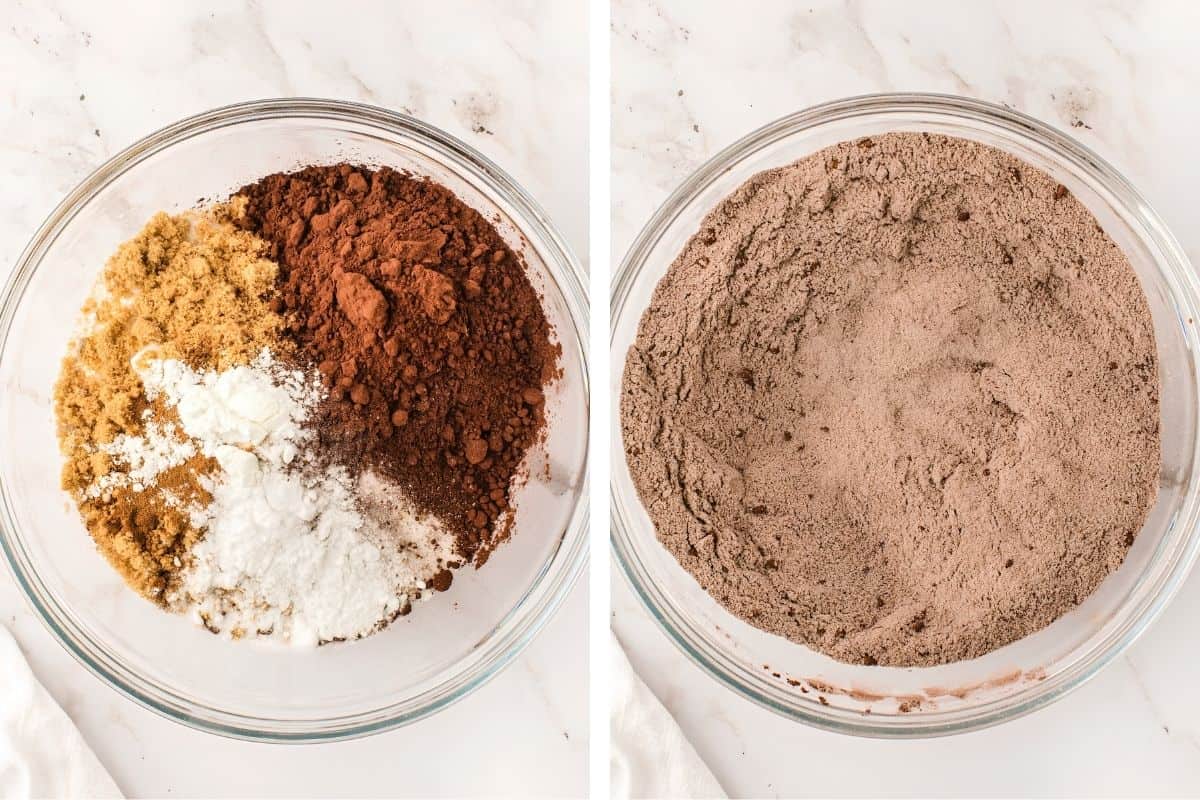
- In a large bowl, whisk together the flour, cocoa powder, granulated sugar, brown sugar, baking soda, baking powder, salt, espresso powder, and cinnamon.
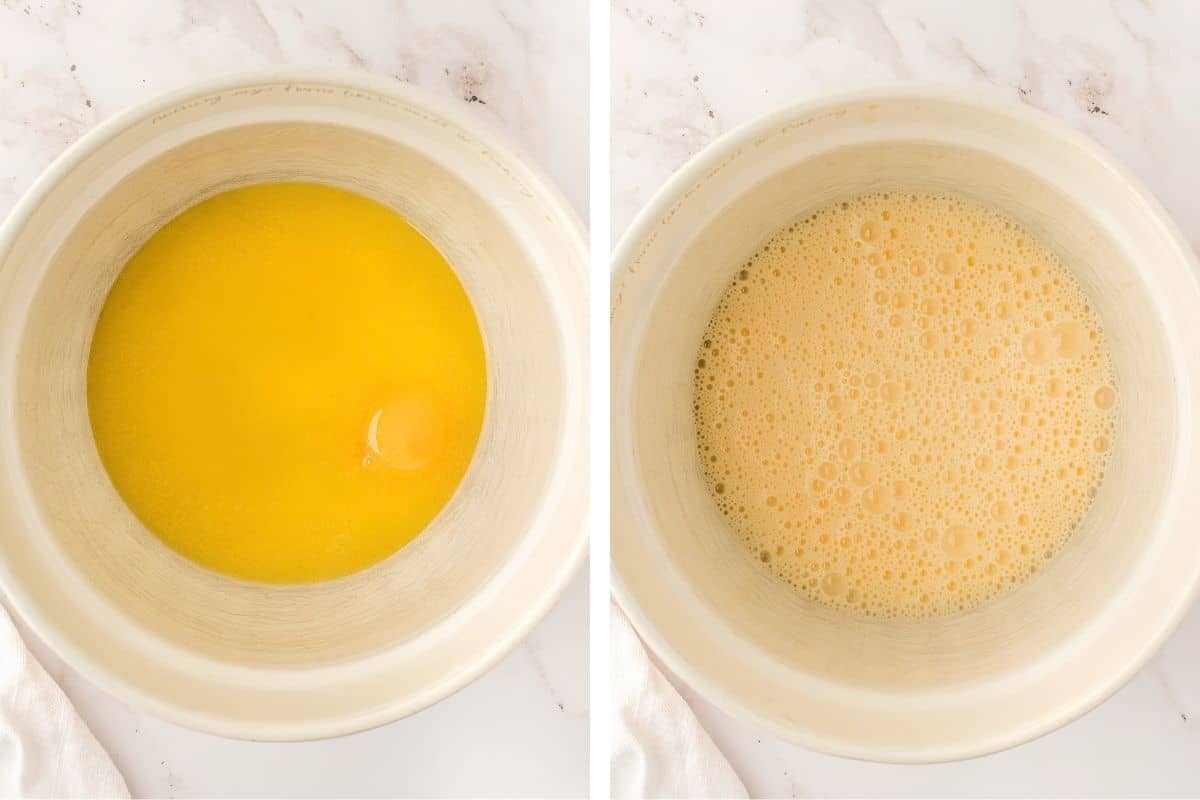
- In a separate large bowl, whisk together the melted butter and vegetable oil. Add the eggs one at a time, whisking well after each addition.
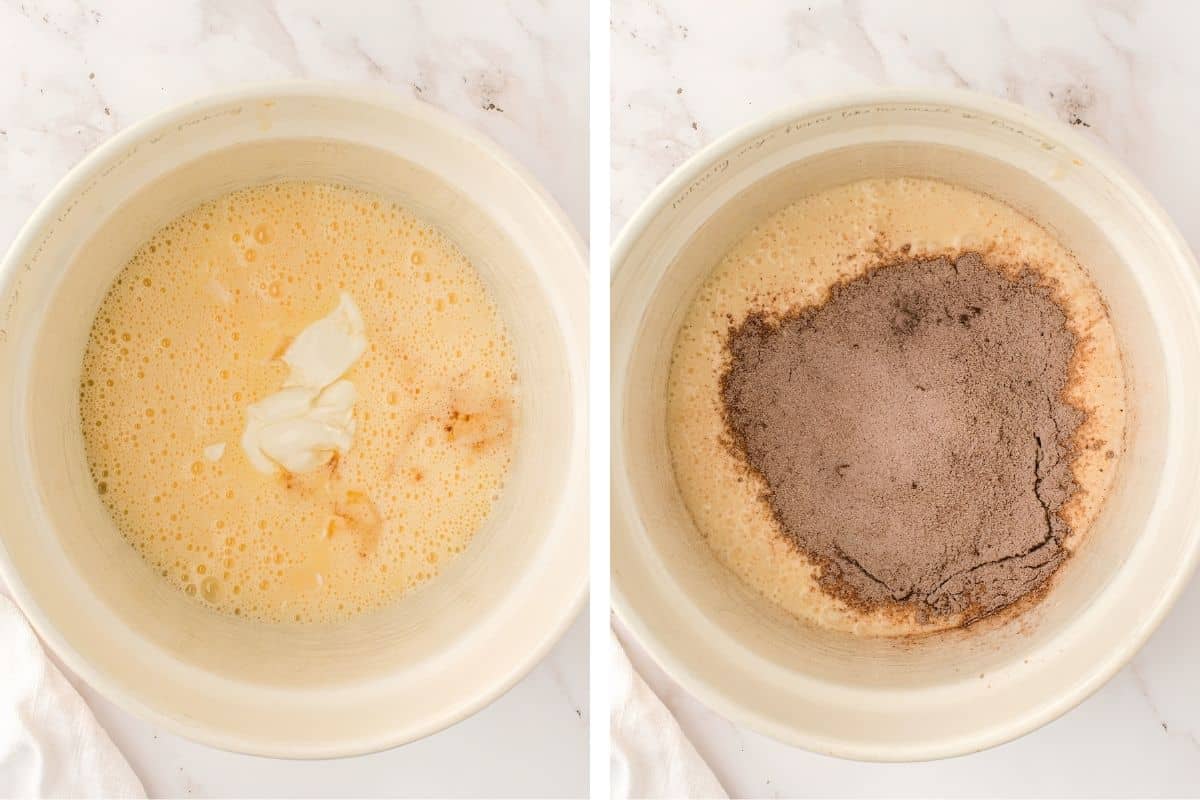
- Add the sour cream and vanilla and whisk until smooth.
- Add the dry ingredients in three additions, alternating with the buttermilk. Begin and end with the dry ingredients. Mix gently after each addition, just until combined.
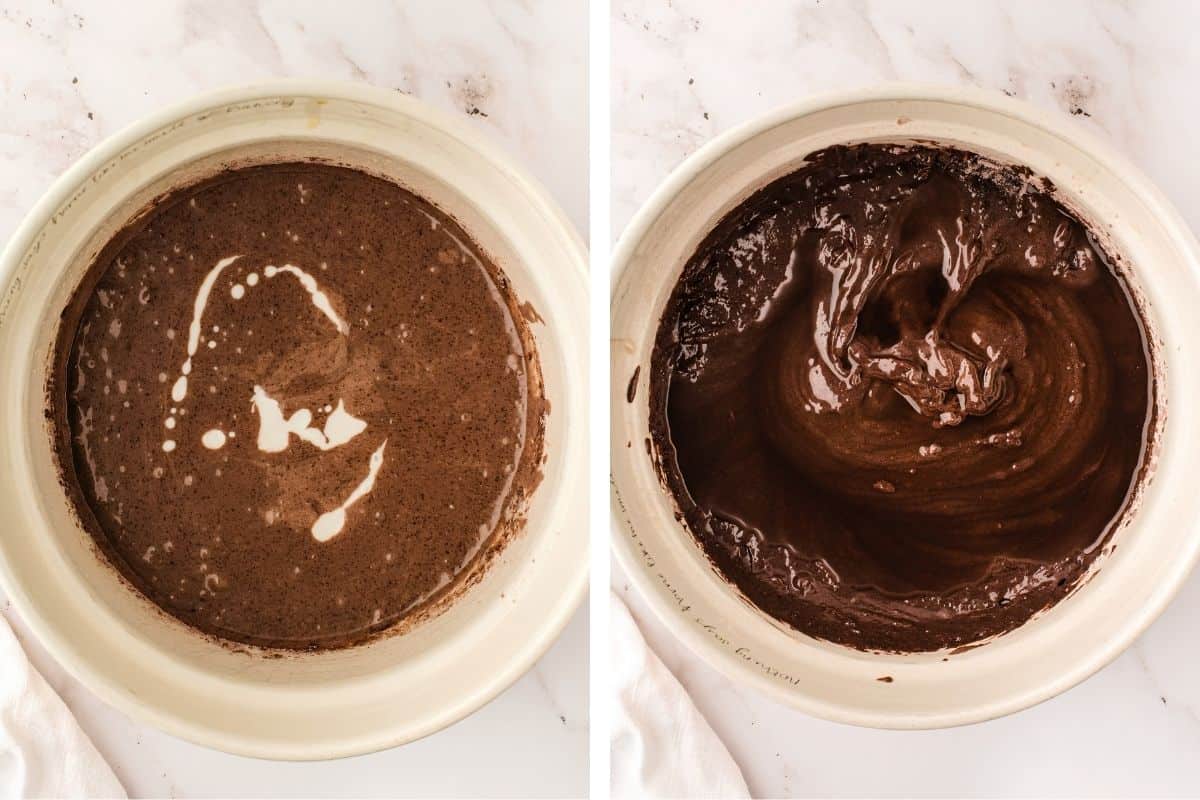
- Slowly pour in the hot coffee and stir until evenly incorporated. The batter will be quite thin. For even layers, I weigh the batter and divide it by 3, but you can eyeball it too.
- Divide the batter evenly between the prepared pans. Bake for 28 to 33 minutes, or until a toothpick inserted into the center comes out clean or with a few moist crumbs.
- Cool the cakes in the pans for 10 minutes, then turn them out onto wire racks. Remove the parchment and let the layers cool completely.
Make the Coconut Pecan Frosting
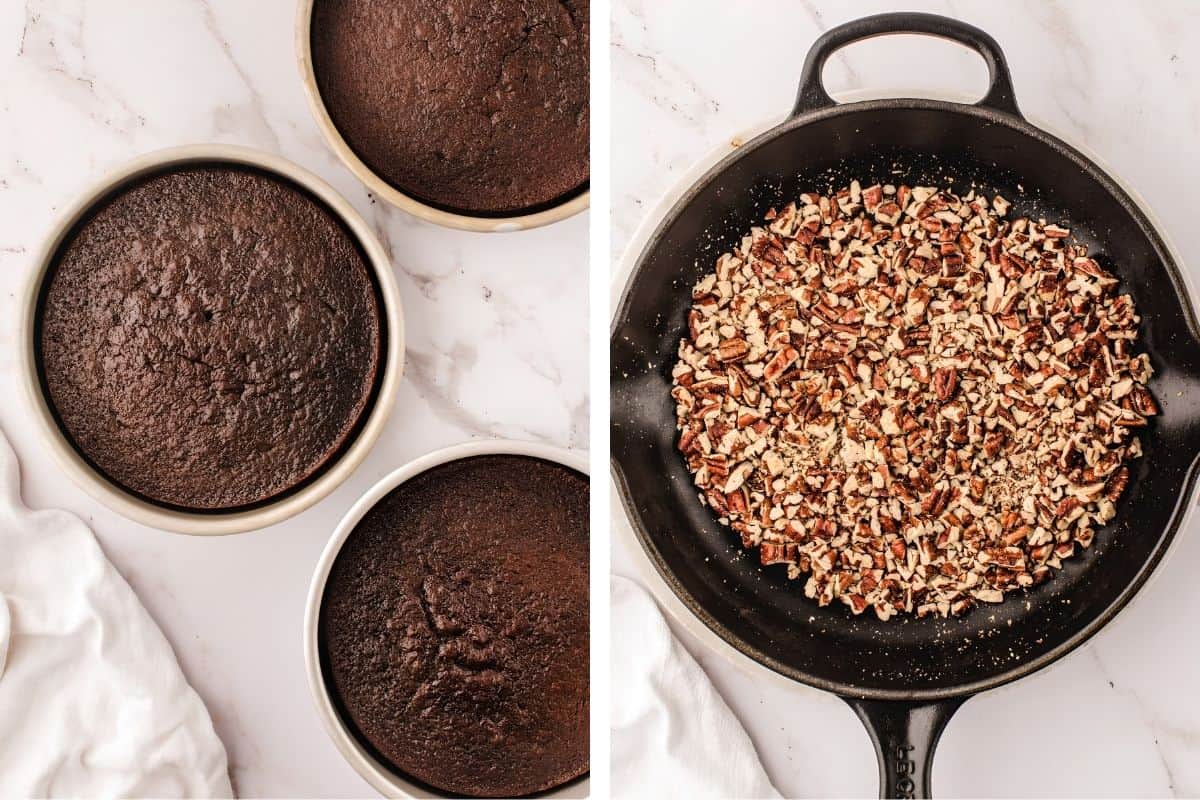
- Spread the pecans on a baking sheet and toast at 350°F (175°C) for 6 to 8 minutes, stirring once, until fragrant. Set aside to cool.
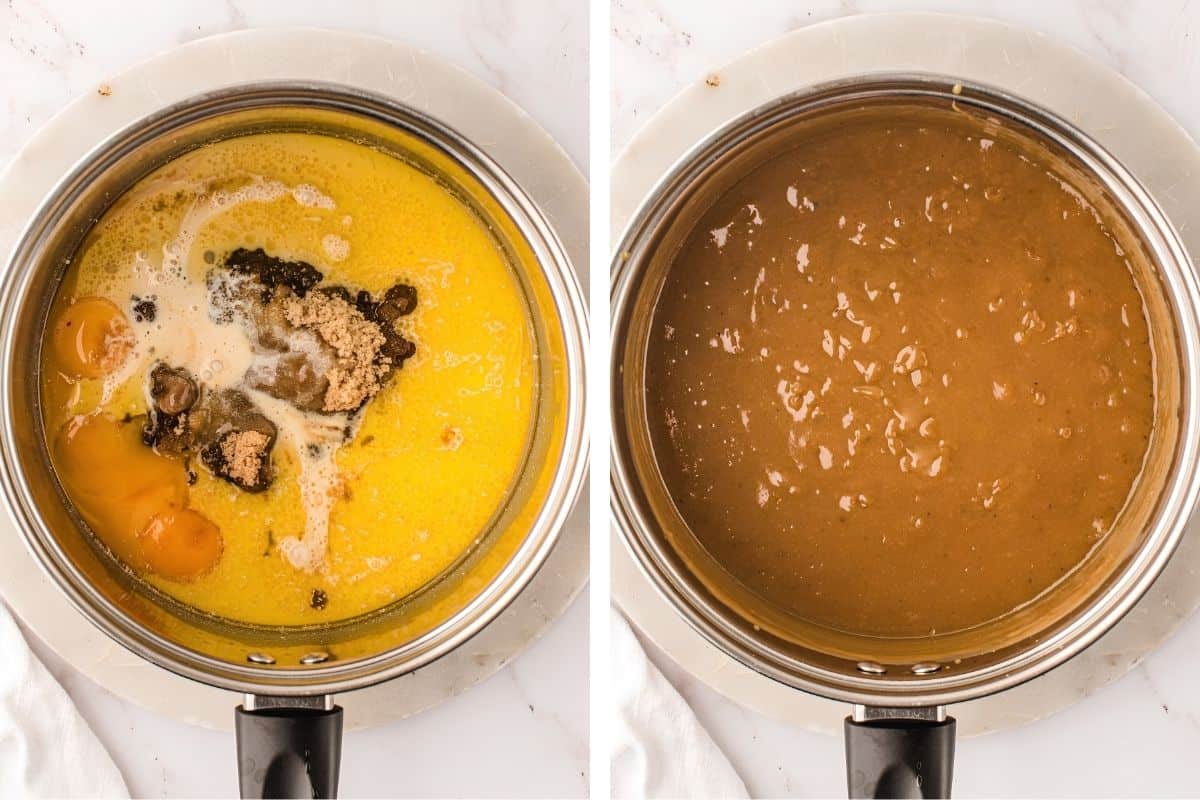
- Melt the butter in a medium saucepan over medium heat. Add the brown sugar, egg yolks, and evaporated milk and whisk until combined.
- Cook over medium heat for 10 to 12 minutes, stirring constantly and scraping the bottom and edges of the pan. It's ready when it has noticeably thickened and coats the back of a spoon.
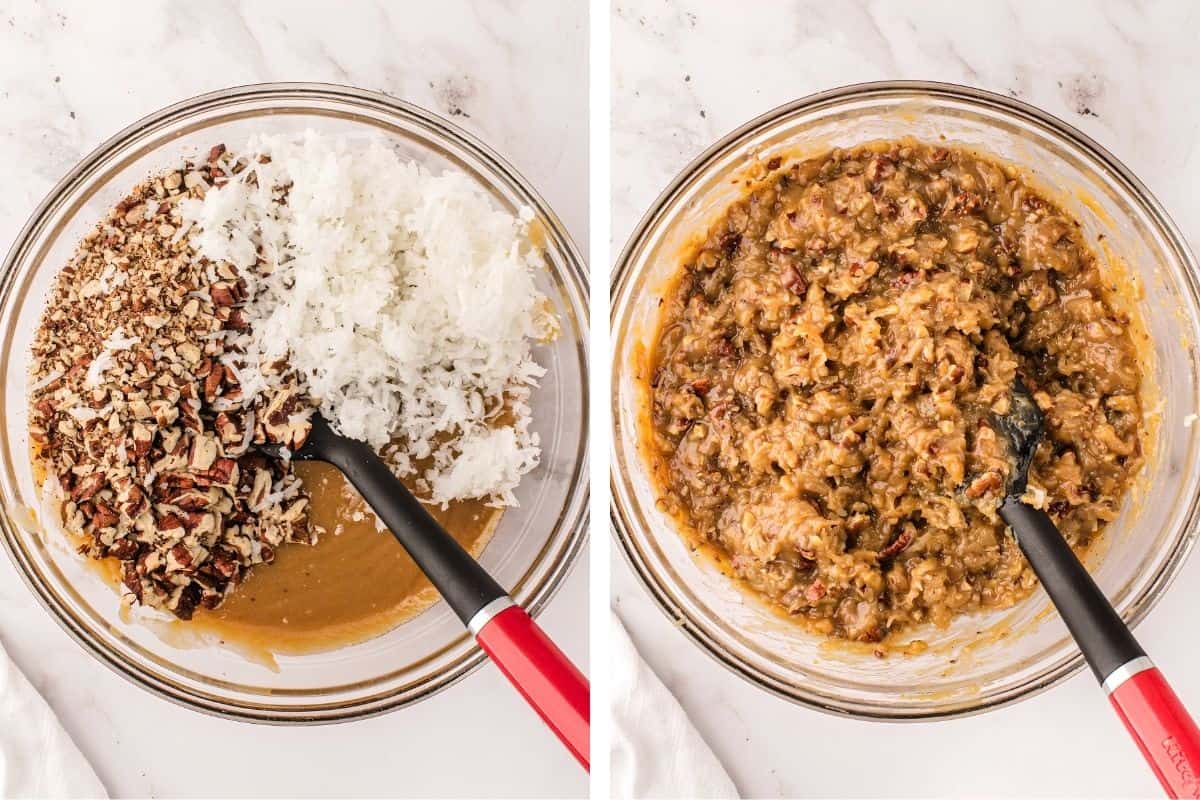
- Remove from the heat and stir in the vanilla and salt. Transfer to a bowl and fold in the coconut and toasted pecans.
- Cool completely before assembling. It will thicken a lot as it cools.
Make the Chocolate Buttercream
- Place the chopped chocolate in a clean, completely dry microwave-safe bowl. Microwave at 50% power in 15 to 20-second intervals, stirring well after each. Stop when a few small pieces remain and stir until they melt.
- Let the chocolate cool to about 85 to 90°F (29 to 32°C). It should feel neutral, not warm, but still be completely fluid. Do not refrigerate it to speed this up (see notes).
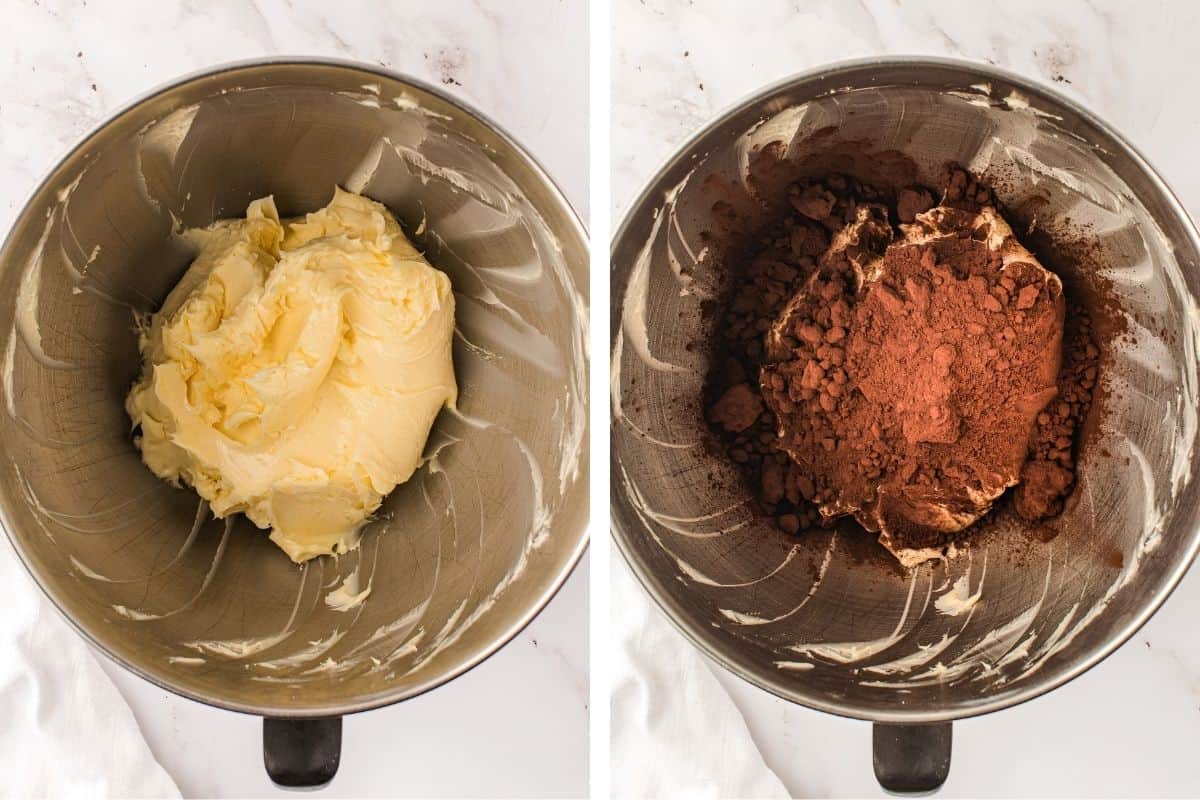
- Place the softened butter in the bowl of a stand mixer fitted with the paddle attachment. Beat on medium-high speed for 3 to 4 minutes, until pale, smooth, and fluffy.
- Add the cocoa powder and mix on low speed until incorporated. Increase to medium speed and beat until smooth, then scrape down the bowl.
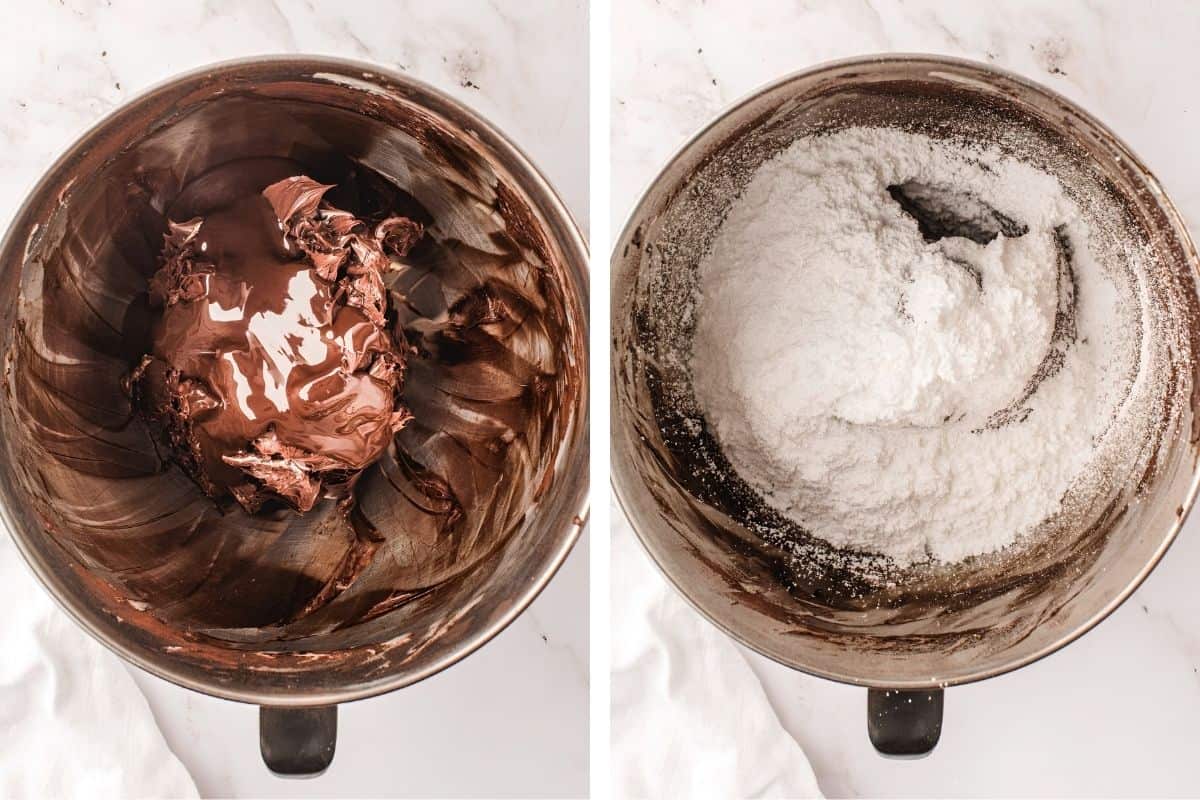
- With the mixer on low speed, pour in the melted chocolate in a slow, steady stream. Mix briefly on medium speed until smooth.
- Add the vanilla and salt and mix until combined.
- Add the powdered sugar in several additions, mixing on low speed and scraping down the bowl as needed.
- Add 2½ tablespoons of heavy cream and beat on medium speed until smooth and fluffy. Add more cream, 1 tablespoon at a time, until the buttercream spreads easily but still holds a piped swirl.
- Mix on low speed for 1 to 2 minutes to remove some of the larger air bubbles.
Assemble the Cake
- Level the cooled cake layers if needed.
- Set aside about ¾ cup of the coconut pecan frosting for the top of the cake.
- Place the first layer on a cake board or serving plate. Pipe a thick ring of buttercream around the outside edge.
- Spread half of the remaining coconut pecan frosting inside the ring.
- Add the second layer, pipe another ring, and spread the rest of the frosting inside.
- Add the final layer and check that the cake is straight and level.
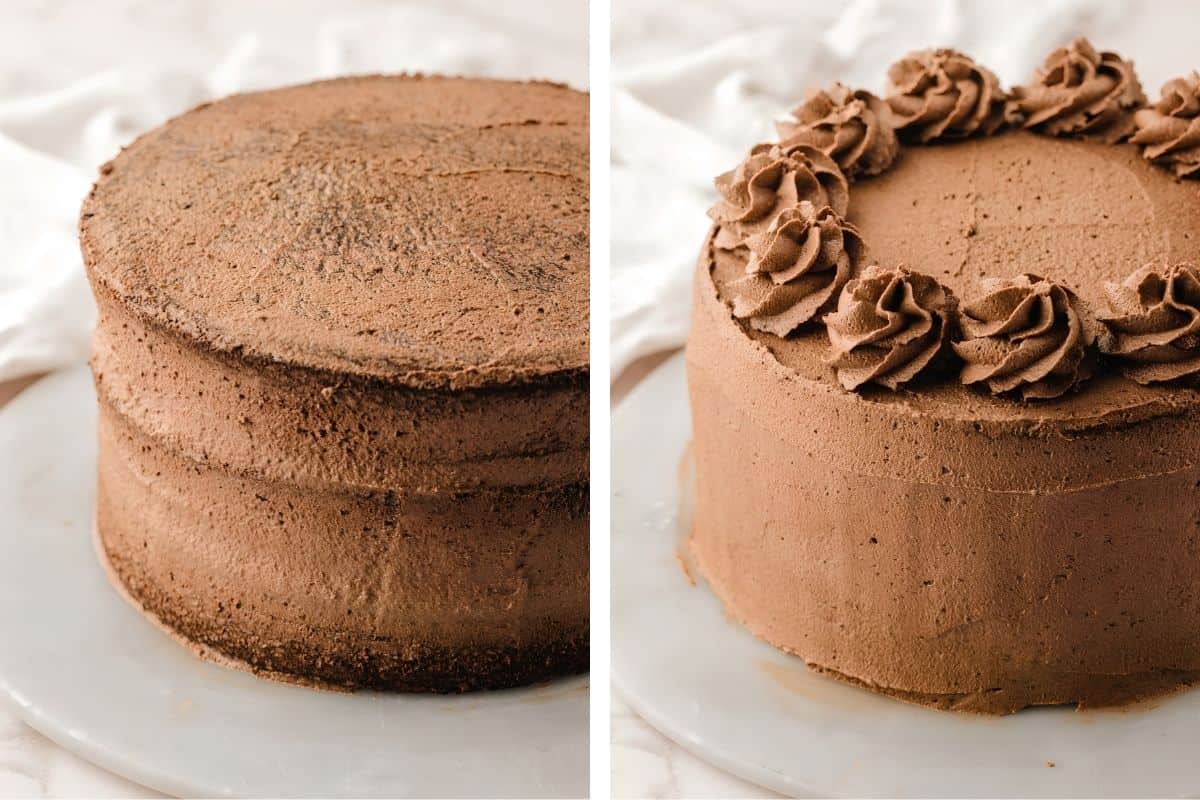
- Cover the cake with a thin crumb coat of buttercream. Refrigerate for 30 to 60 minutes, until firm.
- Frost the top and sides with the remaining buttercream, saving enough to fill a piping bag fitted with an open star tip (I used a Wilton 1M).
- Pipe swirls around the top edge of the cake.
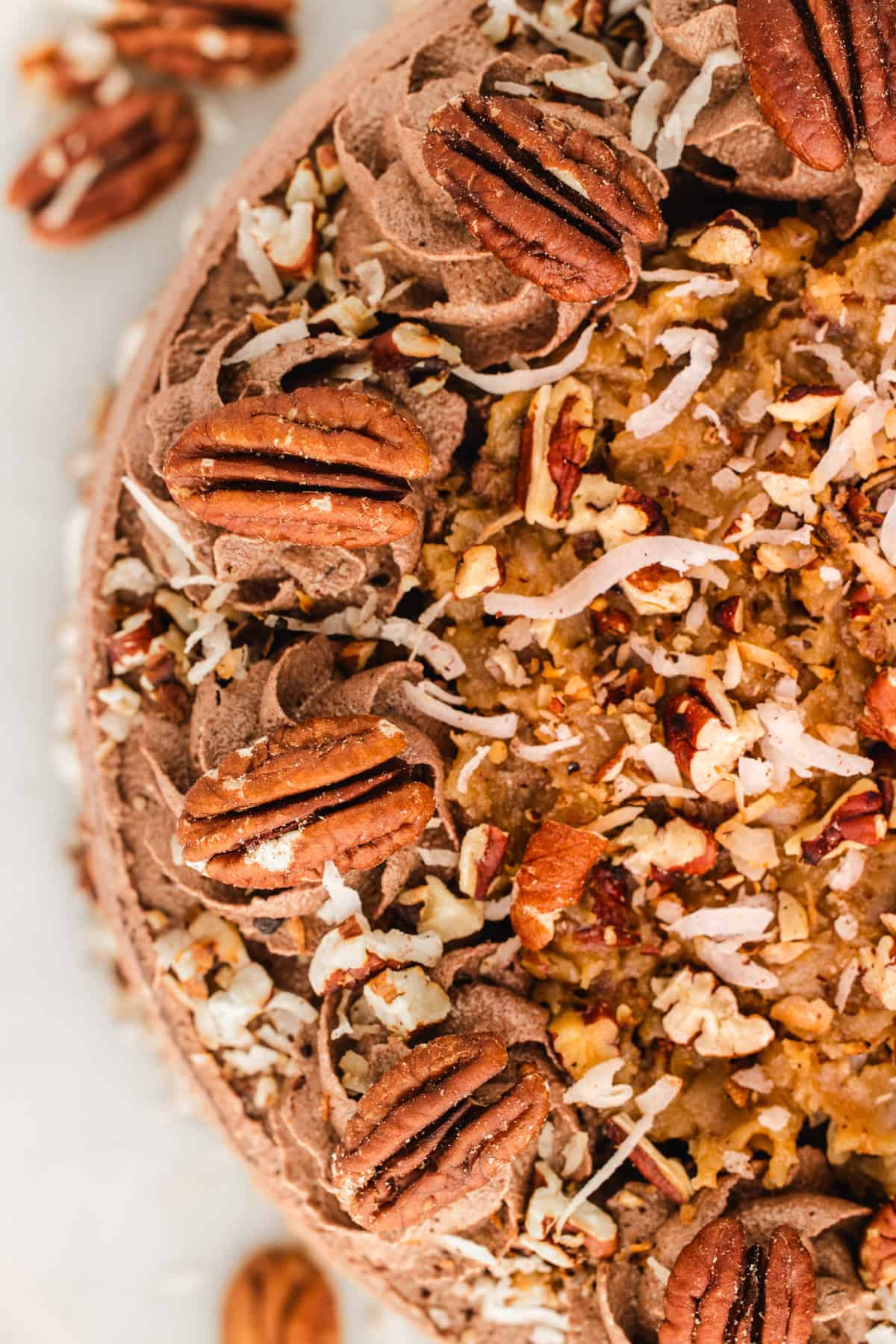
- Spoon the reserved coconut pecan frosting into the center and gently spread it toward the swirls.
- Sprinkle the swirls with toasted pecans and coconut, if desired. You can also press extra pecans and coconut around the bottom of the cake.
- Slice, serve, and enjoy!
Notes
- Cocoa: Use natural unsweetened cocoa in the cake. Dutch-process cocoa won't react the same way with the baking soda.
- Espresso powder: This is optional, but it makes the chocolate flavor deeper and richer. The cake won't taste like coffee.
- Coffee: Hot water works in place of the coffee. Either way, the liquid needs to be hot so the cocoa dissolves fully into the batter.
- Egg yolks: Whisking the yolks into the evaporated milk before they go into the hot butter helps keep them from cooking into little bits. Keep stirring the whole time the filling cooks, and scrape the corners of the pan so nothing scorches.
- Cooling the chocolate: If the chocolate is too warm, it will melt the butter, and the buttercream turns soupy. Don't refrigerate the melted chocolate. It sets unevenly around the edges and leaves small lumps in the buttercream. Letting it cool at room temperature gives you the smoothest buttercream.
- Melted chocolate: If you'd rather skip it, leave the melted chocolate out of the buttercream. The cocoa buttercream still works beautifully.
- Thin batter: The batter is supposed to be thin after the coffee goes in. Don't add more flour.
- Butter shopping list: You'll need 2½ cups (5 sticks) of unsalted butter total.
- Special Tools: Three 8-inch round cake pans | Stand mixer with paddle attachment | Medium saucepan | Piping bag with an open star tip (Wilton 1M) | Cake board or serving plate | Baking sheet | Medium saucepan | Parchment paper | Offset spatula | Cake board or Serving plate
Storage, Freezing, and Make-Ahead
- Fridge: Store the finished cake covered in the refrigerator for up to 4 days. For the best texture, remove the cake from the refrigerator 30 to 60 minutes before serving so the cake and buttercream have time to soften.
- Freezer: For longer storage, the unfrosted cake layers freeze particularly well. Wrap each layer tightly in plastic wrap and freeze for up to 2 months. Thaw overnight in the refrigerator before assembling.
- The cake layers can be prepared a day ahead. Once completely cool, wrap them tightly in plastic wrap and keep them at room temperature overnight or refrigerate for up to 2 days.
- The coconut pecan filling can also be made ahead and refrigerated in an airtight container for up to 2 days. Let it return to a soft, spreadable consistency at room temperature before assembling the cake.
Nutrition
Nutrition Disclaimer:
The nutritional information on this website is only an estimate and is provided for convenience and as a courtesy only. The accuracy of the nutritional information for any recipe on this site is not guaranteed. It should not be used as a substitute for a professional nutritionist's advice.
How to Make German Chocolate Cake (Step-by-Step Photos)
This is a recipe overview. Scroll down to find the complete instructions + ingredient amounts in the recipe card above.
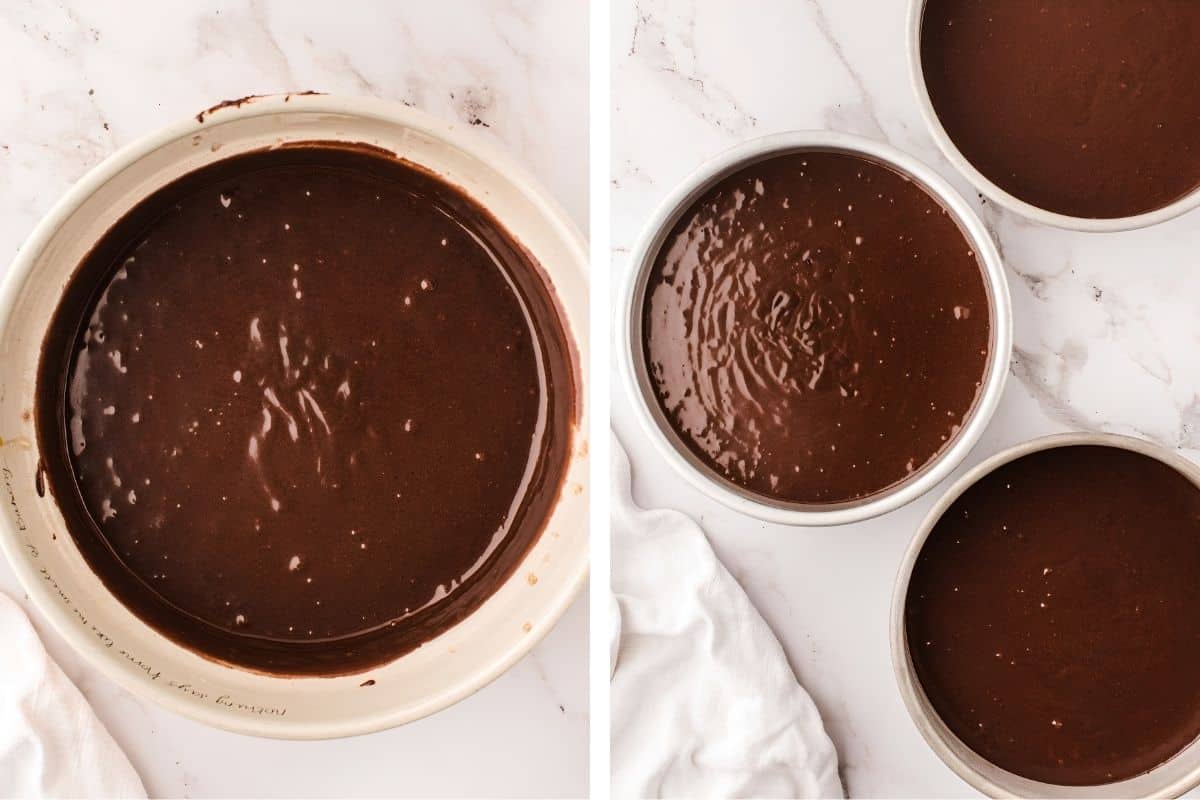
- Make the cake batter. Whisk the dry ingredients in one bowl and the wet ingredients in another. Combine them, then stir in the hot coffee. The batter will be very thin. That's normal!
- Bake the layers. I weigh the batter and divide it evenly between three 8-inch pans so the layers match. Bake at 350°F (175°C) for 28 to 33 minutes.
- Cook the coconut pecan frosting. Stir it constantly over medium heat for 10 to 12 minutes, until it coats the back of a spoon. It thickens a lot as it cools.
- Make the chocolate buttercream. Let the melted chocolate cool to 85 to 90°F (29 to 32°C) before adding it to the butter. If it's too warm, the buttercream turns soupy.
- Assemble. Pipe a ring of buttercream around each layer, fill the center with coconut pecan frosting, and stack. Add a thin crumb coat around and on top of the cake, and chill.
- Decorate. Frost the cake, pipe swirls around the top edge, and fill the center on top with the reserved coconut-pecan frosting. And that's it! Ready to slice!
Serve this German chocolate cake at room temperature so the buttercream is soft and the layers are tender. It's the perfect birthday cake, and it looks right at home on a holiday dessert table next to my Classic Pecan Pie. If you're feeding a big group of chocolate lovers, round things out with my Black Forest Cheesecake or a Chocolate Chip Bundt Cake. And if you have extra pecans left over, bake a batch of my Classic Blondies with toasted pecans. Enjoy! Julia.❤️
Submit your question or provide a review of the recipe + star rating RIGHT HERE.