
This post may contain affiliate links. Read my disclosure policy.
There are many bread machine recipes out there, but if you're looking for just basic and simple homemade white bread - this is the perfect recipe for you!
This is my reliable, "boring", proven recipe for a basic white bread. And, I also provide tips on how to make a homemade white bread less dense in a bread maker. In this recipe, all you do is spend 5 minutes to add ingredients to the bread pan and the bread machine does all the work, on an automatic cycle that is already programmed. That's the whole purpose of the bread maker, right? The end result is a tasty loaf of white bread just of the right density.
I do believe that the day will come when I will use a bread machine for something more sophisticated, but for once this week I am sharing the recipe that doesn't require too much thinking or meddling. Sometimes it's just nice to make certain foods almost on auto-pilot, especially for basic stuff, like white bread.
In the last 3 months I hardly bought any store-made bread, baking about a loaf every week at home, using bread machine recipes. And, I've noticed a couple of trends/issues when making bread: sometimes the bread comes out way too dense, or the loaf does not rise enough and, as a result, comes out even denser. So, here I will describe the homemade bread recipe that works for me to produce a less dense bread in a bread maker, using a basic cycle.
While making bread in a bread machine, make sure to consider these points:
- When you measure flour using cups, make sure not to pack flour too dense in a measuring cup, otherwise you will end up with much more flour than you need, and, therefore, the bread will come out denser. Measuring flour correctly will solve a lot of "dense" issues. The trick that works for me is that I use ⅓ measuring cup to carefully scoop all flour I need into the bread machine (usually about 3 cups), without over-packing it. Another way would be to weigh flour, which I don't do, but it's a solution.
- Use bread flour, not regular all-purpose flour for all bread machine recipes. Bread flour contains a higher percentage of gluten than regular all-purpose flour. Using bread flour will produce taller, less dense loaves. If you use all-purpose flour (which has smaller percentage of gluten than bread flour), your loaves will be flatter and denser.
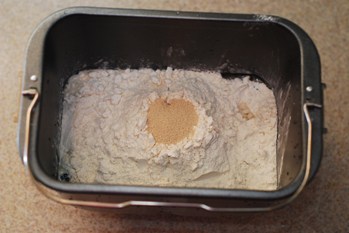
- When adding yeast, make sure you add it last, and add it on top of dry ingredients (flour). Make sure the yeast does not reach wet ingredients. Basically, make a small indentation on top of flour and add the yeast to the indentation, just like this:
And here is the simple white bread recipe. I started with the recipe that came in a little booklet together with my Williams-Sonoma bread machine, and I tweaked the ingredient measurements based on my preferences. It takes 10 minutes to prepare all ingredients together, and then it takes 3 hours and 15 minutes to bake the bread in a bread machine.
Bread Machine Recipe: How to make homemade white bread less dense
Ingredients
- 1 cup and 3 tablespoons water
- 2 tablespoons vegetable oil
- 1 ½ teaspoons salt
- 2 tablespoons sugar
- 3 ¼ cups white bread flour
- 2 teaspoons active dry yeast
Instructions
Important note about properly measuring flour using measuring cups:
- The proper way to measure flour using measuring cups is to aerate it first. This is done either by sifting flour, or aerating it by fluffing it up and whisking it well, then spooning it into the measuring cup, then carefully removing any excess flour with a knife. If you just stick that measuring cup in the bag of flour and scoop some out, you will get a lot more flour than what the recipe calls for. Do aerate the flour, or you will end up with dry dough!
How to make bread in a bread machine:
- Add water and oil into the bread pan. Add salt, sugar. Add flour.
- Make a small indentation on top of flour and make sure it does not reach wet ingredients. Add the yeast to the indentation.
- Keep yeast away from the salt.
- Insert the bread pan into the bread machine, press it down to snap. Close the lid.
- Use Basic bread, 1.5 lb loaf, medium crust cycle (3 hrs 15 minutes)
- When bread is done, remove the bread pan using oven mitts. Turn over the bread pan and shake it to release the loaf. Let the loaf cool on a wire rack for about 30 minutes.
Notes
- The recipe is adapted from Williams-Sonoma bread machine booklet.
- I have recently tweaked this recipe and made a delicious rustic Bread Machine Garlic & Herb Bread (with fresh rosemary and thyme) - worth checking out!
My Other Bread Recipes
Nutrition
Nutrition Disclaimer:
The nutritional information on this website is only an estimate and is provided for convenience and as a courtesy only. The accuracy of the nutritional information for any recipe on this site is not guaranteed. It should not be used as a substitute for a professional nutritionist's advice.

I made this yesterday. This is the easiest and most delicious bread recipe I have used for my bread machine so far!
Hi Karla! Thank you for taking the time to share this positive feedback - I really appreciate it! 🙂
Hi there. I am just about to cook this recipe. I’ve already put all the ingredients in the pan but I have just figured out that the metric conversions are not correct to that of your US measurements. For example, 1 cup does not equal 236g. It’s 250g. So now I’m just trying to figure out how to fix this.
According to Google, the weight of 1 cup of water is 236 grams. Since it's a weight measurement, "1 cup" isn't always going to weight the same depending on what ingredient you are weighing.
Thanks for chiming in, Leanne, and for clearing this confusion! 🙂
Hi! Just to clarify—are you measuring liquids or dry ingredients? Cups measure volume, not weight, so the gram equivalent depends on the ingredient. A US cup is 236 ml, which is why 1 cup of water ≈ 236 g. The 250 g conversion comes from a metric cup (250 ml), which is different from US measurements. Dry ingredients vary even more because of density (for example, flour, sugar, and cheese all weigh very differently per cup). So the conversion isn’t wrong - it’s a US-vs-metric difference. If you tell me which ingredient you’re worried about, I can help you adjust it.
Possibly the best bread that has come out of my machine. Fluffy, wonderful flavor. I thought it was going to burst out of the machine. Makes a big loaf. Awesome.
Ahh this made me smile, Marlene!! So glad it turned out so fluffy and full of flavor - and haha yes, it really does rise like crazy! Love that it’s a new favorite!! ❤️
Do you use warm water
Donna, for this bread recipe, use warm water — not cold, not hot.
Warm water (about 105–115°F / 40–46°C) helps the yeast wake up and start working right away. If the water is too cold, the yeast will be sluggish and your bread can turn out dense. If it’s too hot, you can kill the yeast.
Hello, Again, Julia. The loaves are so perfect I have been giving them as Xmas gifts! Have another question. Can fresh unsalted butter be used instead of oil!
Absolutely — you can use fresh unsalted butter instead of oil!
A couple of things to keep in mind:
1) Keep the amount about the same. Use the same weight/volume called for in oil.
2) Just make sure the butter is softened or melted and slightly cooled so it mixes smoothly with the other ingredients in the bread machine. Happy baking!
Thank you! This is a great recipe but also the perfect amount of backstory. I hate hearing about a trip to Tuscany or some such nonsense when I just want the ideas and thoughts about how to make a thing.
Hi Chris, your comment made me laugh! 🙂 I firmly believe bread doesn’t care where I vacationed, it just wants the right ratios and a hot oven. I’m glad the recipe (and the no-nonsense approach) worked for you. Happy baking! 🙂
I use this recipe a lot and I like it. I would like to know the quantities for 1lb and for 1.5 lb and for 2 lb loaves. Can you create variations for that please? Thanks!
I'm glad you like it, Rob! This recipe is for 1.5 lb loaf. If you want to make a 2 lb loaf, make sure your bread pan can accomodate that size and use the appropriate 2 lb bread cycle. For the ingredients amount, I just multiplied the original recipe x 1.333 (because 2 ÷ 1.5 = 1.333)
Here are the 2-lb loaf measurements:
Water: 1⅔ cups
Vegetable oil: 2⅔ tablespoons
Salt: 2 teaspoons
Sugar: 2⅔ tablespoons
White bread flour: 4⅓ cups
Active dry yeast: 2½–2¾ teaspoons
For 2-lb loaf, cook for about 3 hours 50 minutes or 4 hours on the same “Basic / 2 lb loaf / medium crust” setting.
Hey there! Which bread machine do you use or recommend for a good basic bread like this?
Hi Gen, Zojirushi is the best bread-maker you can buy, head and shoulders above the rest—truly top-tier if you're planning to bake a lot, but it's expensive, it's also quite large and heavy (24 lb) so it might occupy more space in your kitchen that you would've liked. It’s more machine than most people will ever need. It's a better choice for more advanced bread-makers:
https://www.williams-sonoma.com/products/zojirushi-home-bakery-virtuoso-plus-breadkmaker/
A cheaper but still a really good choice is Cuisinart with 2 lb loaf capacity (the machine is nice small size, weighs about 9 lb):
https://www.williams-sonoma.com/products/cuisinart-bread-maker/
For under $100 you can buy Hamilton Beach Breadmaker (it's small size, bakes 2 lb loaves). It's very well-reviewed, a very popular choice, and is more than enough for simple recipes:
Hamilton Beach Bread Maker
Another great option is this Hamilton Beach Artisan Bread Maker (2 lb loaf capacity), small size, lighter weight - great for beginners:
https://www.amazon.com/Hamilton-Beach-Gluten-Free-Stainless-29987/dp/B0CKWL77CW/?th=1
OMG! Followed the recipe exactly as directed. What a beautiful and tasty loaf of bread. It looked store purchased without all the preservatives. Have been trying to make a perfect loaf of white bread for sometime so many thanks. BTW. What is the best way to store bread?
Thank you, Barbara, for your wonderful review!! ❤️❤️.
Here are my storage tips:
1) Once the bread has cooled completely on a wire rack (to prevent sogginess), wrap it tightly in plastic wrap or place it in a well‐sealed plastic bag, removing as much air as possible. Store it at room temperature in a cool, dry spot—ideally consumed within 2–3 days for optimal texture and flavor.
2) If you won’t eat it that fast, slice the loaf, freeze the slices in a single layer on a baking sheet, then transfer them to a freezer bag; when you’re ready, pop a slice into the toaster or oven to revive the crumb and crust.
Do you not need to activate the yeast by adding it to warm water first?
Lea, no, you do not need to activate the yeast in warm water. In fact, when adding yeast, make sure it doesn't touch any water (just as shown in th pics!)
I made this recipe a week ago and added chia, flax, and poppyseeds. It was so good! My daughter said it was my best loaf yet. I will definitely be trying the cinnamon raisin you suggested above. Thank you!
That sounds amazing with all those seeds mixed in, Stephanie! 🙂 Love that your daughter declared it your best loaf yet. 🙂 Hope you love the cinnamon raisin version just as much!
How much chia, flax, and poppy seeds?
HI Carol! You can add about 1 to 2 tablespoons total of seeds (chia, flax, poppy - whatever combo you like). Just mix them in with the flour at the beginning so they blend evenly into the dough. If you’re using chia or flax, they might absorb a bit of liquid, so you can add an extra splash of water or milk if the dough looks dry. Happy baking!
I tried this recipe for your fluffy bread and it worked out perfectly! Thank you for sharing this recipe and if you by chance have any other bread machine recipes, I would love them! Thank you!
Hi Lorrie!! I am so glad you enjoyed this. I have 2 more bread machine recipes coming to my site soon. I will link them up in this post.
For now, Here are some other easy variations that you can do using this recipe:
➡️ 1) Cinnamon raisin bread. Add about 3/4 cup raisins (even pre-plumped ones) and 1 teaspoon cinnamon to the flour (dry mixture). And proceed with the recipe as is.
➡️ 2) Cheese bread. If adding cheese, I would use about 1 cup of shredded cheese (Parmesan or Asiago) and add it with the DRY INGREDIENTS (bread flour). Add the bread machine yeast last. The yeast should not touch the liquid ingredients.
➡️ 3) Bread with herbs. Another variation is to add about 1 tablespoon of Rosemary and 1/2 teaspoon of Italian seasoning (or some other combination of dry herbs, such as thyme) to the flour mixture.
➡️ 4) Garlic bread. Add the crushed or minced garlic (about 2 or 3 tablespoons) together with the LIQUID INGREDIENTS, then add dry ingredients (just like the recipe states), then add the yeast last (making sure the yeast is not touching the liquid ingredients).
I made this recipe a week ago and added chia, flax, and poppyseeds. It was so good! My daughter said it was my best loaf yet. I will definitely be trying the cinnamon raisin you suggested above. Thank you!
And, thank you for your wonderful 5-star review! 🙂
I made this with the fresh garlic and rosemary from my garden this weekend and it baked beautifully in my bread machine. It was very light and my house smelled amazing.
That sounds amazing with fresh garlic and rosemary! So glad you enjoyed it!! 🙂
Amazing bread recipe! Turns out great every time. Thank you so much for sharing! Just wondering, could I substitute a gluten-free bread flour to this recipe, or wheat bread flour and add seeds?
Thank you, Jessica! I've never tried this recipe with gluten-free bread flour and I would be imagine the recipe would have to be quite different.
Turned out dense and too salty.
Sorry to hear about that, Sarah! Let me know if you have any questions!
I liked the texture and the taste but I found it too salty. Next time I’ll cut the salt by half.
Great plan! And glad you liked the texture - that's the most important thing!!
fabulous fabulous bread machine recipe. thank you for sharing.
aww, thank you, Molly! ❤️