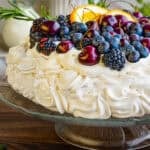
Summer Berry Pavlova with Cherries
This summer berry pavlova has a crisp meringue shell with a marshmallow-soft center, piped rosettes around the rim, and a topping of whipped cream with blueberries, blackberries, and fresh cherries. A make-ahead gluten-free dessert that feeds a crowd.
Servings 10
Calories 411kcal
Equipment
- Stand mixer with whisk attachment
- Large sheet pan
- Parchment paper
- Large piping bag with a large star tip
- Cherry pitter
Ingredients
Meringue Shell
- 8 large egg whites (250 g), about 7 to 8 large egg whites, at room temperature
- 2½ cups granulated sugar (500 g) preferably superfine
- ½ teaspoon cream of tartar or 1 teaspoon white vinegar or lemon juice, see notes
- 1 tablespoon cornstarch
- 1 teaspoon vanilla extract
Whipped Cream
- 2 cups heavy whipping cream (960 ml) cold
- 3 tablespoons powdered sugar
- 1 teaspoon vanilla extract
Fruit Topping
- 1½ cups fresh cherries pitted and halved
- 1 cup fresh blueberries
- 1 cup fresh blackberries
Instructions
- Line a large sheet pan with parchment paper. Trace a 9-inch (23 cm) circle on the parchment, then flip it pencil-side down. Wipe the mixer bowl and whisk with vinegar or lemon juice on a paper towel to remove any trace of grease.
- Add the egg whites to the bowl of a stand mixer. Beat on medium-high until foamy, then add the cream of tartar. Continue beating until you reach soft peaks.
- Add the sugar 1 tablespoon at a time, giving each addition a few seconds to dissolve. After about a third of the sugar is in, add the rest in a slow, steady stream. This should take 8 to 10 minutes total.
- Beat on high until the meringue is thick, glossy, and holds stiff peaks. Rub a little between your fingers. If it feels gritty, keep beating until smooth.
- Sift the cornstarch over the meringue, add the vanilla, and fold gently with a spatula until fully incorporated.
- Spoon a little over half the meringue onto the parchment and spread it into a nest inside your traced circle, smoothing the center so it stays low.
- Transfer the remaining meringue to a piping bag fitted with a star tip. Pipe rosettes all the way around the nest, keeping them the same size and making sure each one touches the next.
- Preheat the oven to 300°F (150°C). Place the pavlova in the oven and immediately reduce the temperature to 250°F (120°C). Bake for 1½ to 2 hours, without opening the oven door.
- The pavlova is done when the shell is dry, pale, and lifts cleanly from the parchment. Turn the oven off, prop the door open a few inches, and let it cool in the oven for at least 3 hours or overnight.
- Beat the cold heavy cream with the powdered sugar and vanilla to soft peaks.
- Pit and halve the cherries. Rinse the blueberries and blackberries and pat them completely dry.
- Just before serving, spoon the whipped cream into the well of the nest and pile the fruit on top. Serve right away.
Notes
- Your bowl and whisk must be spotless and grease-free. I wipe mine with a paper towel dampened with vinegar, then dry it. Any trace of fat or yolk, and the whites will not whip properly.
- Room temperature whites whip better. Separate them cold, then let them sit out for 30 minutes.
- Not one speck of yolk. Fat kills egg whites. Separate each egg into a small bowl first, then transfer — that way one broken yolk doesn't cost you the whole batch.
- Add the sugar one tablespoon at a time. I know it feels slow. Rushing it leaves undissolved sugar, which is what causes those amber beads of syrup on a baked pavlova.
- Test it: rub a bit of meringue between your fingers. Smooth means ready. Gritty means keep mixing.
- Make the rosettes touch each other. Gaps are where cracks start.
- Don't open the oven door while it bakes, and don't pull the pavlova out to cool. A sudden temperature change is the fastest way to a collapsed shell.
- Cracks are normal. Every pavlova cracks a little, and cream and berries cover everything. Make extra cream — not for serving, for camouflage.
- Humidity is the enemy. Meringue pulls moisture from the air. On a rainy or very humid day, your pavlova may stay tacky no matter what you do. Pick a dry day if you can choose.
- Can I use liquid egg whites from a carton? I don't recommend it. Cartoned whites are pasteurized, and they often refuse to reach stiff peaks. Use whole eggs and save the yolks for lemon curd or ice cream.
- What if I don't have cream of tartar? I use ½ teaspoon of cream of tartar for stability. Substitute with ½ teaspoon white vinegar or fresh lemon juice. Add either one at the same point in the recipe when you would add the cream of tartar; you do not need to use both.
Leftovers and storage
- Unassembled meringue: keep it at room temperature in an airtight container for up to 3 days. Do not refrigerate it. The fridge is humid, and it will go soft and tacky.
- Assembled pavlova: eat it the day you top it. Once you add the cream, the shell starts softening within a few hours.
- Leftovers: cover loosely and refrigerate up to 2 days. The texture changes to something more like a soft meringue cake, which is still delicious, just different.
- Freezing: I do not recommend it.
- Cracks: If it cracks, cover it with cream and fruit and tell nobody. Every pavlova cracks a little. It is part of the charm.
Nutrition
Calories: 411kcal | Carbohydrates: 62g | Protein: 5g | Fat: 18g | Saturated Fat: 11g | Polyunsaturated Fat: 1g | Monounsaturated Fat: 4g | Cholesterol: 54mg | Sodium: 58mg | Potassium: 196mg | Fiber: 2g | Sugar: 59g | Vitamin A: 752IU | Vitamin C: 6mg | Calcium: 42mg | Iron: 0.3mg