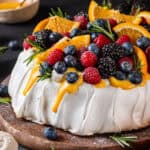
Pavlova (Crisp, Cloud-Like, and Foolproof)
This classic pavlova has a crisp meringue shell and a soft, marshmallowy center, finished with vanilla whipped cream, fresh berries, and bright homemade orange curd. It’s naturally gluten-free and perfect year-round, from winter holidays to spring and summer entertaining.
Servings 8
Calories 452kcal
Equipment
- Stainless steel mixing bowl
- Electric hand mixer
- Fine mesh sieve
Ingredients
For the Pavlova Base:
- 5 large egg whites
- 1 ¼ cups granulated sugar
- 1 tablespoon cornstarch
- 1 teaspoon cream of tartar
- 1 teaspoon vanilla extract
For the Orange Curd:
- 5 large egg yolks
- ⅓ cup granulated sugar
- ½ cup freshly squeezed orange juice
- Zest of 1 orange
- ¼ cup unsalted butter cut into small pieces
For the Whipped Cream:
- 1 ½ cups heavy whipping cream cold
- 2 tablespoons powdered sugar
- 1 teaspoon vanilla extract
For the Topping:
- 1 cup fresh raspberries
- 1 cup fresh blueberries
- 1 cup fresh blackberries
- ½ medium orange sliced into thin rounds with peel on
- 3 fresh rosemary sprigs
- Powdered sugar for dusting
Instructions
Prepare the Pavlova Base
- Preheat your oven to 300°F (150°C). Line a baking sheet with parchment paper and draw a 9-inch (23 cm) circle on the parchment. Flip the parchment over so the pencil doesn’t touch the meringue.
- Wipe down a stainless-steel mixing bowl and the beaters of an electric mixer with vinegar or lemon juice to eliminate any grease, which can prevent the egg whites from whipping properly.
- Add the egg whites to the clean bowl. When separating the whites from the yolks, be very careful not to get any yolk into the whites. Let egg whites come to room temperature (about 20–30 minutes) before whipping for maximum volume.5 large egg whites
- Beat egg whites on medium speed with an electric hand mixer until they form soft peaks—when the whisk leaves visible trails and the peaks flop over slightly.
- Increase the mixer to medium speed (5) and begin adding the sugar 1 tablespoon at a time, waiting 15–20 seconds between additions.1 ¼ cups granulated sugar
- Once all the sugar is added, continue to beat on medium speed until the meringue forms stiff, glossy peaks. This will take up to 10 minutes. Medium speed and a longer beating time is important to allow the sugar to dissolve. The meringue should feel smooth when rubbed between your fingers (no graininess of undissolved sugar). If needed, you can increase the beating speed to high when there are no sugar grains left.
- Reduce mixer to low speed and gently add cornstarch, cream of tartar, and vanilla, mixing just until combined. Don’t over beat, or you risk deflating the meringue.1 tablespoon cornstarch , 1 teaspoon cream of tartar , 1 teaspoon vanilla extract
- Spoon the meringue onto the parchment-lined baking sheet into the center of the drawn circle. Smooth the edges and use the back of a spoon to create a shallow well in the center for toppings.
- Place the pan in the oven, close the door, and immediately reduce the heat to 225°F (110°C). Bake for 1 hour 15 minutes. Do not open the door during baking.
- After baking, turn off the oven and let the pavlova cool completely inside the oven with the door slightly open. You want a very small gap — just enough to allow the moisture to escape, but not enough to cause the oven to cool too quickly. I typically place the end of a kitchen towel in the door to achieve this. Let the pavlova cool like this for at least 4 hours or preferably overnight.
Make the Orange Curd
- In a small saucepan, whisk together egg yolks, sugar, orange juice, and zest until smooth.5 large egg yolks , ⅓ cup granulated sugar , ½ cup freshly squeezed orange juice , Zest of 1 orange
- Cook over low to medium-low heat, stirring constantly with a spoon, scraping the bottom and sides, until the mixture thickens and coats the back of the spoon. It should reach about 170°F (77°C).
- Remove from heat and stir in the butter pieces until melted and glossy.¼ cup unsalted butter
- Strain through a fine mesh sieve for a silky texture. Let cool completely, then refrigerate until ready to use. It will thicken further as it chills.
Whip the Cream
- Beat the cold cream, powdered sugar, and vanilla extract in a large mixing bowl with an electric hand mixer on medium-high speed until soft peaks form.1 ½ cups heavy whipping cream , 2 tablespoons powdered sugar , 1 teaspoon vanilla extract
- Keep whipped cream refrigerated until ready to assemble the pavlova.
Assemble the Pavlova
- Wait to assemble the pavlova until just before serving. When ready to assemble, carefully transfer the cooled pavlova to a serving platter.
- Spoon whipped cream into the center, leaving a small border of meringue visible.
- Dollop orange curd over the whipped cream — don’t fully spread to the edges.
- Generously pile raspberries, blueberries, and blackberries on top. Tuck a few orange slices in between the berries.1 cup fresh raspberries , 1 cup fresh blueberries , 1 cup fresh blackberries , ½ medium orange
- Garnish with fresh rosemary sprigs and lightly dust with powdered sugar.3 fresh rosemary sprigs, Powdered sugar
Notes
- Chill your tools: Before whipping the cream, place the mixing bowl and mixer beaters in the freezer for 15 minutes. This will help keep the cream cold as you whip it.
- The meringue base can be made 2-3 days in advance. Once cooled, wrap tightly and cover, then store at room temperature in a cool, dry place away from humidity.
- The orange curd can be made up to 1 week in advance. Store in an airtight container in the refrigerator.
- Whip the cream close to serving: Wait to whip the cream until no more than a couple of hours before assembling and serving, if possible.
- Substitutions: Other fruits can be substituted for the berries and orange slices, and lemon curd or another fruit curd can be used in place of the orange curd.
Storage, Reheating, Freezing, Make-Ahead
- Storage (unfilled shell): Keep the baked pavlova shell at room temperature in a dry place, loosely covered in parchment inside a large container for up to 2 days. Humidity ruins the crunch, so keep the shell dry and don’t refrigerate it.
- Storage (assembled): Once topped, it’s best within 2–3 hours. Leftovers keep in the fridge (loosely covered) for up to 24 hours; the shell will soften, but it still tastes great.
- Reheating: Pavlova isn’t reheated. If the shell picks up moisture, a brief dry-out (200°F/95°C for 10–15 minutes) before topping can revive crispness. Cool fully before assembling.
- Freezing: The shell does not freeze well (it absorbs moisture and can crack). Orange curd freezes well for up to 3 months; thaw overnight in the fridge, then whisk smooth.
- Make-ahead plan I use: Day 1: bake the shell and leave it in the cooling oven overnight. Make and chill curd. Day 2: whip cream and assemble just before serving.
Nutrition
Serving: 1slice | Calories: 452kcal | Carbohydrates: 53g | Protein: 6g | Fat: 25g | Saturated Fat: 15g | Polyunsaturated Fat: 2g | Monounsaturated Fat: 7g | Trans Fat: 0.2g | Cholesterol: 180mg | Sodium: 54mg | Potassium: 265mg | Fiber: 3g | Sugar: 49g | Vitamin A: 1089IU | Vitamin C: 22mg | Calcium: 62mg | Iron: 1mg